

A blown boot shouldn't be the reason your $5,000 turbo fails, but it happens every day on the open road. You know the sound. It's that sudden hiss or the violent pop that leaves you dead on a steep grade. Dealing with unreliable charge air cooler plumbing is a fast way to kill your fuel economy and your patience. You're tired of chasing boost leaks. You're done with parts that can't handle the heat. It is time to stop the bleeding and start building for real pressure.
We get it. You demand mechanical superiority and raw power. This guide is your blueprint for a leak-free intake system that holds firm under the heaviest loads. We'll break down how to choose high-ply silicone, find the right reducers for custom turbo setups, and secure every connection for maximum torque. You will learn to identify the weak points in your current rig and replace them with hardware built for the long haul. It's time to build a system that dominates. Let's get to work.
Key Takeaways
- Restore lost power and lower EGTs. Fix leaking charge air cooler plumbing to protect your turbo and regain fuel economy.
- Build a bulletproof foundation. Learn how high-ply boots and heavy-duty clamps survive extreme vibration and torque twist.
- Outlast the heat. Swap failing rubber for silicone that thrives at 500°F, ensuring your intake system never goes soft under pressure.
- Eliminate the guesswork. Master precision measuring techniques to secure a leak-free fit for any custom turbo setup.
Why Your Charge Air Cooler Plumbing is Killing Your Torque
Your engine is a massive air pump. It breathes in, compresses, and fires. If your charge air cooler plumbing is leaking, that cycle breaks down. You lose torque. You lose efficiency. You lose the edge that keeps you ahead of the pack. A high-performance Intercooler system is worthless if the pipes leading to it can't hold pressure. Stock components are designed for average conditions, but you don't drive an average rig. You push limits.
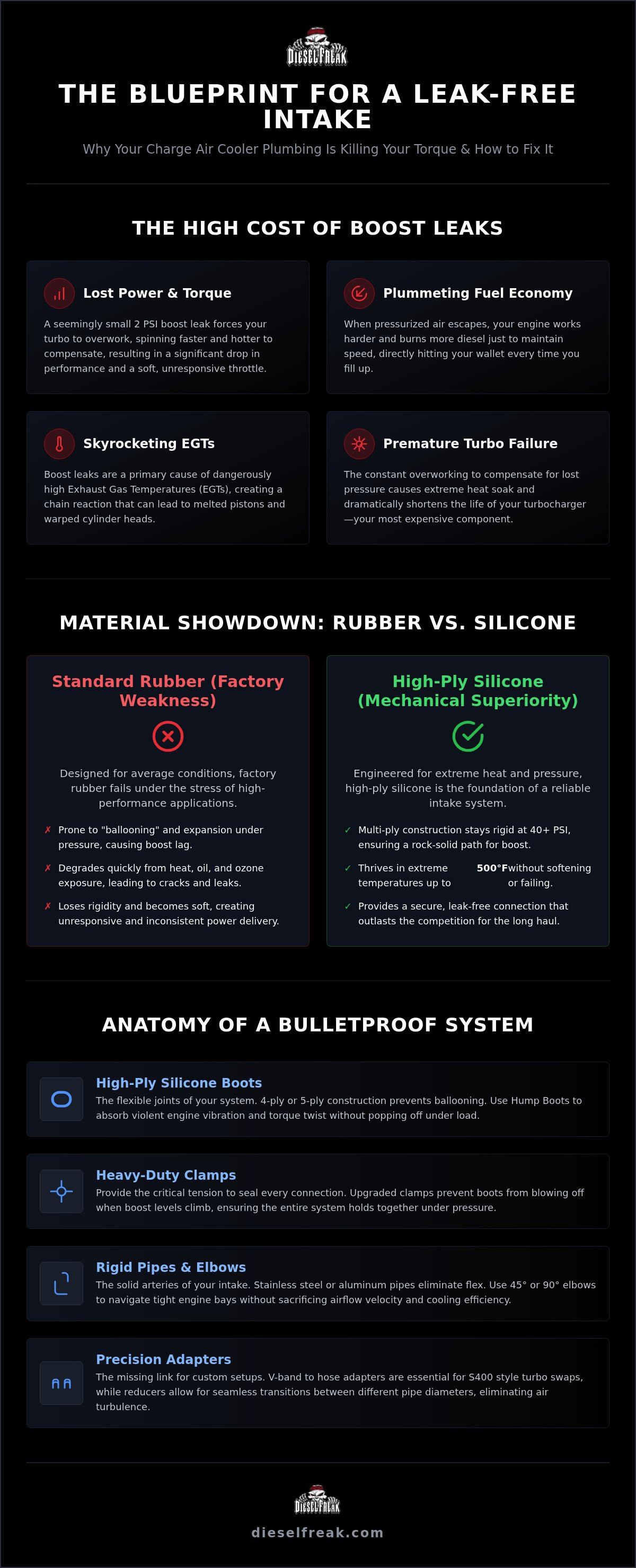
Boost leaks aren't just a minor annoyance. They are a direct hit to your wallet. When air escapes your intake tract, your engine has to work harder to maintain power. This leads to a massive drop in fuel economy. You're burning more diesel just to stay at speed. Even worse, failing plumbing is a primary cause of skyrocketing Exhaust Gas Temperatures (EGTs). High EGTs melt pistons and warp heads. It's a chain reaction that starts with a simple boot failure.
The Hidden Cost of Boost Leaks
A 2 PSI drop might seem small, but it forces your turbocharger to overwork. It has to spin faster and hotter to compensate for the lost air. This creates extreme heat soak. It leads to premature turbocharger wear. You're effectively shortening the life of your most expensive components. Check your boots every time you lift the hood. Look for oil residue or fraying edges. If you see oil on the outside of a joint, pressure is getting out. Replace it before it strands you on the shoulder.
Upgrading for Heavy-Duty Reliability
There's a massive difference between just getting home and dominating a steep grade. If you want to push your truck to its limit, you need a system that won't flinch at 40+ PSI. Building a high-pressure setup starts with your diesel performance parts. You need materials that stay rigid under extreme stress. Stock rubber is prone to "ballooning." It expands under pressure, creating a soft, unresponsive throttle and inconsistent boost. High-tensile silicone and stainless steel pipes eliminate this movement. They provide a rock-solid path for your boost. This is how you build a rig that holds together when the weight is heavy and the road is long. Don't settle for factory weaknesses when you can have mechanical superiority.
The Anatomy of a High-Pressure Connection: Boots, Elbows, and Clamps
Your rig is a beast, but it’s only as strong as its weakest joint. High-pressure air is always looking for a way out. If your charge air cooler plumbing isn't dialed in, you're just bleeding power. Think of your setup as an integrated system of muscle and bone. Every component has a specific job. Every connection must be absolute. When you're pushing 45 PSI, there is no room for "good enough."
Boots act as the flexible joints. They absorb the violent vibration and torque twist of a heavy-duty diesel engine. Without them, your rigid pipes would crack under the constant strain of the road. The pipes are the rigid arteries. They maintain airflow velocity and keep the air moving toward the intake without losing cooling efficiency. Finally, the clamps provide the critical tension. They keep the entire system from blowing apart when your boost levels climb. One weak clamp can leave you dead on the shoulder.
Silicone Boots and Reducers
Pressure resistance comes down to ply-rating. More layers mean more raw strength. A high-quality 4-ply or 5-ply silicone boot won't balloon or soften when the heat rises. Use reducing couplers to transition between different turbo and cooler outlet sizes with precision. If you're building a high-torque rig, hump boots are essential. They provide the necessary flex to handle engine movement without stressing the rest of the charge air cooler plumbing. This flexibility prevents the boots from popping off when the engine rocks under load.
Turbo Elbows and V-Band Adapters
Cramped engine bays demand precision. Use 90-degree or 45-degree elbows to navigate tight spaces without sacrificing flow. For guys running BorgWarner S400 style turbo swaps, V-band to hose adapters are the missing link. This is a common hurdle in single-turbo conversions that most guides ignore. We know it's where projects stall. Smooth internal transitions are vital. They reduce air turbulence and ensure every pound of boost reaches the cylinders. You can find the right heavy-duty hardware to finish your custom build and keep your intake system airtight.
Evaluating Materials: Why Standard Rubber Can’t Handle Real Power
Heat is the ultimate killer of charge air cooler plumbing. If your materials can't handle the soak, your performance will tank. Most factory setups use standard rubber because it is cheap and easy to manufacture. But rubber is garbage for high-performance diesel engines. It begins to degrade and lose its structural integrity at just 300°F. In a heavy-duty environment, that is a recipe for disaster. Silicone is the only real choice for a serious build. High-grade silicone stays flexible and strong up to 500°F. It doesn't get brittle. It doesn't crack. It just works when the pressure is on.
Don't overlook the "bead" on your pipes. A smooth pipe is a liability. Without a raised bead at the end of the metal tubing, your boots have nothing to bite into. Under high boost, that boot will slide right off. It doesn't matter how tight your clamp is. Ensure every piece of your charge air cooler plumbing has a rolled bead to lock that connection down. It is the insurance policy your turbo needs to stay in the fight.
Silicone: The Performance Standard
Gloss black silicone is the professional's choice. It isn't just about the aesthetic. This material is designed to resist the oil and fuel spray that naturally occurs in a diesel engine bay. Cheap boots soak up those fluids and turn into mush. Multi-ply silicone is reinforced with layers of fabric to prevent the "ballooning" effect. This ensures your boost response stays crisp and your pressure stays consistent. Pair these with heavy-duty T-bolt clamps for a secure fit. If you're dealing with extreme temperature swings, spring-loaded clamps are even better. They expand and contract with the metal to maintain constant tension at all times.
Metal Piping: Stainless vs. Aluminum
Choosing between stainless steel and aluminum is a matter of priority. Aluminum is lightweight and dissipates heat faster than steel. However, it is soft. In high-vibration spots, aluminum is prone to stress cracking over time. For Class 8 trucks and heavy-duty builds, 304 Stainless Steel is the gold standard. It offers maximum corrosion resistance and the toughness to handle the constant shaking of a large-displacement engine. Diesel Freak focuses on heavy-duty stainless for a reason. We build for durability. We want you to install it once and never think about it again. This is "set it and forget it" hardware for people who value mechanical superiority and raw capability.
The Precision Fit: How to Measure and Choose Your CAC Components
Close enough isn't good enough. If you're building a custom turbo setup, guessing on your charge air cooler plumbing sizes is a death sentence for your boost levels. Grab a caliper. You need to measure the Inner Diameter (ID) of your boots and the Outer Diameter (OD) of your pipes. A fraction of an inch is the difference between a sealed system and a whistle that kills your torque. Don't eyeball it. Measure twice. Install once.
Precision measurement ensures your turbo outlet matches your cooler inlet exactly. This is critical when using reducers to bridge different component sizes. If the transition isn't seamless, you create turbulence. Turbulence creates heat. Heat kills power. Every connection in your intake tract must be a smooth, high-pressure highway for air. Plan your route before you buy your parts. This is especially true for the Mahindra Roxor, where a custom intake path requires tight tolerances and sharp planning to avoid frame interference.
Measuring for Custom Builds
Start with the necessary offset. If you need a 90-degree bend, measure the distance between the two pipe ends. You need enough straight pipe on each side of the bend to seat your clamps. Aim for at least 2 inches of flat surface. If your clamp sits on the start of a curve, it won't apply even pressure. It will leak. It will blow off. Calculating these offsets prevents you from buying elbows that are too short or too long. Focus on the ID of the boot matching the OD of the pipe. This creates the primary seal that holds your boost in check.
Choosing the Right Clamp
Clamps are the muscle of your charge air cooler plumbing. Standard T-Bolt clamps are the rugged workhorse of the diesel world. They provide the raw clamping force needed for heavy-duty applications. However, if you're pushing extreme boost in varying climates, spring-loaded T-Bolts are superior. These clamps use a heavy-duty spring to maintain constant tension. As your metal pipes heat up and expand, the spring adjusts. When they cool, it tightens. This prevents cold-side leaks that happen when standard clamps lose their grip. Never install a pipe without a rolled edge. A bead-roll is mandatory. It acts as a mechanical lock that keeps the boot from sliding off under pressure. Secure your system with our heavy-duty CAC hardware and stop worrying about your boots popping.
Build Your Custom Setup with Diesel Freak CAC Hardware
Stop compromising with universal kits that don't fit. You need specific solutions for a specific rig. Diesel Freak provides a massive collection of 307+ products dedicated to charge air cooler plumbing. We don't just sell parts; we provide the backbone for high-performance builds. Whether you are running a Class 8 semi or a modified Mahindra Roxor, our inventory is built to handle the heat. We stock everything from individual gloss black silicone elbows to complete high-pressure systems. This is where mechanical superiority meets raw capability. We give you the tools to build a system that won't back down.
Our selection is curated for the enthusiast who demands more. We know the frustration of a project stalling because of a missing reducer. We've been there. That's why we keep our shelves loaded with the specific hardware you need to finish the job. Our components are designed for those who value toughness and the pursuit of peak mechanical potential. You aren't just fixing a leak. You are transforming your intake into a high-pressure fortress.
Standout Products for Your Rig
The PDI Big Boss Charge Air Cooler Boot Kits are the gold standard for Class 8 trucks. They are engineered to survive where stock boots fail. If you are performing a custom turbocharger conversion, you know the struggle of finding the right transition. We stock the hard-to-find 90-degree reducing elbows that make tight turbo-to-cooler connections possible. These gloss black silicone pieces are as durable as they are clean. For those pushing the limits with BorgWarner S400 series turbos, our high-pressure V-band adapters provide the absolute seal required for maximum boost. These aren't just accessories; they are essential components for mechanical dominance.
Why Trust Diesel Freak?
We are family-owned and have been specialized in high-performance Class 8 parts since 2009. We don't just read the manuals; we live in the shop. We know exactly what breaks under load and how to fix it for good. Our expertise is baked into every part we stock. When you order from us, you get fast shipping on over 300 in-stock charge air cooler plumbing components. You don't have time to wait for backorders when your rig is down. Efficiency matters. You can browse the full Charge Air Cooler plumbing collection here and get the hardware you need to stay on the road.
Built for the shop, the road, and the dirt. Our hardware is tested in the real world by people who actually turn wrenches. We value grit and superior performance above all else. Don't let a weak connection kill your torque. Build it right the first time with Diesel Freak. Push your boundaries and seek out the highest level of performance possible. We are here to make sure your plumbing never lets you down.
Lock Down Your Boost and Dominate the Road
You've seen the damage a weak connection can do. From warped heads to overworked turbos, the risks of failing charge air cooler plumbing are too high to ignore. Standard rubber simply doesn't cut it. You need high-ply silicone and 304 stainless steel that thrives under extreme pressure. Precision measurement is your best defense against torque twist and engine vibration. Roll your beads. Use spring-loaded clamps. Stop settling for factory limits and start building for mechanical superiority.
We have been backing diesel performance since 2009. We know exactly what it takes to keep a Class 8 rig or a custom Roxor in the fight. With over 300 parts in stock and high-performance PDI Big Boss kits ready to ship, we have the hardware you need to finish the job right. Don't let a cheap boot kill your power or your fuel economy. Shop the Full Charge Air Cooler Plumbing Collection. It is time to build a system that holds firm under every load. Stay gritty. Stay powerful.
Frequently Asked Questions
What are the symptoms of a leaking charge air cooler boot?
A sudden hissing or whistling sound under acceleration is the most common sign. You will notice a sharp drop in engine power and a spike in your Exhaust Gas Temperatures (EGTs). Look for black smoke from the exhaust; it indicates an over-fueled condition because the air isn't reaching the cylinders. Check the boots for oil residue. If you see wet spots near the clamps, your charge air cooler plumbing is leaking pressure.
Can I use standard worm-gear clamps on my CAC plumbing?
No, standard worm-gear clamps are a liability in high-boost applications. They lack the consistent clamping force required to hold 30+ PSI. These thin clamps often "cheese-cut" through silicone boots as they tighten, leading to premature failure. Use heavy-duty T-bolt clamps instead. They provide a wider surface area and a high-tensile bolt to ensure your connections stay rock-solid under the heaviest loads. Don't risk a blowout with hardware store parts.
What is the difference between 3-ply and 5-ply silicone boots?
The difference lies in the number of reinforcement fabric layers embedded in the silicone. A 3-ply boot is built for standard, low-pressure applications and offers more flexibility. A 5-ply boot is designed for high-performance rigs pushing extreme boost. More layers mean higher burst pressure and less "ballooning" under load. If you're running a modified turbo setup, the 5-ply option provides the mechanical superiority needed to survive extreme heat and pressure.
How do I prevent my CAC boots from blowing off under high boost?
Ensure every pipe has a rolled bead on the end to act as a mechanical lock. Clean the inside of the boot and the outside of the pipe with a degreaser before installation. Any oil residue acts as a lubricant that helps the boot slide off. Use spring-loaded T-bolt clamps to maintain constant tension as the metal expands and contracts. This setup keeps your charge air cooler plumbing secure even at 50+ PSI.
Do I need to replace my metal CAC pipes if they aren't cracked?
You don't need to replace them if the diameter matches your needs and they have a proper bead roll. However, factory pipes are often restrictive or made of thin material that dissipates heat poorly. If you are upgrading your turbo or intercooler, switching to 304 stainless steel pipes ensures better airflow and corrosion resistance. Inspect the ends; if the bead is worn or non-existent, replace them to prevent boots from popping off.
What size CAC plumbing does a Mahindra Roxor use for custom builds?
Most custom Mahindra Roxor builds utilize 2-inch or 2.25-inch plumbing depending on the turbocharger outlet size. If you are performing a turbo swap or adding an intercooler, you will likely need reducers to bridge the gap between the turbo and the intake manifold. Use a caliper to measure the Outer Diameter of your specific components. We stock the exact silicone elbows and stainless pipes needed to navigate the Roxor's tight engine bay with precision.
Is stainless steel better than aluminum for charge air cooler piping?
Stainless steel is superior for heavy-duty Class 8 trucks because it handles vibration without cracking. It offers maximum corrosion resistance and a "set it and forget it" lifespan. Aluminum is lighter and dissipates heat faster, but it is softer and prone to stress fractures in high-vibration spots. For a rig that works for a living, stick with 304 stainless. It provides the rugged durability required for the long haul and extreme conditions.
How often should I inspect my charge air cooler plumbing?
Inspect your system every time you change your oil or after a long haul under heavy load. Check for oil mist around the joints; it's a dead giveaway for a boost leak. Look for fraying on the boot edges or loose clamp bolts. A quick five-minute check can prevent a catastrophic failure on a steep grade. Replace any boot that feels soft or shows signs of heat-related cracking immediately. Don't wait for a blowout.
Disclaimer
Diesel Freak LLC is in no way associated, sponsored, or affiliated with Any OEM manufacturer. Products from Diesel Freak LLC presented in this listing are not to be confused with any of the products or trademarks of any OEM company. All parts listed to fit these manufacturers are replacement aftermarket parts.