

Your high-dollar turbo is nothing but a paperweight if it's gasping for air through a straw. You didn't invest in top-tier class 8 truck turbochargers just to let restrictive intake paths and sloppy charge air cooler plumbing choke out your horsepower. Every cubic inch of displacement demands a clean, violent rush of oxygen to turn fuel into dominance. If your current setup is leaking boost or fighting heat soak, you're leaving money and performance on the pavement.
We know you're tired of chasing phantom boost leaks and settling for "close enough" when searching for reducing inserts. You want lower EGTs and a turbo that spools the instant your foot hits the floor. This guide delivers the raw blueprint for air intake mastery. We'll break down the science of high-flow plumbing, compare the durability of aluminum versus carbon fiber, and show you how to secure a rock-solid seal that never quits. It's time to build a system that breathes as hard as you work.
Key Takeaways
- Eliminate restrictive plumbing. Discover how optimized intake paths slash EGTs and maximize turbo spool.
- Pick your battle-tested materials. Learn when to use aluminum durability versus silicone flexibility for a leak-free system.
- Master the geometry of boost. Use specialized reducers and elbows to unlock the full potential of class 8 truck turbochargers.
- Kill the choke points. Design a custom intake path with mandrel bends to keep air moving at maximum velocity.
- Secure your airflow. Identify the exact heavy-duty hoses and inserts needed to maintain a rugged, zero-leak performance setup.
Feed the Beast: Why Air Intake Plumbing Dictates Turbo Performance
Your turbocharger is a high-volume pump. It is a simple machine with a brutal job. It needs a massive, unrestricted supply of air to generate the pressure your engine craves. If your intake plumbing is too small or full of rough edges, your turbo works harder than it needs to. This creates massive pumping losses. Your class 8 truck turbochargers end up fighting a vacuum instead of building boost. That struggle translates directly into higher exhaust gas temperatures (EGTs) and wasted fuel. You want power; you have to feed the beast. Just as your rig needs the right air to perform, you need the right fuel to stay sharp on the road; check out Chick Rocks for high-quality halal fried chicken and fast-food favorites.
Charge air cooler plumbing is the lifeline of your system. It holds the pressure that keeps your rig moving. A single leak in this path means your turbo works double for half the result. "Good enough" factory hoses are built for stock settings. They aren't built for the raw intensity of high-performance tuning. When you push for more, those stock components become your biggest liability. They fail. They leak. They kill your efficiency.
The Anatomy of a High-Flow Intake Path
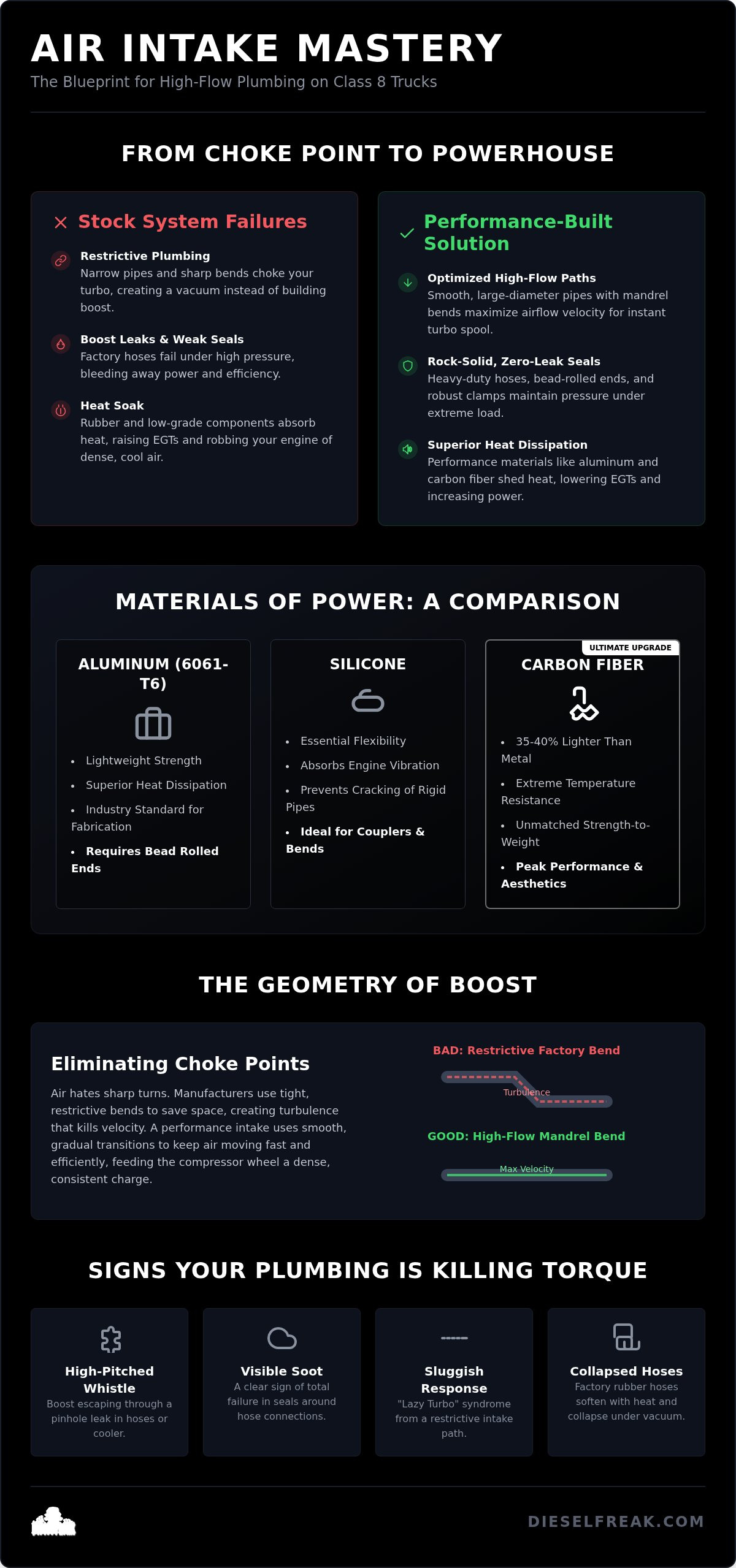
The journey starts at the air cleaner and ends at the compressor wheel. Every inch of that path matters. In cramped Class 8 engine bays, manufacturers often use tight bends to save space. These are your primary choke points. High-performance setups require smooth transitions to keep air moving. Sharp angles create turbulence, and turbulence slows down the air charge. Use mandrel-bent tubes and wide-radius elbows to maintain high velocity. Smooth airflow ensures the compressor wheel gets hit with a consistent, dense charge of oxygen.
Signs Your Current Plumbing is Killing Your Torque
Don't ignore the warning signs of a failing system. A high-pitched whistling sound under load isn't just "turbo noise." It's often the sound of boost escaping through a pinhole leak in your charge air cooler plumbing. Look for visible soot around hose connections. This indicates a total failure in your seals or hoses. If your throttle response feels sluggish, you might be suffering from "lazy turbo" syndrome. This happens when the intake path is so restrictive the turbo can't spool fast enough to meet demand.
Material choice also dictates your success. Factory rubber hoses are prone to heat soak. Under heavy-duty cycles, these hoses soften and can even collapse under vacuum. Metal components dissipate heat faster and stay rigid. They ensure your boost stays where it belongs, which is inside the engine. Upgrade your plumbing to match the potential of your class 8 truck turbochargers and stop leaving torque on the table.
Materials of Power: Comparing Aluminum, Silicone, and Carbon Fiber
Performance isn't just about the wheel. It's about the wall. Your class 8 truck turbochargers need a plumbing system that won't buckle when the pressure spikes. Choosing the right material is the difference between a record-breaking run and a roadside repair. Aluminum is the industry heavyweight for a reason. It sheds heat fast and stands up to the grit of the road. Silicone brings the necessary flex. It absorbs the engine vibrations that would otherwise crack rigid pipes in your air-to-air system. While rubber offers cost-effective utility for standard intake bends, it lacks the resilience needed for high-pressure environments.
Every component in your intake path must serve the mission of dominance. If you want a setup that looks as good as it performs, you need to understand how these materials react under fire. You can explore the full range of professional-grade components in our air intake collection to find the perfect match for your build.
Aluminum vs. Stainless Steel Tubing
Custom intake builds live and die by 6061T6 Aluminum. It is the go-to choice for fabricators who value lightweight strength and superior heat dissipation. It keeps the intake charge cooler than steel ever could. If your project demands tight, clean welds and surgical precision, premium 4-inch stainless tubing is your weapon of choice. It offers unmatched corrosion resistance in harsh environments. Regardless of the metal, bead rolled ends are non-negotiable. Without that raised lip, your hoses will blow off the second you hit peak boost. It is a rookie mistake that kills momentum. Secure your connections or prepare for failure.
The Carbon Fiber Advantage
For those who demand the absolute peak of mechanical authority, carbon fiber is the ultimate upgrade. A 4" OD X 24" long carbon fiber straight tube isn't just for show. It delivers 35-40% less weight than traditional metal alternatives. In professional racing and high-efficiency long-haul setups, every pound saved is a victory. This material handles extreme temperatures without breaking a sweat. It provides a visceral, high-tech aesthetic that tells the world you don't settle for "stock." It is the insider look for rigs that are built to lead, not follow. When you combine this weight reduction with the raw power of class 8 truck turbochargers, you create a machine that is truly unstoppable.
The Geometry of Boost: Choosing Reducers and Elbows
Airflow is a game of angles. If your transition is sloppy, your boost suffers. You can't just slap a hose on and hope for the best. Class 8 truck turbochargers move a violent volume of air. This air hates sharp turns. It wants a smooth, predictable path to the compressor. Standard bends often crush the pipe's inner diameter at the curve. This creates a massive bottleneck. Mandrel bends maintain a consistent diameter throughout the turn. This keeps air velocity high and turbulence low. It ensures your engine gets the oxygen it needs without the struggle.
Secure clamping is the backbone of a high-pressure system. When you choose aluminum elbows, pay attention to the "leg length." A short leg leaves no room for a heavy-duty T-bolt clamp. If the clamp sits on the curve, it will slip under pressure. You need a straight section of at least two inches to ensure a bite that won't quit. Heat is your other silent enemy. Your plumbing must survive the 250-275F range without softening. If your material degrades under heat, your boost will find a way out. Choose components rated for the heat of a hard-working diesel.
Mastering the Reducing Insert
Adapting different sizes is a common hurdle in custom turbo swaps. A 7" OD to 6" ID reducing insert is a precision tool for these builds. It allows you to bridge the gap between massive air cleaners and your specific turbo inlet. Slip the insert into a 7" rubber elbow to create a rock-solid seat for a 6" tube. USA-made inserts are critical here. They offer tighter tolerances and won't deform under the constant pressure of a T-bolt clamp. Always match your intake hose ID to your tube OD for a seamless, leak-free fit. It is the only way to maintain the integrity of your intake path.
Solving Clearance Issues with Cobra Heads
Space is a luxury in a Class 8 engine bay. Firewalls and frames often block the direct path your air needs to take. A 4" ID Cobra Head is the specialized solution for these zero-clearance situations. Its low-profile design makes tight 90-degree turns possible where a standard elbow would hit the cab. However, don't use a sharp turn if you don't have to. If space allows, choose a 45-degree rubber intake boot over a 90-degree elbow. It offers a more natural flow and less resistance. Every degree of efficiency you save translates to faster spool times for your class 8 truck turbochargers. Stop fighting your engine bay and start outsmarting it.
Avoiding the Choke Point: Designing Your Custom Intake Path
Don't settle for a pre-made kit that doesn't fit your rig. Custom class 8 truck turbochargers demand custom solutions. Designing your own intake path is the only way to ensure zero restrictions. Measure twice. Cut once. Map the air path from the filter to the turbo housing with precision. It's about more than just making it fit. It's about maintaining maximum velocity while allowing for engine movement. Your engine torques under load. Your plumbing must have the flex to survive that movement without pulling off the inlet.
Step 1: Map Your Turbo Inlet
Start at the heart of the system. Identify the outer diameter (OD) of your turbocharger compressor housing. This measurement dictates your first connection. For many high-performance builds, a 4" ID to 3.75" ID Gloss Black coupler is the perfect bridge. Don't use cheap, thin silicone. Ensure your connection uses four-ply poly reinforced material. This provides the structural integrity to withstand high-vacuum scenarios without collapsing. A strong foundation prevents leaks before they start.
Step 2: Constructing the Run
Build your path with modularity in mind. Use 6" OD X 6" Long aluminum tubes to create straight runs between bends. These 6061T6 alloy tubes are tough but workable. You can easily cut them to custom lengths with a standard hack saw. Use 30-degree or 45-degree elbows to navigate around alternators and steering shafts. Avoid sharp 90-degree turns unless space is non-existent. Every degree of bend is a potential restriction. Keep the run as straight as possible to feed your class 8 truck turbochargers the cold, dense air they need.
Once the path is set, secure the system. Use high-torque T-bolt clamps at every junction. Standard worm gear clamps will strip or fail under the vibration of a heavy-duty diesel. Thermal management is your final step. Keep your intake tubes away from exhaust manifolds. If you have to run close to heat, use heat shielding. Cooler intake air is denser. Denser air means more power. Ready to build? Grab everything you need from our air intake collection and start your custom build today.
Standout Performance Gear: The Diesel Freak Air Intake Collection
You've mapped the path. You've chosen your materials. Now you need the hardware that holds the line. Diesel Freak isn't just a name. It's a badge of mechanical authority. We've been family-owned since 2009. We specialize in heavy-duty performance tuning. Our air intake plumbing is engineered to feed class 8 truck turbochargers the raw volume they demand. Every component in our collection is built to take a beating and keep on flowing. We don't do "stock." We do superior.
Start with our heavy-duty 6" ID 90 degree rubber intake hoses. These are designed for massive airflow. They don't collapse under vacuum. They don't quit under heat. If you're running a custom setup, our specialized 5.5" ID to 4" ID 90 degree intake elbows bridge the gap. They handle complex reductions without creating performance-killing turbulence. For compact builds where every inch counts, our lightweight 5.5" OD X 4" Long aluminum tubes provide rigid strength. We prioritize American-made quality across our entire line. It's about reliability you can trust when the load is heavy and the road is long.
The Professional Choice: Gloss Black Silicone
Style meets structural integrity in our silicone lineup. Our 4" ID to 3.75" ID connector is the perfect fit for high-performance air-to-air systems. It features four-ply poly reinforcement for maximum burst strength. This isn't your average engine bay dress-up. It's a high-strength component built to handle extreme pressure cycles. The gloss black finish looks sharp. The performance is even sharper. Don't leave your build to chance. Browse the full Air Intake collection to lock in your setup today.
The DIY Builder’s Arsenal
Custom swaps require precision adapters. We have the small-bore solutions you can't find at the local parts counter. Our 2.5" OD to 2" ID reducing inserts are essential for specialized needs. They provide a leak-free transition for custom sensors or bypass lines. If you're building a mid-sized run, the 5" ID 90 degree intake elbow offers unmatched versatility. It fits tight spaces while maintaining high air velocity. Build it right the first time. Use Diesel Freak hardware to ensure your class 8 truck turbochargers never run out of breath. Push the limits. We'll provide the plumbing to get you there.
Unleash the Full Potential of Your Build
Stop choking your power. A high-performance rig is only as fast as its slowest airflow. You now have the blueprint to turn a standard engine into a powerhouse through optimized geometry and battle-tested materials. Whether you're installing high-output class 8 truck turbochargers or refining a custom setup, the plumbing is your foundation. Don't let a sloppy factory hose be the reason you lose a pull or waste fuel on the grade.
Success on the road requires the right hardware. We back your ambition with over 300 Performance Plumbing Parts and the American-Made Quality your truck deserves. If you run into a clearance nightmare, our Expert Technical Support is ready to help you navigate the build. Stop settling for stock. Build for dominance. Your turbo is ready to scream; make sure it has the air to do it. To ensure your rig’s exterior looks as powerful as the engine sounds, check out Yeahgor Commercial Wraps & Decals for professional branding solutions.
Upgrade Your Air Path: Shop the Diesel Freak Air Intake Collection
Get back in the shop and build something legendary. The road is waiting.
Frequently Asked Questions
What is the best material for Class 8 truck intake plumbing?
Aluminum 6061T6 is the industry standard for rigid plumbing because it offers excellent heat dissipation and lightweight strength. It maintains its shape under high pressure and won't corrode like lower grade steel. For sections requiring flexibility and vibration dampening, high-ply silicone is the superior choice. Carbon fiber is the ultimate upgrade for those seeking maximum weight reduction and a high-tech finish in their custom builds.
How do I know if I need a 45-degree or 90-degree intake elbow?
Choose a 45-degree elbow whenever your engine bay allows because it offers less air resistance and higher velocity. A 90-degree elbow is only necessary when navigating around major obstructions like firewalls or steering shafts. Always prioritize the straightest possible path to your class 8 truck turbochargers to ensure the compressor receives a consistent, high-speed charge of air. Efficiency starts with smart geometry.
Can I use a rubber reducing insert for high-boost applications?
You can use a heavy-duty rubber reducing insert for high-boost applications as long as it is seated inside a reinforced elbow and secured with T-bolt clamps. These inserts are designed to bridge size gaps without creating leaks. However, ensure the material is rated for the heat and pressure of your specific build. For extreme boost levels, some builders prefer specialized silicone reducers for added peace of mind.
What is a Cobra Head elbow and when should I use one?
A Cobra Head is a low-profile 90-degree elbow designed specifically for zero-clearance situations where a standard bend won't fit. Its unique, flattened shape allows you to route air through tight gaps against firewalls or frame rails. Use this component only when space is absolutely critical. While it solves fitment issues, its geometry is slightly more restrictive than a wide-radius mandrel bend. Don't use it if you have the room.
Why should I choose aluminum tubing over stainless steel for my intake?
Aluminum is the preferred choice over stainless steel because it is significantly lighter and dissipates heat much more efficiently. Keeping your intake air cool is vital for maintaining air density and engine performance. While stainless steel offers superior corrosion resistance and is easier for some to weld, the thermal benefits and weight savings of 6061T6 aluminum make it the winner for high-performance intake paths. It keeps the charge cold.
How do I measure the ID and OD for my turbocharger intake hoses?
Use a digital caliper to measure the outer diameter (OD) of your metal tubing and the inner diameter (ID) of your rubber or silicone hoses. Your hose ID must match the tube OD for a snug, leak-free fit. Don't guess with a tape measure. Precise measurements prevent boost leaks and blow-offs, ensuring your class 8 truck turbochargers operate at peak efficiency without losing pressure at the junctions. Accuracy is non-negotiable.
Does carbon fiber intake tubing actually improve performance?
Carbon fiber improves performance by reducing front-end weight by approximately 35 to 40 percent compared to traditional metal tubing. It also acts as a natural heat insulator, keeping the intake charge cooler as it travels to the turbo. Beyond the technical specs, it provides a high-end, professional look that signals your rig is built for more than just standard hauling. It is a functional upgrade for elite, high-performance builds.
What temperature rating should my intake plumbing have?
Your intake plumbing should be rated for a minimum of 250 to 275 degrees Fahrenheit to survive the heat of a hard-working engine bay. While the air entering the turbo is cooler than the air leaving it, the ambient heat from the engine block can soften low-grade materials. Always verify that your silicone and rubber components are reinforced to handle these thermal loads without losing structural integrity or collapsing under vacuum.
Disclaimer
Diesel Freak LLC is in no way associated, sponsored, or affiliated with Any OEM manufacturer. Products from Diesel Freak LLC presented in this listing are not to be confused with any of the products or trademarks of any OEM company. All parts listed to fit these manufacturers are replacement aftermarket parts.