

That violent chirp coming from your turbo isn't a badge of honor. It’s the sound of your compressor wheel screaming for mercy. You’ve spent thousands on your rig. Don't let a single lift of the throttle shatter your hardware. Turbo bark is a mechanical death sentence for high-performance engines. Installing a heavy duty diesel blow off valve is the only way to safeguard that massive investment. It’s not just about the crisp sound. It’s about survival on the road.
You want peak performance without the fear of a catastrophic failure. We get it. This guide delivers the ultimate blueprint to eliminate compressor surge and extend your turbocharger’s lifespan. We’re breaking down the 2026 shift toward electronic controllers and how to match your BOV with elite charge air cooler plumbing. Get ready to dominate the pavement with a setup that’s as rugged as your drive. We build for power. We build for those who refuse to settle for stock.
Key Takeaways
- End the surge. Learn why turbo bark is a mechanical death rattle and how pressure relief saves your compressor wheels from total destruction.
- Pick your tech. Compare mechanical simplicity against the high-tech precision of a heavy duty diesel blow off valve managed by electronic controllers.
- Plumb it right. Discover why proper charge air cooler plumbing placement is the secret to keeping your intake system sealed and responsive.
- Shield your boost. Master the physics of air stacking to protect your high-dollar turbo investment and ensure your rig survives the long haul.
- Master the mechanics. Get the 2026 blueprint for diesel boost management to achieve professional sound and bulletproof reliability on the road.
Why Heavy-Duty Diesels Need a Blow Off Valve
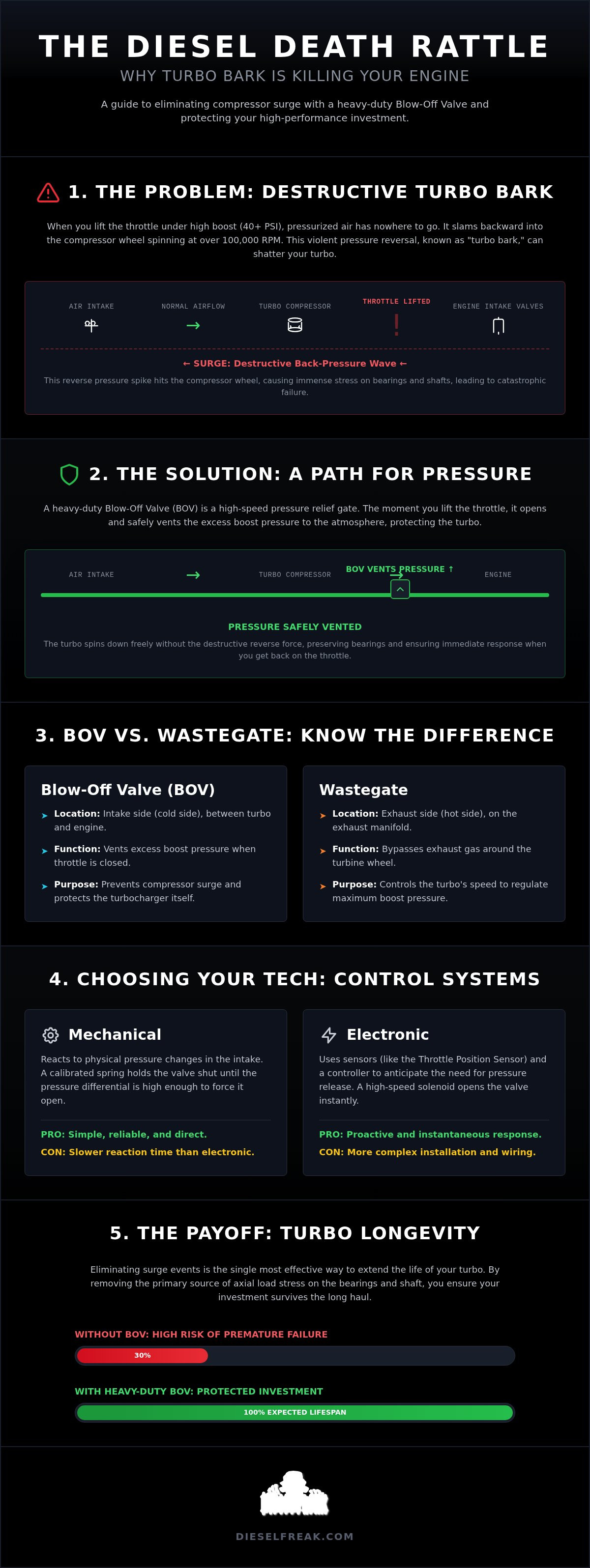
Stop listening to the "experts" who claim diesels don't need pressure relief. They'll cite the lack of a throttle plate as proof. They're dead wrong. While a gas engine hits a literal wall when the butterfly valve closes, a high-performance diesel faces a different beast: air stacking. When you're pushing 40+ PSI of boost and suddenly lift, that air doesn't just vanish. It stacks up against the intake valves and creates a massive back-pressure spike. Without a heavy duty diesel blow off valve, that pressure wave travels backward. It hits your spinning compressor wheel like a sledgehammer.
Class 8 rigs running high boost are at the highest risk. These massive turbos move a huge volume of air. When that volume has nowhere to go, the physics are unforgiving. The compressor wheel is still spinning at six-figure RPMs, but the air flow has reversed. This creates an immediate mechanical conflict that can destroy five-figure engine builds in seconds. You need a way to vent that energy before it vents your bank account.
The "Turbo Bark" Phenomenon
You've heard it at the track or on the highway. That sharp, rhythmic chirping sound when a driver grabs the next gear or lets off the pedal. That's turbo bark. It isn't a badge of honor; it’s the sound of your turbocharger trying to rotate in two directions at once. This surge event puts immense stress on the thrust bearings and the shaft. It’s a violent interruption of momentum that kills performance.
Surge events lead to snapped shafts and catastrophic wheel failure. It happens most often during rapid deceleration or fast shifting under heavy load. If you don't give that air a way out, it will find one. Usually, it finds its way out by breaking your hardware. A Blowoff valve provides the essential escape route that air needs to prevent these destructive spikes and keep your turbo spinning freely.
BOV vs. Wastegate: Know the Difference
Don't confuse your relief systems. A wastegate lives on the exhaust manifold to control turbo speed by bypassing the turbine. A heavy duty diesel blow off valve is a pressure relief system for the intake side that vents excess boost when the engine can't consume it. You need both to survive. The wastegate manages the power you make, while the BOV manages the pressure that wants to break your equipment.
Integrating these components with high-quality charge air cooler plumbing ensures your system stays sealed and responsive under the most brutal conditions. It’s about more than just a crisp sound. It’s about building a rig that can handle the grit of the road without folding under pressure. Protect your hardware and maintain your dominance on the pavement.
How Diesel BOVs Prevent Turbo Bark and Surge
A heavy duty diesel blow off valve is a precision gate for your intake system. It stays sealed under heavy load. It holds the line when boost is climbing. The moment you lift off the accelerator, the pressure needs an exit. Mechanical valves use a calibrated spring and boost pressure to trigger the opening. They react to the physical change in the manifold. It’s a direct response to the air stacking against your valves. This prevents the destructive reversal of airflow that kills performance.
Modern 2026 performance kits have evolved beyond simple springs. Many now utilize electronic controllers and high-speed solenoids. These systems don't wait for a pressure spike to occur. They monitor your throttle position sensor. They anticipate the lift. The solenoid receives a signal and dumps the air instantly. This precision venting maintains boost consistency across the entire RPM range. It keeps your system ready for the next hit of the pedal. You get faster response and zero hesitation.
Anatomy of a High-Performance Valve
For Class 8 rigs, piston-style valves are the only choice. Diaphragm-style valves often fail under the extreme heat and pressure of a high-boost diesel. You need hardware that can take a beating. Look for billet aluminum construction. It offers superior strength and heat dissipation. High-temp seals are just as critical. They prevent leaks that bleed off your power. The diameter of the valve dictates how much air you can dump. A larger valve vents more volume, faster. It’s about moving mass before it moves your turbo.
The Impact on Turbo Longevity
Every surge event is a blow to your turbo's thrust bearings. Rapid deceleration causes the wheel to fight against reversed airflow. This creates axial load that grinds away at the internal components. A BOV eliminates this stress. It keeps the turbo spinning freely. By venting the air that would otherwise act as a brake, the BOV maintains turbo RPM during shifts. You stay in the power band. You stay on the move. Your equipment lasts longer because it isn't fighting itself.
Maintaining this level of performance requires the right hardware. Check out our selection of performance turbo components to see how we build for the long haul. We focus on grit. We focus on results. Don't settle for parts that fold under pressure.
Choosing the Right Kit: Mechanical vs. Electronic Controllers
Don't pick your hardware based on a price tag. Pick it based on how your rig actually works. A heavy duty diesel blow off valve is either a blunt instrument or a precision tool. Mechanical valves are the old-school standard for a reason. They offer simplicity and raw reliability for constant-load rigs. These units rely on manifold pressure and calibrated springs to do the work. No wiring. No sensors. Just pure physics. If you’re running a dedicated hauler that stays under steady load, mechanical simplicity is a powerful ally.
Modern trucks with complex ECMs require a different approach. Electronic kits are the 2026 standard for integrated performance. These systems use a controller to monitor throttle position and actuate a high-speed solenoid. This prevents the computer from seeing pressure spikes that trigger limp mode or "check engine" lights. You need a system that talks to your truck, not one that fights it. Evaluating your boost threshold is the first step. If your setup pushes past standard limits, a basic valve won't hold the line.
When to Go Electronic
Variable Geometry Turbos (VGT) demand precision. These turbos change their internal geometry to manage boost, and they don't tolerate sloppy air management. Electronic controllers integrate with performance tuning and aftermarket ECMs to ensure the valve opens exactly when it should. This setup also allows for easy adjustments based on load weights. Whether you're hauling a full 80,000-pound load or running bobtail, you can tune the venting response to match the weight. It’s about total control over your machine’s behavior.
Spring Pressure and Tuning
Selecting the right spring is critical for a leak-free seal. If the spring is too soft, you'll bleed off boost when you're trying to climb a grade. If it’s too stiff, you risk turbo bark because the valve won't crack open. You need a seal that stays tight at 40+ PSI. Fine-tuning the "blow off" point ensures the valve stays shut under full load but reacts instantly when you lift. Every pound of boost you lose to a leaking valve is wasted fuel and lost momentum. Match the spring to your maximum boost level and keep your power where it belongs: in the cylinders.
Compatibility is the final piece of the puzzle. Ensure the valve diameter can handle the volume of your turbocharger. A massive Class 8 turbo moves more air than a standard automotive valve can dump. If the valve is too small, the back-pressure won't vent fast enough to protect the wheel. Get the sizing right and build a system that can handle the grit of the road.
Installation Essentials: CAC Plumbing and Mounting
Proper placement is the difference between a bulletproof rig and a mechanical nightmare. Your heavy duty diesel blow off valve belongs between the charge air cooler and the intake manifold. This is the strike zone. Placing it here allows the system to vent high-density, cooled air the moment you lift. It stops the pressure wave before it can travel back through the cooler and hammer your turbo. Don't cut corners on the location. If you place it too close to the turbo, you're venting hot, turbulent air that hasn't been stabilized. That’s a recipe for inconsistent performance.
Integrating the valve with high-quality charge air cooler plumbing is non-negotiable for high-boost builds. You need a rock-solid foundation. For Class 8 applications, welding the flange is the gold standard. It provides a permanent, leak-free seal that can handle 40+ PSI without flinching. Clamp-on mounts offer modularity, but they require constant inspection. Vibration on long hauls can rattle them loose. If you’re building for the long haul, weld it and forget it. Secure your boost. Protect your power.
Mounting Best Practices
Accessibility is key. Mount the valve where you can reach it for routine cleaning and maintenance. Road grit and oil vapor can gum up the piston over time. Strategic positioning also helps you avoid heat soak. Keep the valve away from the exhaust manifold and the turbo hotside. Excessive heat degrades the internal seals and slows down the reaction time. Use heavy-duty zip ties or clamps to secure all vacuum and boost lines. A loose line is a boost leak waiting to happen. High-revving engines create intense vibrations. Your plumbing needs to be ready for the shake.
Common Installation Mistakes
Reaction time is everything. Many installers use undersized vacuum lines that choke the valve's ability to breathe. Use the diameter recommended by the manufacturer to ensure the piston snaps open instantly. Incorrect spring tension is another performance killer. If it’s too loose, you’ll experience "boost creep" where air leaks out before you hit your target pressure. If it’s too tight, the valve won't open fast enough to stop the bark. Finally, never neglect the seal on the CAC pipe flange. A tiny pinhole leak here will kill your efficiency and skyrocket your EGTs.
Ready to upgrade your rig with hardware that actually lasts? Explore our full range of Class 8 semi truck parts and build a system that dominates the road.
Diesel Freak Performance: Turbo Kits Built for the Long Haul
Don't trust your rig to a corporate catalog that doesn't understand the dirt under your fingernails. Diesel Freak lives for the intensity of high-performance machinery. We understand the grit of the road because we’re out there on it every single day. Every heavy duty diesel blow off valve we recommend is chosen for one reason: raw capability. We don't sell fluff or filler. We sell hardware that dominates. Since 2009, we’ve been the expert shop for those who refuse to settle for stock performance. We build for power. We build for those who demand the highest level of mechanical durability.
Ultimate performance requires a unified system that works as hard as you do. Pairing your relief valve with a BorgWarner turbo creates a powerhouse that’s nearly untouchable on the pavement. You get the massive airflow you need with the protection your investment deserves. This isn't just about adding parts to a list. It’s about engineering a machine that can handle the most brutal boost levels 2026 has to offer. We provide the expert support you need for Class 8 rigs and specialized high-performance builds. If you value mechanical superiority, you belong in our community.
The Diesel Freak Advantage
Get insider knowledge from a family-owned shop that knows diesel performance inside and out. We aren't just selling goods; we’re fellow participants in the lifestyle. Our parts are tested for the intensity of the open road and the heat of competition. We take a "bad-ass" approach to heavy-duty engineering because that's what the road demands. It’s about grit. It’s about pushing boundaries and seeking out the thrill of peak machinery. We ensure your hardware never lets you down when the pressure is on. You get reliability rooted in passion and performance-driven edge.
Complete Your Build
A blow off valve is just the start of your journey toward total dominance. Explore our full range of diesel performance parts to find the next upgrade for your machine. If you’re running a specific platform, check out our cummins engine performance parts to unlock maximum torque and long-term reliability. Don't just build a better truck. Represent the culture that values strength and durability above all else. Grab some Diesel Freak apparel and show the world you value mechanical dominance and the pursuit of peak potential. Build it right. Run it hard. Stay ahead of the pack with gear that’s built for the long haul.
Dominate the Road with Bulletproof Performance
Turbo bark isn't a sound of power. It’s a mechanical threat to your bottom line. This guide has laid out the blueprint for protecting your investment and maintaining peak response. A heavy duty diesel blow off valve is the essential insurance your high-boost rig needs to survive the long haul. Whether you rely on mechanical simplicity or the precision of electronic controllers, your focus must remain on durability. Proper placement in your plumbing keeps the air moving and the compressor wheels safe from catastrophic spikes.
Diesel Freak has specialized in Class 8 performance since 2009. Our hardware is expertly engineered for rugged durability and tested by diesel enthusiasts for diesel enthusiasts. We understand the grit of the road because we live it every day. Don't settle for parts that fold under pressure. It's time to equip your machine with the strength it deserves and the reliability you demand.
Shop High-Performance Diesel Turbo Kits at Diesel Freak and build a machine that never backs down. Push your boundaries and claim your dominance on the pavement today.
Frequently Asked Questions
Do diesel engines actually need a blow off valve?
High-performance diesels absolutely need pressure relief. While stock engines might survive without them, a heavy duty diesel blow off valve is critical once you increase boost levels. It prevents air from stacking against the intake valves when you lift. This protection stops the pressure from reversing and slamming into your compressor wheel. It’s about safeguarding your expensive hardware from the violent physics of high-density air management. Don't leave your turbo's life to chance.
What is turbo bark and how does a BOV stop it?
Turbo bark is the audible warning of compressor surge. It happens when high-pressure air reverses flow and fights against the spinning turbo wheel. This creates a violent, chirping sound that stresses the thrust bearings and can snap shafts. A BOV stops this by providing an immediate exit for that excess pressure. It vents the air before the reversal can occur. You eliminate the bark and keep your turbo spinning in the right direction. It’s mechanical survival.
Will a blow off valve increase my diesel engine’s horsepower?
A blow off valve doesn't add raw horsepower to your dyno sheet. It does, however, improve your usable power by maintaining turbo RPM during shifts. By venting back-pressure, the turbo isn't forced to slow down when you lift the throttle. You stay in the boost threshold longer and experience faster recovery when you get back on the pedal. It preserves the performance you’ve already built and ensures your hardware lasts long enough to use it.
Can I install a BOV on a stock Class 8 semi truck?
You can install one, but it’s usually overkill for a completely stock rig. These valves are designed for high-performance builds pushing significant boost. Most stock Class 8 trucks don't generate enough pressure to cause destructive surge events. If you’ve upgraded your turbo or tuned the engine for more torque, a heavy duty diesel blow off valve becomes a mandatory upgrade. Evaluate your boost levels before cutting into your charge air cooler plumbing to ensure the investment fits your build.
How do I know if my diesel BOV is leaking boost?
Watch your boost gauge for inconsistent readings or a failure to hit target pressure. A leaking valve often creates a high-pitched whistling or hissing sound while you’re under load. You might also notice sluggish acceleration as the turbo struggles to overcome the air loss. Perform a pressure test on your intake system to confirm the seal. A leak-free system is the only way to ensure you aren't wasting fuel and losing power on the open road.
What is the difference between an atmospheric and recirculating BOV?
Atmospheric valves vent excess air directly into the engine bay, creating that iconic "pssh" sound. This is the standard for most performance builds. Recirculating valves pipe that air back into the intake stream before the turbocharger. Recirculating setups are quieter and keep the intake air within a closed loop. For most heavy-duty diesel applications, atmospheric venting is preferred because it simplifies the plumbing and provides a clear signal that the valve is functioning correctly under pressure.
Does a blow off valve affect my diesel engine’s fuel economy?
A properly functioning blow off valve has zero negative impact on fuel economy. In fact, it helps maintain efficiency by protecting your turbocharger’s health. A damaged or surging turbo creates drag and heat, which kills your MPG. However, a leaking valve will skyrocket your fuel consumption. It forces the engine to work harder to maintain boost levels. Keep your seals tight and your springs calibrated to ensure you aren't burning cash through an open vent.
How often do heavy-duty blow off valves need maintenance?
Inspect your valve during every major oil change or service interval. Heavy-duty environments expose the piston to road grit, oil vapor, and extreme temperature cycles. Disassemble the unit to clean out any debris and apply a light coat of high-temp lubricant to the piston. Check your vacuum lines for cracks or heat damage. Consistent maintenance prevents the valve from sticking and ensures it reacts instantly when your turbocharger needs protection the most.
Disclaimer
Diesel Freak LLC is in no way associated, sponsored, or affiliated with Any OEM manufacturer. Products from Diesel Freak LLC presented in this listing are not to be confused with any of the products or trademarks of any OEM company. All parts listed to fit these manufacturers are replacement aftermarket parts.