

You’re hauling a maxed-out load up a six percent grade when the smell hits you. It’s the scent of burnt clutches and wasted potential. Your Duramax has the muscle to climb, but your factory Allison is screaming for mercy. Stop treating your drivetrain like a weak link. Whether you are researching Class 8 semi truck transmission upgrades or building a high-performance pickup, the goal remains the same: total dominance. Stock components are engineered for the average driver. You aren’t average. You demand raw power and the mechanical grit to handle it without flinching.
We get it. The fear of a catastrophic failure on the highway is real. It’s frustrating to watch your operating temperatures spike while your confidence hits the floor. You deserve crisp, firm shifts that snap into place under load. This guide delivers the definitive 2026 blueprint for choosing transmission upgrades that weaponize your diesel torque. We’ll break down high-capacity rebuild kits, reinforced clutch drums, and the tuning secrets that keep your rig cool. Stop slipping and start pulling. It’s time to build a transmission that finally outlasts the truck.
Key Takeaways
- Stop treating your drivetrain like a weak link by identifying the factory "mechanical fuse" components that limit your engine.
- Select the right tier of hardware for your specific mission, from reliable daily driving to the demands of extreme, heavy-haul towing.
- Master the core components like billet torque converters and performance valve bodies that weaponize your diesel torque.
- See how the rugged tech used in Class 8 semi truck transmission upgrades is adapted to make your Duramax indestructible.
- Protect your investment with proven cooling and break-in strategies designed to keep your operating temperatures low and your shifts crisp.
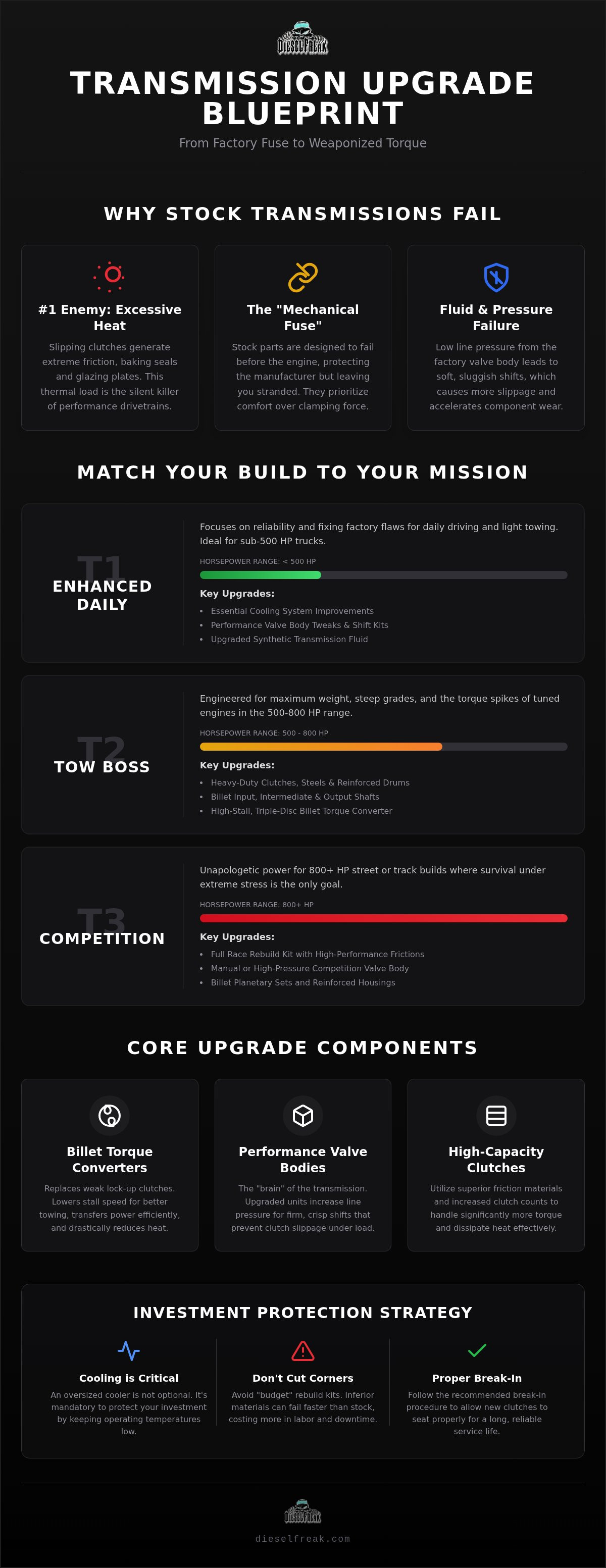
Why Stock Transmissions Fail Under Heavy-Duty Stress
Stock units are engineered for comfort. They prioritize smooth shifts over raw clamping force. This is fine for a grocery getter, but it’s a death sentence for a workhorse. Your factory transmission acts as a mechanical fuse. It’s designed to slip or fail before you can damage the engine. This protects the manufacturer’s warranty, but it leaves you stranded on the shoulder with a burnt-out rig.
Excessive heat is the silent killer. When your clutches slip, they generate friction. That friction turns into a thermal load that bakes your seals and glazes your plates. If you’ve added a high-boost turbo, you’ve created a synergy problem. More boost creates a torque spike that the factory valve body can’t counter. Without Class 8 semi truck transmission upgrades to increase line pressure, your clutches will burn under the pressure. While Semi-trailer truck transmissions are built for extreme durability, your pickup needs specialized hardware to match that standard.
The Limits of Factory Torque Converters
Stall speed is your first hurdle. Factory converters often have a stall speed that’s too high for heavy towing, which generates massive heat before the truck even moves. Under high torque, the small factory lock-up clutch begins to fail. This creates a massive thermal load that thin factory fluid can't dissipate. In the high-stress environment of 2026 diesel performance, heat soak in factory torque converters occurs when the fluid's thermal capacity is exceeded during continuous high-torque lock-up phases, leading to immediate power loss.
Fluid Dynamics and Pressure Failures
Clamping force is the only thing keeping your gears together. Low line pressure leads to soft, sluggish shifts that destroy friction material. High-mileage fluid makes the situation worse. It clogs solenoids and causes erratic pressure drops. Internal leaks bleed off the critical force needed to hold the load. Watch for these common pressure failure points:
- Pressure drops: Clutches lose their bite and begin to smoke.
- Solenoid lag: Slow, hesitant response times during gear changes under load.
- Seal failure: Hardened internal seals that bleed off line pressure and prevent full engagement.
Don't wait for a total meltdown on the highway. Upgrading your fluid dynamics and mechanical components is the only way to ensure your transmission survives the raw power of a modified diesel. Investing in Class 8 semi truck transmission upgrades technology for your rig is the insurance policy your engine deserves.
Evaluating Your Build: Daily Driver vs. Extreme Towing
Define your mission before you spend a dime. You aren't just buying parts; you're building a solution for a specific problem. A truck that hauls a boat once a month needs a different setup than a dedicated workhorse pulling max GVWR through mountain passes. Many owners look at Class 8 semi truck transmission upgrades for inspiration because those rigs are designed to never stop. You want that same level of industrial reliability in your pickup.
Choose your tier based on how you use the truck. Tier 1 is the Enhanced Daily. It focuses on reliability without the race price tag. It fixes factory flaws without making the ride harsh. Tier 2 is the Tow Boss. This build is engineered for maximum weight and steep grades. It uses heavy-duty clutches and improved cooling to survive high-stress cycles. Tier 3 is the Competition Grade. This is for the highest horsepower builds where comfort is optional and survival is the only goal. It’s unapologetic power for the street or the track.
Matching Upgrades to Horsepower Goals
Your engine's output dictates your transmission's needs. If you're running sub-500 HP, focus on essential cooling and valve body tweaks. This keeps your fluid fresh and your shifts firm. Once you hit the 500 to 800 HP range, you’re in the danger zone for factory internals. You need re-engineered clutches and billet input shafts to handle the torque spikes. The evolution of modern transmission technology means you can now have massive strength without sacrificing shift quality. For those pushing 800+ HP, full race builds with manual valve body options become a necessity to maintain control over the power.
The Cost of Cutting Corners
Don't fall for the trap of the cheap rebuild kit. These budget sets often fail faster than stock units because they use inferior friction materials. You’ll end up paying for labor twice. Standard torque converters are another hidden expense. They might fit the bellhousing, but they can’t handle the raw grunt of a tuned diesel. Justifying the investment in high-quality diesel performance parts is about more than just speed. It’s about insurance. You’re protecting your engine and your time. If you want a rig that stands up to real abuse, check out the hardware in our Chevy diesel pickup truck collection to see what true durability looks like.
High-Performance Components: Torque Converters and Valve Bodies
Building a bulletproof drivetrain requires more than just a basic rebuild kit. You need components that take a punch and keep swinging. Much like the heavy-duty components found in Class 8 semi truck transmission upgrades, these high-performance parts turn your transmission from a weak link into a weapon. You’re not just repairing a truck; you’re re-engineering it for dominance.
The torque converter is the heart of your power transfer. Factory units use stamped covers that flex and single-disc clutches that slip under pressure. Billet torque converters solve this by using a solid block of steel to eliminate flex. Multi-disc clutches are mandatory for any Duramax build pushing serious weight or high boost. They provide the massive surface area needed to lock down the power without burning up. Anti-ballooning plates act as the final insurance policy. They prevent the converter housing from expanding under high RPM and destroying your thrust bearings. Billet steel input shafts provide the torsional rigidity required to prevent catastrophic shear when the turbo hits peak boost.
The Billet Advantage
Billet components are the only choice for a high-output rig. Stamped factory parts are prone to cracking and warping when the torque hits. Multi-disc clutches distribute the load across multiple friction surfaces, which drastically increases holding capacity. This is critical for heavy towing where the heat builds up fast. Anti-ballooning plates keep the internal tolerances tight even when you're pushing the engine to its limit. You need parts that can handle the grit of the road without flinching.
Precision Shifting with Upgraded Valve Bodies
The valve body is the brain of your transmission. Factory programming favors "comfort" shifts, but comfort is just another word for slipping. Performance valve bodies re-map the hydraulic circuits for maximum efficiency. They increase line pressure to ensure instant clutch engagement. This eliminates shift overlap, which is that annoying "flare" or RPM spike between gears. Firm shifts aren't just for feel; they actually extend your transmission's life by reducing the time clutches spend rubbing against each other. By cutting down on shift duration, you lower the heat generation and keep your friction material intact.
Billet shafts are the backbone of a reliable build. They eliminate the snap-points in the driveline that occur during high-torque shifts or sudden traction. If you're running upgraded turbos, you're putting immense stress on the internal hardware. Deep pans complete the cooling package. They increase fluid capacity by several quarts for superior thermoregulation. This extra volume keeps the fluid from cooking during long pulls over mountain passes. It provides a larger heat sink to stabilize pressures and protect your expensive internal seals. When you invest in Class 8 semi truck transmission upgrades technology for your pickup, you’re building for the long haul.
Installation and Long-Term Durability Strategies
You’ve spent the money on high-end hardware. Don’t kill it with a lazy installation. Precision is the difference between a rig that dominates and one that ends up on a flatbed. Much like the rigorous standards for Class 8 semi truck transmission upgrades, your pickup requires a disciplined approach to assembly and maintenance. If you skip the small details, the raw torque of a Duramax will find the weakness and exploit it.
The first 500 miles are critical. This is the break-in period where clutches seat and seals take their final shape. Don't hook up the heavy trailer the second you roll out of the shop. Vary your speeds. Let the heat cycles stabilize. Heat is your primary enemy, so bigger coolers are always better for heavy trucks. They provide the surface area needed to shed thermal load before it cooks your fluid. Use specialized synthetics only. High-performance diesel engines create shear forces that destroy standard oils. Gauges aren't optional. You need accurate temperature readings to monitor your vitals in real-time. If the needle climbs, back off.
Mastering the Install
Start by cleaning the lines. If you don't flush the cooler and lines, old metal debris from your previous failure will lunch your new parts in minutes. Proper torque converter seating is the #1 mistake in DIY installs. You must feel those three distinct "clicks" as it seats onto the stator and pump. If it’s not deep enough, you’ll crush the pump the moment you bolt the bellhousing to the block. Verify your line pressure after the first heat cycle. This ensures your valve body is delivering the clamping force you paid for.
Maintenance for the Long Haul
Annual fluid analysis is the blood test for your transmission. It reveals internal wear and metal contamination before it becomes a catastrophe. Check for leaks and adjust your bands regularly to maintain that crisp shift feel. If you’ve stepped up to a high-flow BorgWarner turbo, your transmission must be synced to handle that aggressive spool-up. This synergy ensures your power reaches the ground instead of turning into heat. Real durability is earned through maintenance. Treat your rig like the professional tool it is. For the ultimate hardware to back up your build, explore our Chevy diesel pickup truck collection and get the parts that outlast the competition.
Dominate the Road with Diesel Freak Chevy Upgrades
Your transmission is only one part of the war machine. Total dominance requires a complete driveline strategy. Since 2009, Diesel Freak has provided the hardware that turns stock trucks into legends. We understand the demands of heavy hauling. Our deep expertise in Class 8 semi truck transmission upgrades informs every single part we select for the pickup market. We don't do generic. We do grit. Duramax owners trust the Diesel Freak name because we’re in the trenches with you. This isn't just about selling parts. It's about a lifestyle defined by raw power and mechanical superiority.
Featured Chevy Diesel Accessories
Protect your investment with the right fluids. Utilize S3 Heavy Duty 15w-40 Engine Motor Oil to protect your driveline and engine components from extreme thermal stress. It’s engineered for the high-pressure environment of a working diesel. Move to the mechanical connections. Reinforce your build with Axiom Supply CV Axle Flange Bolt Sets. These bolts provide the clamping force needed to prevent backing out under heavy torque spikes. Stability is the final pillar of a heavy-duty build. Enhance stability under load with Timbren SES for Chevy HD. It eliminates rear-end sag and keeps your steering responsive when you’re towing at the maximum GVWR. These accessories transform your truck from a standard pickup into a professional-grade hauler.
Take the Next Step in Performance
Stop settling for parts designed for the average driver. Your Duramax is a precision machine that deserves better than a parts-store special. Reinforce your Chevy driveline now before a minor weakness turns into a catastrophic highway failure. Expert-selected components provide a level of reliability that generic kits simply can’t match. We’ve curated our collection to include 111 products that meet our unapologetic standards for toughness. Every item is chosen to handle the raw torque of a modified diesel engine. This is more than a shop. It’s a resource for those who refuse to be sidelined by weak components. Take the next step toward a bulletproof rig. Shop the Chevy Diesel Pickup Truck Collection and build a truck that commands the road.
Own the Grade: Build a Transmission That Never Quits
Your Duramax was built to work. Don't let a factory-spec transmission hold it back. We have exposed why stock components act as a bottleneck and how billet torque converters transform power delivery. You now have the blueprint to move from a slipping daily driver to a dominant heavy hauler. Whether you're pulling max GVWR or chasing high-boost street performance, your hardware must match your ambition.
Diesel Freak brings the same uncompromising durability seen in Class 8 semi truck transmission upgrades to the pickup market. We don't do generic parts. We offer 111 specialized Chevy diesel products that are performance-tested for the most extreme loads. It's time to stop worrying about heat soak and start trusting your driveline. Reinforce your rig with rugged hardware designed for owners who refuse to compromise on grit. You have the engine power. Now give it the transmission it deserves.
Build Your Beast: Shop Chevy Diesel Pickup Truck Upgrades
Get back on the road with total confidence. Your next heavy haul starts here.
Frequently Asked Questions
What are the first signs of heavy-duty transmission failure?
Watch for slipping under load and a distinct burnt smell coming from the dipstick. If your RPMs spike during gear changes, your clutches are losing their bite and generating excessive heat. Discolored, dark fluid is a red flag that your internals are cooking. Don't ignore these warnings. A small slip today is a total meltdown tomorrow. Catch the failure early before you need a tow truck. Catching these signs early saves your hard-earned cash.
Can I upgrade my transmission without doing a full rebuild?
You can add external coolers and performance valve bodies without cracking the case. These components increase line pressure and shed heat, which helps a healthy unit live longer. However, if your clutches are already glazed, these parts won't fix the damage. Think of these as preventative insurance. They are great for moderate power increases but won't replace the need for Class 8 semi truck transmission upgrades if you're chasing high horsepower and extreme durability.
How much horsepower can a stock Allison 1000 really handle?
Most stock Allison 1000 units begin to struggle once you cross the 450 horsepower mark at the crank. High-torque tunes from aggressive programmers can overwhelm the factory holding capacity instantly. You'll notice the 5th and 6th gear clutches are the first to go under load. If you've added a larger turbo or heavy injectors, you're on borrowed time. Build the transmission before you turn up the boost. Don't let a stock part limit your engine's potential.
Is a triple-disc torque converter worth the extra cost for towing?
A triple-disc converter is absolutely worth the investment for any dedicated towing rig. It provides three times the friction surface area compared to a factory single-disc unit. This means it can lock up under full load without slipping or generating massive heat. You'll get better power transfer and lower transmission temperatures. It’s the difference between struggling up a grade and pulling with total confidence. Invest in the hardware that handles the raw grunt of your diesel.
What is the ideal operating temperature for a performance transmission?
Keep your fluid between 160°F and 200°F for maximum longevity. While modern synthetics can handle spikes up to 230°F, sustained heat above 210°F begins to degrade the fluid and harden your internal seals. If you consistently see temperatures over 220°F, you need a larger cooler or a deep pan. Monitoring your vitals is the only way to prevent a catastrophic highway failure. Stay cool to stay on the road. Accurate gauges are your first line of defense.
How often should I change the fluid in an upgraded heavy-duty transmission?
Change your fluid every 20,000 to 30,000 miles if you are hauling heavy loads regularly. Performance builds generate more friction and heat, which breaks down additives faster than a grocery getter. Using high-quality synthetics is a requirement, not a suggestion. Regular intervals are cheap compared to the cost of a full overhaul. Treat your transmission like the professional tool it is. Fresh fluid is the lifeblood of your high-performance drivetrain. Don't cut corners on maintenance.
Does a performance valve body make the ride too uncomfortable for daily use?
A performance valve body makes shifts feel crisp and deliberate, not violent. You'll lose the "mushy" factory feel, which is actually a good thing for your clutches. While the shifts are firmer, they won't rattle your teeth during daily driving. You'll appreciate the instant engagement when you're merging onto the highway or pulling a trailer. It’s about control, not just harshness. Firm shifts extend the life of your friction plates by reducing shift overlap and heat.
Why should I choose Diesel Freak parts for my Chevy diesel truck?
Diesel Freak is a family-owned operation that lives and breathes performance since 2009. We specialize in the rugged hardware needed for Class 8 semi truck transmission upgrades and heavy-duty pickups. Our collection features 111 products specifically chosen for Chevy rigs. We don't sell generic junk; we sell the parts we use in our own trucks. You get insider expertise and the grit required to build a bulletproof machine. Trust the name that knows diesel performance inside and out.
Disclaimer
Diesel Freak LLC is in no way associated, sponsored, or affiliated with Any OEM manufacturer. Products from Diesel Freak LLC presented in this listing are not to be confused with any of the products or trademarks of any OEM company. All parts listed to fit these manufacturers are replacement aftermarket parts.