

Your stock plastic tank is a ticking time bomb on the trail. One hard landing or a washboard road and that flimsy OEM mount snaps, leaving you blind in the mud. You didn't buy a Roxor to baby it on pavement. You bought it to dominate the dirt. A Mahindra Roxor windshield washer reservoir replacement isn't just about maintenance. It's about upgrading to a system that handles raw vibration and heavy-duty use. We've seen these stock units fail under pressure. We're here to make sure yours doesn't.
We agree that off-road performance requires gear as tough as the engine under your hood. This guide promises to walk you through the installation of a high-pressure, rugged Windshield Washer Reservoir Kit that delivers a clear view when the terrain gets nasty. We'll cover the custom-bent flat bar mounting techniques we use in our own shop and provide the wiring instructions needed to get your spray hitting with maximum force. It's time to ditch the weak plastic. Build something that lasts.
Key Takeaways
- Ditch the flimsy stock plastic and upgrade to a Mahindra Roxor windshield washer reservoir replacement built for extreme diesel vibrations.
- Choose a high-pressure pump and HDPE tank to blast through thick mud without cracking under pressure.
- Fabricate a custom flat bar bracket for a rock-solid mount that refuses to fail on the toughest terrain.
- Wire your new Windshield Washer Reservoir Kit directly to the 12v bus for instant, manual control when visibility drops.
- Execute a full-pressure trail test to guarantee leak-free performance before you hit the dirt.
Why Your Mahindra Roxor Needs a Reservoir Upgrade
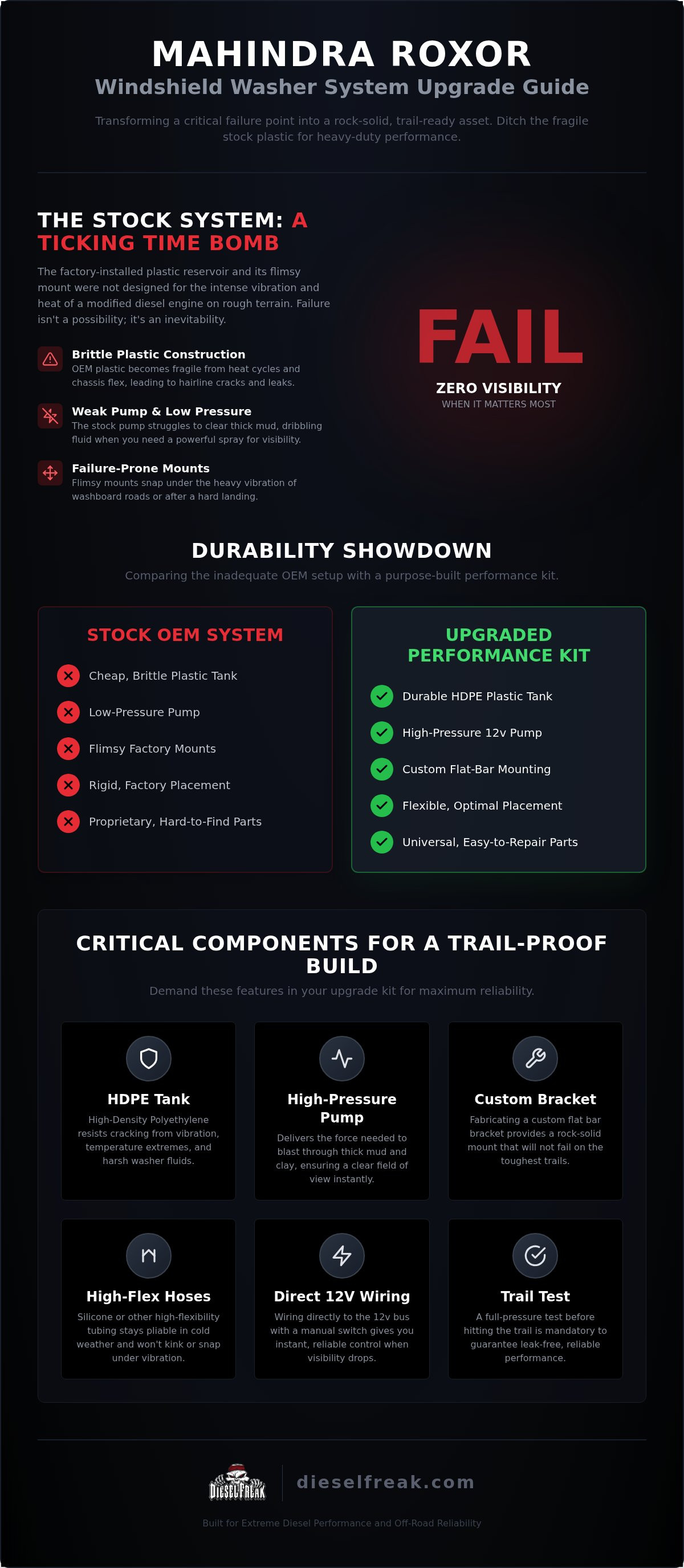
Stock equipment belongs on a golf cart. Your Roxor is a heavy-duty machine that generates massive vibration and intense engine heat. Factory plastic reservoirs weren't built to handle the constant thrashing of a diesel engine on a washboard trail. A Mahindra Roxor windshield washer reservoir replacement is about more than just fixing a leak. It’s about building a system that won’t quit when visibility hits zero. We've seen stock mounts snap after one hard landing. We've seen pumps fail when they're needed most. It's time to upgrade to something that matches the grit of your machine.
When you’re pushing through deep mud, visibility is a non-negotiable safety requirement. You need windshield washer fluid delivered with enough pressure to strip away thick clay instantly. Most stock pumps just dribble fluid onto the glass. That’s a liability, not a feature. We design for toughness. We build for the dirt. Diesel Freak has focused on rugged, mechanical reliability since 2009. We know that soft OEM solutions don't cut it in the real world. We use these exact kits on our own high-performance builds to ensure they survive the grit.
Signs of Reservoir and Pump Failure
Don’t wait for a total blackout on the trail. Check your gear for these common failure points before your next outing. First, inspect the housing for hair-line cracks. Extreme heat cycles and chassis flex turn cheap plastic brittle over time. Second, listen to your pump. If it’s whining or struggling, it’s likely ingested trail dust or suffered an electrical short. Finally, check your lines. Factory hoses often snap in cold weather or high-vibration environments, leaving you dry when you need a spray. If you see fluid pooling under the hood, your reservoir is compromised.
The Advantage of a Universal Performance Kit
The Windshield Washer Reservoir Kit is a versatile, heavy-duty alternative to stock plastic that prioritizes raw durability over cost-cutting. It’s a professional choice for Roxor owners who demand more from their machines. This kit offers total compatibility with both Type 1 and Type 2 Roxor windshield setups. It features a simplified mechanical design that makes trailside repairs fast and easy. You get a larger tank capacity and a high-PSI pump that actually clears the glass. It’s a direct upgrade that transforms your visibility from a weakness into a strength. We advocate for custom-bent flat bar mounting to ensure this setup stays locked in place, no matter how hard you wheel.
Choosing the Right Windshield Washer Reservoir Kit
Stop looking for cheap fixes. You need hardware that matches your Roxor’s soul. When you're buried in a mud hole, a weak dribble of fluid won't save you. You need a pump with enough PSI to blast through thick clay instantly. Standard pumps fail here. They lack the raw power to push fluid through clogged nozzles. Look for a kit that prioritizes high-pressure output. Visibility isn't just about comfort; it's about survival on the trail. Meeting Federal Motor Vehicle Safety Standard No. 104 requires a system that actually clears the field of view, and off-road conditions demand even more than the legal minimum.
Tank material is your next priority. Standard plastic is for street cars. For a Mahindra Roxor windshield washer reservoir replacement, high-density polyethylene (HDPE) is king. It resists cracking when the temperature drops or the chassis twists. It handles the chemical stress of heavy-duty cleaners without degrading. Check for kit completeness before you buy. You want the pump, high-flex hoses, and adjustable nozzles in one package. Don't waste time hunting for individual fittings. Grabbing a professional Windshield Washer Reservoir Kit ensures you aren't left guessing about compatibility or performance when you're miles from the shop.
Universal vs. OEM: The Durability Debate
OEM reservoirs are often the first thing to snap in a custom build. They're designed for assembly line speed, not trail abuse. Universal kits offer a massive advantage in weight distribution. You can mount them where they make sense, not just where the factory had a spare inch. This flexibility allows you to keep the reservoir away from extreme turbo heat. Using a kit with standard, easy-to-find components means you can perform trailside repairs without waiting weeks for a proprietary part to ship.
Critical Components to Look For
Demand quality in the details. Integrated pumps are generally easier to maintain and protect the motor from external debris. Look for UV-resistant tank caps. They won't crumble after a summer under the sun. Your tubing should be high-flex silicone. It stays pliable in the cold and won't kink under high-vibration loads. Size matters too. The Roxor engine bay is crowded. Find the "sweet spot" that offers maximum capacity without interfering with your air intake or cooling lines. Build it right the first time.
Step-by-Step: Mounting the Reservoir Like a Pro
Plastic brackets are for pavement queens. Real off-roading demands steel. When performing a Mahindra Roxor windshield washer reservoir replacement, the mounting system is where most guys fail. They rely on flimsy zip ties or thin sheet metal that vibrates until it snaps. We do things differently. We use custom-bent flat bar to create a rock-solid foundation for our Windshield Washer Reservoir Kit. This isn't just about sticking a tank under the hood. It’s about ensuring that tank stays put when you’re slamming through a rock garden or hitting washboard trails at speed.
Before you pick up the drill, prioritize DIY car maintenance safety by securing your vehicle and clearing your workspace. You need a setup that handles the raw torque and vibration of a diesel engine without breaking a sweat. Identify a mounting point that offers maximum rigidity. Secure the tank to your custom bracket using heavy-duty bolts and lock washers. Don't settle for anything less than a permanent, mechanical connection. If it moves by hand, it’ll fall off on the trail.
The Flat Bar Fabrication Method
Start with a piece of steel flat bar. Measure the width and depth of your reservoir jug to ensure a snug fit. Bend the bar into a cradle that supports the base and sides of the tank. This provides superior strength compared to a single-point mount. Drill your pilot holes carefully to allow for a secure, bolt-on installation directly to the chassis or inner fender. Once the fit is perfect, apply a coat of black paint to prevent rust. This extra step ensures your custom bracket survives the elements as long as your Roxor does.
Locating the Sweet Spot in the Engine Bay
Engine bay real estate is tight; don't just shove the reservoir anywhere. Avoid the turbocharger heat soak area. High temperatures will degrade your fluid and eventually warp the HDPE tank. Look for a location on the driver-side firewall or near the radiator support that offers clear vibration clearance. You need enough room to refill the jug during pit stops without burning your hands. For more layout tips on optimizing your machine, check out Mahindra Roxor: The Ultimate Guide. Test the clearance against the fenders one last time before final torque. If it rattles in the shop, it’ll fail in the dirt.
Wiring and Plumbing Your New Washer Pump
Mounting the tank was the warm-up. Now you need to bring it to life. A Mahindra Roxor windshield washer reservoir replacement is only as good as the current flowing through it. If your wiring is sloppy, your pump will quit the moment you hit a deep puddle. You need a clean, 12v power source from the Roxor’s electrical bus. Don't tap into a weak circuit. Find a dedicated lead that can handle the draw when you're blasting mud off the glass. This is mechanical dominance, not a science project. If you want a setup that survives the trail, grab a professional Windshield Washer Reservoir Kit and do it right.
Proper grounding is non-negotiable. Scrape the paint away and secure your ground wire directly to the chassis. A bad ground leads to electrical interference or a pump that stutters under load. Once the power is solid, route your fluid lines through the firewall. Use protective rubber grommets to prevent the metal edges from slicing through your hoses. Vibration will eat unprotected lines for lunch. Keep your path clear and your connections tight. Every wire and hose must be secured. If it dangles, it’s a liability.
The Electrical Setup
Use 16-gauge wire for this job. It offers low resistance and stays durable in a high-heat engine bay. Thinner wire will heat up and fail under constant use. Install an inline fuse between the power source and the switch. This protects your pump motor from surges and prevents a small short from melting your harness. You can connect directly to the factory wiper switch if your Roxor is equipped, or run a dedicated aftermarket toggle on the dash. Manual control gives you the spray you need, exactly when you need it. Heat-shrink every connection. Keep the moisture out and the power in.
Plumbing for Performance
Route your delivery hose with purpose. Cut the lines to length, but leave enough slack for engine movement. Kinks are the enemy of high-pressure spray. Use a T-connector to split the flow for dual-nozzle patterns. This ensures total coverage across the entire windshield. Secure every inch of tubing with heavy-duty zip ties. Keep the lines away from the exhaust manifold and moving belt components. A melted line is a dead system. Check your nozzle aim before you tighten everything down. You want that fluid hitting center-mass on the glass, not spraying over the roll bar. Double-check every fitting. Pressure is your friend; leaks are your enemy.
Final Inspection: Trail-Proofing Your Visibility
Installation is done. Now it's time to prove it. You don't want to find a leak when you're nose-deep in a mud pit. A Mahindra Roxor windshield washer reservoir replacement requires a final inspection that’s as tough as the trail itself. Start with a dry test of the pump. Trigger the switch for a split second to hear the motor whine. If it’s silent, check your grounds. Once you hear life, fill the tank and hit it again. Check every connection point under full pressure. If a single drop of fluid escapes, tighten the clamp. Leaks in the shop become total failures in the dirt.
Verify your spray angle hits the center of the Mahindra Roxor windshield. You need total coverage to clear the field of vision instantly. If the fluid hits too low, you're just washing the hood. Adjust the nozzles until the pattern is perfect. One final pro tip: add a mesh filter to the reservoir inlet. Trail dust and grit always find a way into your tank. A filter keeps that debris out of the pump’s internal gears, extending its life through every season. This is how you build for the long haul.
Maintenance for the Off-Road Enthusiast
The trail is relentless. Mud dries and clogs nozzles fast. Use a fine needle to clear the spray ports after every heavy excursion. Don't let dried clay kill your visibility when you need it most. Check your custom bracket bolts for tightness after every 50 miles of hard wheeling. Vibration is a constant force in a diesel machine; don't let it win. For a deeper look at long-term care and seasonal prep, visit Rugged Vision: The Ultimate Guide to Your Windshield Washer Reservoir. Stay ahead of the grime.
Upgrading Your Wiper Game
A high-pressure spray is only half the battle. Pair your new setup with heavy-duty off-road wiper blades that can handle the grit without streaking. Use a high-concentration washer fluid to cut through diesel soot and engine grease. Standard blue water won't cut it when the trail grime gets thick. You’ve built a machine that dominates the terrain. Make sure you can actually see the path you're conquering. Ready to upgrade? Grab the Windshield Washer Reservoir Kit and get to work. Build it tough. Drive it hard.
Dominate the Dirt with Crystal-Clear Vision
Visibility isn't a luxury; it's a requirement for trail dominance. You've learned how to ditch the brittle stock plastic and engineer a mounting system that survives the harshest washboard roads. A proper Mahindra Roxor windshield washer reservoir replacement transforms your machine from a fair-weather cruiser into a mud-shredding beast. By prioritizing custom flat bar brackets and high-pressure plumbing, you ensure that every spray clears the grime instantly. Don't let a clogged pump or a snapped bracket end your day early.
Stop settling for weak OEM components that fail when the terrain gets tough. We’ve tested our gear on real Roxor builds to guarantee it handles the raw vibration of a diesel engine. Our kit offers a universal fit for all model years and includes a heavy-duty pump designed for maximum output. It’s time to upgrade your rig with hardware that matches your ambition. Get the Rugged Windshield Washer Reservoir Kit Built for the Roxor and take control of your visibility today. Your machine is ready for the next challenge. Get out there and conquer the trail.
Frequently Asked Questions
Does the Mahindra Roxor come with a factory windshield washer reservoir?
The Mahindra Roxor is classified as a non-road vehicle, so it doesn't ship with a factory windshield washer reservoir. Owners who want to make their rigs street-legal must add one to meet safety requirements. A Mahindra Roxor windshield washer reservoir replacement or initial install is a standard upgrade for anyone taking their machine on public roads. It’s a critical safety component for maintaining visibility when the trail gets nasty.
Can I use a universal washer kit on my Mahindra Roxor?
You can absolutely use a universal washer kit on your machine. Diesel Freak sells a high-performance Universal Domestic & Import Washer Pump / Reservoir Kit that we use on our own custom builds. These kits are superior to soft OEM solutions because they offer higher pressure and rugged durability. They provide the raw capability needed to blast through heavy mud and trail grime without failing under the stress of off-road vibration.
What is the best location to mount a washer reservoir in the Roxor engine bay?
The optimal mounting spot is on the driver-side firewall or near the radiator support. Avoid the area around the turbocharger to prevent heat soak from warping the reservoir or boiling your fluid. You need a location that offers easy access for refilling while staying clear of moving engine components. Proper placement ensures your Mahindra Roxor windshield washer reservoir replacement stays protected from the extreme temperatures generated by high-performance diesel engines.
How do I wire a windshield washer pump to a 12v power source?
Run a dedicated line from the 12v power source on the Roxor’s electrical bus to your dashboard switch. Ground the pump motor directly to the chassis to ensure a solid, interference-free connection. Always install an inline fuse to protect the system from electrical surges. This setup gives you manual control over your spray, ensuring you have high-pressure fluid available the second your visibility hits zero on the trail. Build it for reliability.
Why is my windshield washer pump not spraying fluid?
Check for clogged nozzles first, as trail dust often blocks the spray ports. If the nozzles are clear, inspect your inline fuse and the ground connection at the chassis. A stuttering pump often signals a bad ground or debris ingestion in the motor. Perform a dry test to hear if the pump is actually engaging. If the motor is silent despite having power, it’s likely burned out and requires a full replacement to restore your vision.
What gauge wire should I use for an aftermarket washer pump?
Use 16-gauge wire for a reliable, low-resistance connection that can handle the pump's draw. Thinner wire can overheat or snap under the intense vibration of a diesel engine. High-quality 16-gauge wire provides the mechanical durability needed for long-term trail use. Pair this with heat-shrink connectors to keep moisture out of your electrical system, ensuring your washer pump delivers maximum pressure every time you hit the toggle. Don't cut corners on your wiring.
How do I prevent my washer fluid lines from freezing in winter?
Use high-concentration, winter-grade washer fluid to prevent the reservoir and lines from cracking in freezing temperatures. Standard blue fluid often freezes solid, which can burst your pump or snap brittle hoses. Route your lines through the firewall using rubber grommets to protect them from cold wind blasts and sharp metal edges. Keeping your fluid moving and protected is the only way to maintain visibility when the temperature drops below zero on the trail.
Is it necessary to use a custom bracket for the Roxor reservoir?
A custom bracket is essential for true off-road performance. Stock plastic mounts can't handle the raw vibration and trail impacts of a Roxor. We advocate for a custom-bent flat bar mounting system because it offers superior strength and rigidity. Fabricating your own steel bracket ensures the reservoir stays locked in place no matter how hard you wheel. It’s a professional-grade solution that beats flimsy zip ties or thin sheet metal every time you hit the dirt.
Disclaimer
Diesel Freak LLC is in no way associated, sponsored, or affiliated with Any OEM manufacturer. Products from Diesel Freak LLC presented in this listing are not to be confused with any of the products or trademarks of any OEM company. All parts listed to fit these manufacturers are replacement aftermarket parts.