

The wrong turbo can turn a power upgrade into a parts mismatch. Before choosing Roxor turbo upgrade kits, check your engine, fitment, and exactly what the setup includes. A turbo core or replacement part isn’t automatically a complete upgrade, and a different turbo may call for tuning or other supporting components.
Model year and build goals matter. The 2018-2022 models use a 2.5L diesel, while 2023-2026 models use a 2.7L engine, so don’t assume a turbo or tune fits every Roxor. This guide explains how to verify compatibility, distinguish a standalone turbo component from a full setup, and plan for tuning and supporting parts before you buy. Start by identifying your vehicle and current hardware, then compare products against your intended use. Diesel Freak lists turbochargers, charge air cooler plumbing, Roxor engine and driveline parts, and ROXOR TUNING. Confirm current availability, exact contents, and fitment before ordering.
Key Takeaways
- Check whether you’re buying a replacement turbo, a turbo-focused upgrade, or a package, then confirm exactly which components are included.
- Roxor turbo upgrade kits can differ in scope, so compare documented fitment, hardware, tuning requirements, and seller information before choosing.
- Use your vehicle details and existing setup to verify compatibility. Confirm part numbers and manufacturer documentation rather than relying on appearance.
- Plan tuning and supporting components around the selected turbo and vehicle configuration, not assumptions about what every build needs.
- Match your upgrade path to your build goals, and confirm current availability and fitment before ordering.
Roxor Turbo Upgrades: What Are You Actually Buying?
The word “kit” can sound like a complete, ready-to-install solution, but don’t assume that’s what a listing includes. One seller may use it for a package of coordinated components, while another may be describing only a turbocharger or core assembly. Check the itemized contents and product documentation before deciding what else your build needs.
A replacement turbo part substitutes for an existing component; a coordinated turbo upgrade system pairs a compatible turbo with the supporting parts and calibration its setup requires. That distinction matters on a Mahindra Roxor. A different turbo by itself doesn’t establish fitment or guarantee a particular power result.
Turbo replacement, turbo core, or upgrade kit: what is the difference?
A replacement is intended to take the place of an existing component. A turbo core assembly is a narrower listing, and its exact scope depends on the seller. It may not include charge-air plumbing, other supporting hardware, or tuning. A turbo upgrade may change the turbo itself, but that doesn’t necessarily make it a complete package.
Read beyond the product title. Compare itemized contents, installation information, fitment notes, and any stated tuning requirements. If a listing is unclear, ask the seller to specify what’s included and what you’ll need to source separately. The word “kit” alone isn’t proof that the box contains every part required for your intended setup.
What should a Roxor owner expect from a turbo upgrade?
Start with the job your Roxor needs to do, its current configuration, and the change you’re aiming for. A replacement may make sense when the goal is to substitute a failed or worn component. A performance-focused change calls for a closer look at how the turbo works with engine calibration and the rest of the air system.
A larger or different turbo alone doesn’t guarantee more usable power, improved response, or any specific result. Compatibility and the wider engine system matter, and requirements can vary with the selected turbo and vehicle configuration. Don’t treat a claim about another build as evidence of what your Roxor will deliver.
Apply the same checks when comparing Roxor turbo upgrade kits. Diesel Freak lists turbochargers, charge air cooler plumbing, Roxor engine and driveline parts, and ROXOR TUNING. These categories can help you plan a build, but confirm current availability, exact contents, and fitment before ordering. Choose parts that match your verified setup, not just a product label that sounds complete.
How a Roxor Turbo Upgrade Connects to Tuning and Supporting Parts
A turbo doesn’t work in isolation. It moves more air into the engine, but the result depends on how the air path, engine calibration, and the rest of the vehicle work together. The basics of how turbochargers work help explain why the full setup deserves attention: compressing intake air also affects its temperature, so the turbo is only one part of the system.
Confirm compatibility across the complete setup, including the turbo, engine calibration, intake and charge-air components, and the vehicle’s existing configuration. This doesn’t mean every Roxor needs the same supporting parts. Let the requirements for the specific turbo and vehicle guide your plan.
Why tuning belongs in the turbo-upgrade conversation
Engine calibration governs how the engine responds to operating conditions. A turbo change can alter airflow and boost behavior, so ask whether the selected turbo calls for a revised calibration, whether your existing tune is compatible, and what hardware details the tuner needs. Don’t assume a tune is included just because a listing describes an upgrade package.
ROXOR TUNING is a separate category from turbochargers. Diesel Freak’s Roxor tuning guide offers broader context, but confirm calibration requirements for the exact turbo and Roxor with the relevant seller or manufacturer.
Which supporting components should buyers ask about?
Use the parts list to ask focused questions. Find out whether the package includes the components your setup requires or whether they’re separate:
- Intake: Are any intake parts included, or does the product documentation specify which existing parts can be retained?
- Charge-air system: Does the setup require particular charge-air plumbing or other charge-air components?
- Engine and driveline: Are your existing engine and driveline parts appropriate for the planned configuration?
- Tuning: Is a particular calibration required, recommended, or sold separately?
Forum builds can give you ideas, but they don’t prove universal fitment or repeatable results. Another Roxor may have different hardware, calibration, or modifications, and a parts list alone doesn’t establish compatibility. Ask for manufacturer guidance tied to your vehicle and chosen turbo. Review those categories as you map out your build, then verify current availability and exact requirements before ordering.
Compare Roxor Turbo Upgrade Options by Fitment, Scope, and Build Goals
Choose by need, not by the biggest-sounding listing. A replacement part intended to restore an existing setup differs from a turbo-only performance change, and both differ from a package with documented supporting hardware. Use the comparison below to see what you still need to verify. It isn’t a ranking: the right path depends on your Roxor and your build plan.
| Option | Fitment and included hardware | Tuning, documentation, and seller support |
|---|---|---|
| Replacement component | Confirm it matches the existing turbo or component and your exact vehicle configuration. The listing may focus on the replacement part, so don’t assume additional hardware is included. | Check whether your existing calibration remains appropriate. Look for part numbers, application details, and clear replacement instructions, then ask the seller to confirm fitment. |
| Turbo-only upgrade | Verify compatibility with the Roxor’s model year, engine, and existing modifications. Confirm what comes with the turbo and what must be sourced separately. | Ask whether calibration changes are required and what supporting components the manufacturer specifies. Seek written fitment guidance and installation documentation. |
| Verified complete package | “Complete” should mean the seller itemizes the included components and identifies the vehicle configuration they fit. Confirm exclusions, too. | Check whether tuning is included or separate, what documentation is provided, and who can confirm application questions before ordering. |
Match the option to your Roxor and intended use
Start with your vehicle, not the listing. Record the model year, engine details, current turbo and related hardware, and any existing modifications. Then define the goal: are you replacing a component or planning a performance-focused build? Those are different jobs. Don’t call one option “best” without confirmed specifications and evidence that it suits your intended use.
An owner’s build combining a custom turbo with an intercooler and tune can illustrate how modifications may be linked. It doesn’t establish a universal parts recipe or prove another Roxor will have the same outcome.
Compare sellers and product documentation before ordering
Look for explicit application details, itemized contents, part numbers, and installation documentation. Ask who confirms fitment and which vehicle and modification details they need. The BorgWarner turbo guide can help explain turbo terminology, but it doesn’t verify a specific Roxor application.
Product listings can change. Before choosing among Roxor turbo upgrade kits, confirm current availability, exact package contents, fitment, and tuning requirements with the seller or manufacturer. Diesel Freak lists turbochargers, Roxor engine and driveline parts, and ROXOR TUNING. Check current inventory and application details rather than assuming a particular kit is offered.
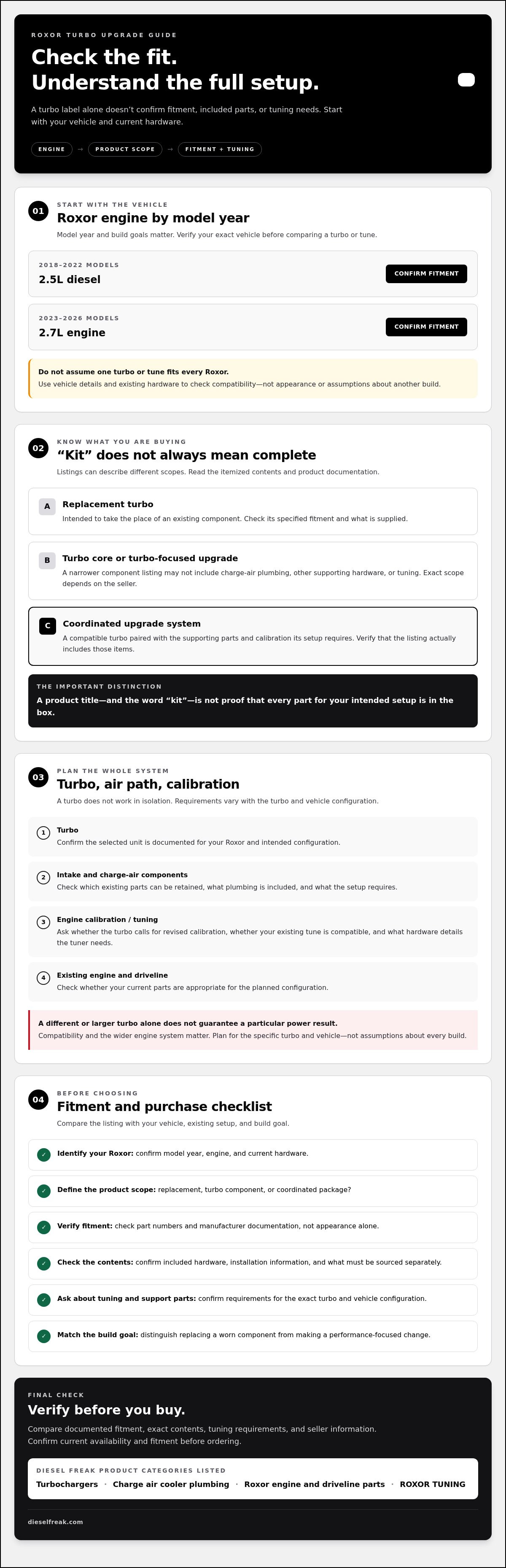
Roxor Turbo Kit Fitment Checklist: Verify These Details Before Buying
Fitment shouldn’t be a guess. Before ordering Roxor turbo upgrade kits or individual components, gather details about your vehicle and the product, then get compatibility confirmed. A familiar-looking part or a forum post isn’t a substitute for application information from the seller or manufacturer.
What vehicle and existing setup details should you gather?
Build a clear snapshot of your Roxor before asking for fitment help. Record its model year and engine identification, along with any previous turbo, tuning, intake, or charge-air changes. If you’re unsure of a component’s name, take clear photos of the part and its labels. Don’t assume two Roxors share compatibility just because they look alike.
What questions should you ask the seller or installer?
Use this checklist before buying. Ask for answers tied to your vehicle and planned setup, rather than relying on a general “should fit” response.
- Confirm vehicle details. Provide the model year, engine identification, and any relevant vehicle details the seller requests.
- Describe the current setup. List existing turbo hardware, tuning changes, and related modifications. Share photos and component labels when they can help identify what’s installed.
- Verify the exact part. Compare the listing’s part number with manufacturer documentation. Ask whether the component is specified for your Roxor configuration. Appearance alone doesn’t confirm interchangeability.
- Get the contents itemized. Ask what comes with the product and what must be sourced separately. Confirm whether charge-air plumbing, intake parts, or other supporting hardware are included or required.
- Check installation and calibration needs. Ask for documented installation instructions and whether the selected setup calls for a calibration change. Confirm who can verify that requirement for your vehicle.
- Check intended-use requirements. If the Roxor will be used on public roads or in a location with emissions rules, verify the applicable requirements for the vehicle, parts, and intended use before purchase.
Save this rule: Match the part number, vehicle details, package contents, and documented requirements before you order. If any detail is unclear, pause and ask the seller or manufacturer to confirm it in writing.
Review its Roxor parts and tuning offerings, then confirm current availability and exact fitment before ordering.
Choose a Roxor Turbo Upgrade Path and Take the Next Step
The right path starts with what your Roxor needs, not with a product label. If you’re replacing a worn or failed component, focus on an exact-match replacement and confirm the part number. If you’re targeting a performance change, compare turbo-focused options alongside their documented tuning and hardware requirements. If the build involves several changes, plan the full system before buying parts one at a time.
Keep the decision grounded in verified information. For each option, confirm your vehicle details, fitment, itemized contents, and any calibration or supporting-part requirements. If a listing doesn’t answer those questions, get clarification before adding it to your shortlist.
Build your shortlist around verified information
Put the same questions to every seller: Does this fit my model year and engine? What exactly is included? Are supporting components or tuning required? What documentation confirms the application? Keep the answers together so you can compare options fairly, rather than weighing an incomplete listing against a fully documented setup. For broader vehicle background, see this Mahindra Roxor guide.
A confirmed replacement, a turbo-focused upgrade, and a broader build plan serve different goals. None is automatically the best choice for every owner. Match the scope to your intended use, current configuration, and the information the manufacturer or seller can verify. Then confirm current availability, package contents, and compatibility before ordering.
Explore Diesel Freak’s relevant Roxor categories
Diesel Freak lists turbochargers and ROXOR TUNING, along with Roxor engine and driveline parts. These categories are relevant places to investigate as you map out a setup, but they don’t confirm that a specific Roxor kit is currently available or that a particular combination fits your vehicle. Check the current listing and verify the details before you commit.
Ready to compare relevant categories? Explore Diesel Freak’s Roxor and turbo parts, then confirm the exact product, fitment, contents, and tuning requirements for your build.
Build Your Roxor Upgrade With Confidence
The right choice depends on the job. A replacement part addresses a component need, while a turbo-focused upgrade or broader build calls for a closer look at fitment, included hardware, and calibration. Before choosing among Roxor turbo upgrade kits, confirm your Roxor’s details and ask the seller or manufacturer to verify compatibility and exact package contents.
Keep tuning and supporting parts in the same conversation as the turbo. A part that fits on paper still needs to make sense for your existing setup and build goals. Verify current availability, too, rather than assuming a listing describes a complete system.
Diesel Freak is family-owned and operated, and was founded in 2009. Its offerings include turbochargers, Roxor engine and driveline parts, and ROXOR TUNING. Explore Diesel Freak’s Roxor and turbo parts, then confirm what’s currently available and whether it matches your vehicle before ordering.
Frequently Asked Questions
What does a Roxor turbo upgrade kit usually include?
There’s no guaranteed standard set of parts: “kit” can mean different things depending on the seller. A listing might include a turbocharger and related hardware, or describe a narrower collection of components. Check the itemized contents, installation documentation, fitment details, and whether tuning or supporting parts are included or sold separately. If the package description is unclear, ask the seller to confirm exactly what you’ll receive before ordering.
Will a turbo upgrade fit every Mahindra Roxor model year?
No. Don’t assume a turbo fits every Roxor just because the vehicle name matches. The 2018-2022 models use a 2.5L diesel, while 2023-2026 models use a 2.7L engine, so confirm the product’s stated application against your model year and engine. Existing modifications can matter, too. Check manufacturer documentation and ask the seller to verify your exact configuration before buying.
Can I upgrade a Roxor turbo without changing the tune?
Possibly, but don’t assume the existing calibration will suit a different turbo. Whether a tune change is required depends on the specific turbo, engine, and vehicle setup. Check the product documentation and confirm the requirement with the turbo seller or tuning provider before installation. Also ask whether a tune described in a listing is included or must be sourced separately. Verify the calibration plan rather than guessing.
Do Roxor turbo upgrades require an intercooler or other supporting parts?
Not every setup requires the same supporting components. Requirements depend on the selected turbo, Roxor configuration, and manufacturer guidance. Ask whether the product calls for an intercooler, specific charge-air plumbing, intake parts, or other hardware, and whether those components are included. Don’t buy complementary parts based only on another owner’s build. Verify installation and tuning requirements for your own setup before assembling a parts list.
How do I check whether a turbo listing fits my Roxor engine?
Start with your model year and engine identification, then note the turbo and related modifications already installed. Compare those details with the listing’s stated application, part number, and manufacturer documentation. Photos of existing components and labels can help a seller assess a fitment question, but appearance alone isn’t proof. Ask for confirmation tied to your exact vehicle and configuration before ordering, especially if the listing leaves out engine or year details.
Is a turbo core assembly the same as a complete turbo upgrade kit?
No. A turbo core assembly describes a turbo component, while a complete upgrade package should have its included parts clearly itemized. A core listing may not include charge-air plumbing, tuning, installation hardware, or other supporting components. Read the contents rather than relying on the word “kit” in a product title. Ask the seller what’s supplied, what’s separate, and which additional requirements apply to your Roxor.
Can a turbo upgrade affect Roxor reliability or emissions compliance?
It can affect how the engine operates, especially if the turbo, calibration, and supporting components aren’t compatible. No part label alone guarantees a particular reliability outcome. Before buying, confirm the manufacturer’s requirements and consider how the planned setup matches your vehicle’s intended use. Emissions rules can depend on the part and where or how the vehicle is used, so check applicable requirements before purchase and installation.
Disclaimer
Diesel Freak LLC is in no way associated, sponsored, or affiliated with Any OEM manufacturer. Products from Diesel Freak LLC presented in this listing are not to be confused with any of the products or trademarks of any OEM company. All parts listed to fit these manufacturers are replacement aftermarket parts.