

Visibility isn't a luxury; it is a tactical requirement for every heavy-duty operator. Your engine might have the torque to move mountains, but a single layer of dried salt or thick mud can shut you down in seconds. You need a windshield washer reservoir that doesn't just hold fluid. You need a component that survives the constant vibration of a diesel engine and the brutal impact of off-road terrain. Generic, thin-walled plastic tanks fail when the pressure hits. They crack. They leak. They leave you staring at a brown smear across your glass while you're hauling eighty thousand pounds.
You know the frustration of a clogged pump or a mounting bracket that snaps under pressure. It's time to stop settling for parts that weren't built for your lifestyle. This guide promises to turn you into an expert on heavy-duty vision systems. You will learn how to choose a reservoir that stands up to mechanical abuse and ensures uninterrupted visibility in the harshest environments. We cover everything from diesel-specific fitments to high-density materials that won't quit when the road gets rough. Get ready to upgrade your rig with parts that match your grit.
Key Takeaways
- Stop treating your fluid tank as an afterthought. It is the heart of a tactical visibility system that keeps you moving through mud and grime.
- Cheap plastic cannot handle the heat. Learn why vibration and thermal cycles cause generic tanks to crack and leak when you need them most.
- Spot the signs of a dying windshield washer reservoir early. Avoid pump burnout and electrical failure by identifying corrosion before it shuts you down.
- Keep your lines clear with professional maintenance. Regular flushes and lead inspections ensure your spray hits the glass every single time.
- Upgrade to gear built for the long haul. Choose hardware designed for the raw power of Class 8 trucks and the grit of off-road trails.
What is a Windshield Washer Reservoir and Why It Matters
Visibility is a tactical requirement. It isn't just about comfort; it's about keeping your rig on the road and out of the ditch. The windshield washer reservoir is the pressurized storage unit that serves as the heart of your visibility maintenance system. It holds the line against road grime, salt spray, and thick mud. If this component fails, your wipers are just dragging sandpaper across your glass. You need a system that delivers fluid under pressure every single time you hit the switch. Build it tough or stay home.
The Anatomy of a Reservoir System
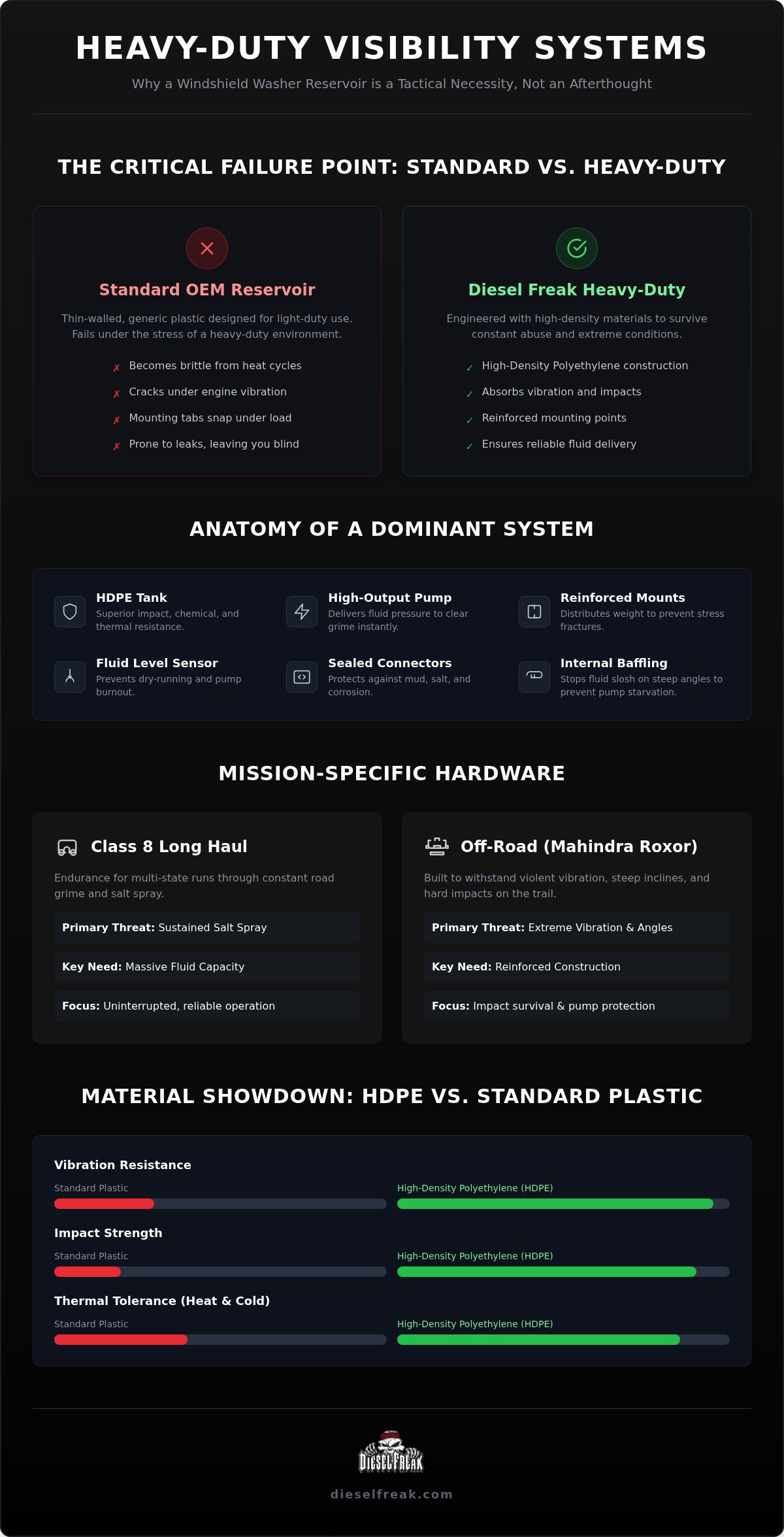
Build quality matters when the terrain gets ugly. The anatomy of a rugged reservoir starts with a high-density polyethylene tank. This material offers superior impact resistance. It handles the extreme heat cycles found under the hood of a diesel engine without becoming brittle. Next is the washer pump. This is the mechanical muscle of the system. It must generate enough force to clear the entire sweep of the blade instantly. Finally, integrated fluid level sensors provide the data you need. They ensure you know exactly when your windshield washer fluid levels are dropping. Don't wait for a dry pump to tell you it's time for a refill. Precision sensors keep you ahead of the grime.
Class 8 vs. Off-Road Needs
Heavy-duty hardware isn't one-size-fits-all. Class 8 trucks require massive capacity for long-haul endurance. These drivers face hours of salt spray on winter highways. They need a windshield washer reservoir that holds enough volume to get through a multi-state run without constant stops. Reliability on the interstate is about volume and pump longevity.
Mahindra Roxor owners face a different beast entirely. Trail riding involves violent vibration and steep angles. A standard tank will slosh, starve the pump, or simply crack at the mounting points. Universal parts are usually built for light-duty cars. They are under-engineered for the raw power and environmental abuse of a diesel rig. You need a design that stays mounted when the trail gets rough. Look for reinforced mounting tabs and thick-walled construction. These aren't just accessories. They are essential components of a complete visibility system designed for mechanical superiority. Stop settling for generic plastic that snaps under pressure.
Durability Standards: Why Quality Construction Wins
Vibration is the silent assassin of the engine bay. It’s the primary reason standard plastic components fail. A standard windshield washer reservoir made from thin-walled plastic cannot handle the constant resonance of a high-torque diesel engine. Over time, those vibrations create microscopic stress fractures. Add in the brutal heat cycles of a hard-working engine and you have a recipe for disaster. Cheap tanks embrittle. They turn from flexible containers into fragile shells. When you hit a washboard trail or a rough stretch of interstate, they shatter. You need hardware that absorbs energy instead of breaking under it.
Don't settle for "standard" plastic. High-density polyethylene (HDPE) is the industry benchmark for a reason. As of August 2026, HDPE remains the professional choice for heavy-duty builds because it offers the chemical resistance needed to survive concentrated de-icers and harsh washer fluids. Unlike cheap polypropylene alternatives, HDPE maintains its structural integrity under extreme thermal stress. It stays flexible in sub-zero temperatures and won't sag when the engine bay gets hot. It absorbs impact instead of cracking. It’s the difference between a part that lasts a season and one that lasts a decade.
Engineered for the Long Haul
Durability isn't just about the tank material. It’s about the connection points. Look for reinforced mounting tabs that distribute weight evenly across the bracket. If the tabs are thin, they will snap under the weight of a full fluid load. Sealed electrical connectors are just as vital. Mud and salt spray create a "green crust" of corrosion that kills pumps and sensors. UV resistance is another non-negotiable for off-road rigs. If your reservoir is exposed on a custom mount, the sun will bake it until it fails. Our gear is built to outlast the vehicle it’s bolted to.
Performance Under Pressure
Off-road maneuvers mean fluid slosh. Without internal baffling, your pump will suck air when you're at a steep angle. This leads to dry-running and eventual pump burnout. High-output pumps require reservoirs that can handle internal burst pressure without bulging or leaking at the seams. Your visibility system should be as robust as your diesel performance parts. If you want a setup that survives the abuse, you need hardware designed by specialists who actually hit the trail. Check out our heavy-duty diesel hardware to see the difference for yourself. Stop replacing the same weak parts and start building for dominance.
Common Failures: Why Your Fluid Reservoir Quits
Your windshield washer reservoir is a battle-hardened component, but even the best gear has a breaking point. Failure usually starts small. A hairline fracture. A slight drip. Before you know it, you’re out of fluid and out of luck. Road shock is the primary culprit. Every mile of washboard trail sends shockwaves through the mounting tabs. Eventually, the plastic gives way. Age doesn't help. Years of UV exposure and chemical contact turn your tank into a liability. If you see a blue puddle under your rig, the clock is ticking.
Pump burnout is the next major threat. Most pumps rely on the fluid itself for cooling and lubrication. Run that tank dry too many times and the internal seals overheat. The motor seizes. You’re left with a silent switch and a dirty windshield. Contaminated fluid is just as dangerous. Dirt and sediment settle at the bottom of the tank. The pump sucks it up and grinds its internal gears to dust. Keep your fluid clean or pay the price in replacement parts. Mechanical superiority requires clean inputs.
Clogged nozzles and sensor malfunctions round out the list of common headaches. Sediment doesn't just kill pumps; it plugs the spray heads. If your pump hums but nothing hits the glass, you’ve got a blockage. Meanwhile, corrosion is eating your electrical interface. Salt and moisture create a high-resistance bridge at the connector. Your sensor might report a full tank when you’re bone dry. Trust your eyes, not just the dash lights. If the system feels off, it probably is.
Diagnosing the Leak
Stop guessing and start inspecting. A visual check of your windshield washer reservoir is your first line of defense. Look closely at the seams and mounting tabs. These are the high-stress areas where cracks usually form. Next, test the pump. Turn the key and hit the washer switch. Listen for the mechanical hum. If it’s silent, check your fuses and electrical leads. If it’s loud but no fluid moves, look for a kinked or disconnected hose. Sometimes the tank is solid, but a loose line is bleeding your system dry.
Environmental Impact on Hardware
Nature wants to destroy your gear. Extreme cold is a primary killer. If you don't use a winter-grade mix, the fluid expands as it freezes. This internal pressure ruptures the tank walls instantly. Extreme heat is just as brutal. It warps the plastic and degrades the rubber seals at the pump interface. Grit and mud are the constant enemies of your mahindra roxor components. Fine silt finds its way into every crevice. It acts like liquid sandpaper on your pump and clogs your nozzles. Protect your vision by understanding the environment you’re conquering.
Maintenance and Upgrades for the Gritty Life
Maintenance isn't a chore. It is an insurance policy for your vision. A neglected windshield washer reservoir becomes a breeding ground for sediment and chemical scale. This grit eventually migrates to your pump and nozzles, causing total system failure when you're miles from the nearest shop. Don't treat your hardware like a disposable toy. High performance requires proactive care. Flush the system annually to clear the sludge that settles at the bottom of the tank. While the hood is up, inspect the electrical leads. Look for the "green crust" of corrosion. This oxidation blocks current and kills pump pressure. Clean the contacts and apply dielectric grease to lock out moisture. Move fast. Stay sharp.
If your factory spray feels weak, it’s time to upgrade. High-output pumps deliver a more consistent, forceful spray pattern. They cut through heavy mud and salt crust faster than stock units ever could. Match your hardware to your environment by selecting the right fluid for your specific climate. High-performance concentrates offer superior cleaning power compared to the cheap, watered-down jugs found at gas stations. Better fluid means less work for your pump and a cleaner sweep for your blades. Precision starts with the right chemistry.
Step-by-Step System Flush
Do the job right or don't do it at all. Start by draining the remaining fluid completely. Never spray old, sediment-heavy fluid through your nozzles; you will only plug the spray heads. Disconnect the main supply line and let gravity empty the tank. Use distilled water to rinse out any internal debris. Avoid tap water, as the minerals create scale buildup that eventually chokes the pump. Finally, pull the pump and check the filter screen. If it is covered in slime or grit, clean it with a soft brush. A clear path is the only way to ensure maximum pressure.
Winterizing Your Rig
Cold weather is a silent killer of plastic components. Switch to low-temp concentrates well before the first freeze hits. If you wait until the mercury drops, the water in your lines has already expanded. Ensure the reservoir cap is sealed tight to prevent evaporation. Alcohol-based antifreeze components evaporate quickly, leaving you with plain water that will freeze and rupture the tank. Be careful when switching formulas. Never mix different brands or types of fluid without a full flush. Incompatible chemicals often react to form a thick, snot-like gel. This sludge will plug your entire system and require a complete teardown to fix.
Build a system that never quits on the trail. Explore our high-performance diesel hardware to keep your vision clear in the most brutal conditions.
Diesel Freak Gear: Built for Dominance
We don't just sell hardware. We live the diesel lifestyle. Since 2009, Diesel Freak has focused on raw performance and mechanical superiority. We understand the unique demands of Class 8 rigs and Mahindra Roxor builds because we are in the shop and on the trail every day. If a component can't survive the vibration of a heavy-duty engine or the impact of a rock crawl, it doesn't belong on your vehicle. Our parts are forged from grit and tested under real-world pressure. We aren't a generic retail outlet. We're your tactical partner in the pursuit of peak performance. Build it right. Build it to last.
True visibility requires a complete system. You can't rely on a weak windshield washer reservoir when the mud starts flying. We provide integrated solutions that include rugged windshields, heavy-duty wipers, and high-performance reservoirs. Each part is selected for its ability to dominate the environment. We know that custom rigs require custom knowledge. Our team offers expert support for specialized Mahindra Roxor builds, ensuring every bolt and bracket matches your power output. Don't settle for "good enough" when you're pushing the limits of your machine. Demand more from your gear.
The Diesel Freak Advantage
Reliability is our baseline. For Class 8 operators, our gear means staying compliant and keeping the glass clear during the longest hauls. For the off-road community, it means hardware that survives the abuse of the trail. We build for the long game. Our brand is rooted in the belief that mechanical superiority is earned, not bought. Every upgrade we offer is a step toward total dominance. We value hard work and raw capability. Experience the difference that comes from a brand built by enthusiasts for enthusiasts. We speak your language because we share your passion for iron and power. Join the community that values grit over everything else.
Final Steps for Your Rig
Prepare for the next challenge. Inspect your windshield washer reservoir before your next big haul or trail run. Look for the cracks and leaks that signal imminent failure. Upgrade your system now to ensure you never lose your line of sight when it matters most. While you are optimizing your visibility, don't neglect the heart of your engine. Explore our full line of performance upgrades, including the legendary borgwarner turbo and heavy-duty driveline parts. Build a rig that commands respect. Take action today and upgrade to the Diesel Freak standard. Your machine deserves nothing less than total mechanical dominance.
Dominate the Elements with Clear Vision
Your rig is built for power. Don't let a cracked windshield washer reservoir kill your momentum. High-density materials outlast cheap plastic. Routine maintenance keeps your spray patterns sharp. You now have the knowledge to spot failures before they leave you blind on the trail. Mechanical superiority isn't just about the engine. It's about every component working under pressure. Resilience is the only standard that matters when you're miles from civilization.
Since 2009, we've been the expert diesel performance shop for those who value grit. We test our parts in the shop and on the trail. They survive the abuse. Stop settling for generic hardware that wasn't designed for your machine. Equip your build with hardware that matches your ambition. Upgrade your rig with high-performance parts at Diesel Freak and take control of your visibility today. Push your machine to the limit. Never look back.
Frequently Asked Questions
How do I know if my windshield washer reservoir is cracked?
Check for fluid puddles under the engine bay or a tank that won't hold fluid for more than a day. Inspect the mounting tabs and seams for hairline fractures. These stress points often fail first due to diesel engine vibration. A visual inspection with a flashlight is the most reliable method. If you see blue or orange staining on the plastic, you've found your leak.
Can I repair a leak in the washer fluid tank or should I replace it?
Replace the tank immediately if you find a crack or leak. Patching high-density polyethylene with glue or tape is a temporary fix that will fail under the heat and vibration of a heavy-duty rig. A compromised windshield washer reservoir can't handle the internal pressure of the pump. Don't risk losing visibility on the trail for a cheap patch. Get a fresh unit built for mechanical superiority.
Why is my washer pump not spraying even if the tank is full?
Check for a clogged filter screen or a failed pump motor. If the pump hums but no fluid moves, you likely have a blockage in the lines or the nozzles. If there is no sound at all, inspect your electrical connectors for corrosion. Mud and salt often create high resistance at the plug. Clean the terminals and test the fuse before you tear the whole system apart.
Is a universal washer reservoir kit safe for a Class 8 truck?
Universal kits are rarely safe or effective for Class 8 trucks because they lack the capacity and reinforced mounting required for long-haul endurance. These generic parts often use thin plastic that shatters under the intense heat of a semi-truck engine bay. You need a reservoir designed for heavy-duty hardware. Commercial rigs demand parts that comply with safety regulations and survive the brutal reality of the interstate.
How often should I clean my windshield washer fluid reservoir?
Flush your system at least once a year to remove settled sediment and chemical buildup. If you frequently drive in muddy off-road conditions, increase this to every six months. Silt and grit settle at the bottom of the tank and eventually destroy the pump gears. A clean windshield washer reservoir ensures maximum fluid pressure and prevents nozzle clogs when you are deep in the woods or hauling heavy.
What causes the washer fluid sensor to give a false low reading?
Corrosion on the sensor probes or a stuck internal float is the most common cause of false readings. Over time, washer fluid additives can leave a film on the electrical contacts. This film creates a false signal that the tank is empty. Pull the sensor and clean it with an electrical contact cleaner. If the float is weighted down by grime, it won't rise with the fluid level.
Can cold weather cause my windshield washer reservoir to explode?
Cold weather causes fluid expansion which can rupture the tank walls if you aren't using winter-grade fluid. Standard summer mixes are mostly water and will freeze solid at thirty-two degrees Fahrenheit. As the water turns to ice, it expands with enough force to shatter high-density plastic. Always switch to a low-temp concentrate before the first freeze. This prevents catastrophic failure and keeps your vision clear in sub-zero temps.
Are there high-capacity reservoirs available for custom Mahindra Roxor builds?
Specialized high-capacity units are essential for custom Roxor builds that spend long days on the trail. Standard tanks are often too small for aggressive off-roading where mud is constant. Look for reservoirs that feature reinforced mounting brackets to handle the extreme vibration of off-road terrain. Upgrading to a larger, more durable tank ensures you have the fluid volume needed to conquer the grime without stopping to refill every hour.
Disclaimer
Diesel Freak LLC is in no way associated, sponsored, or affiliated with Any OEM manufacturer. Products from Diesel Freak LLC presented in this listing are not to be confused with any of the products or trademarks of any OEM company. All parts listed to fit these manufacturers are replacement aftermarket parts.