

Stop treating your VGT like a government-mandated anchor. It's a precision weapon designed for total engine dominance. You know the drill. You hit the throttle and wait for a spool that feels like it's taking years. Meanwhile, your EGTs are climbing fast and your fuel economy is tanking. It's frustrating to feel your Class 8 rig struggle under load. You need power that hits hard and stays there. You want a truck that responds the second you demand it.
Mastering your diesel semi truck variable geometry turbocharger is the only way to reclaim that lost performance and protect your bottom line. With VGTs projected to hold a 55% market share in 2026, this technology is the standard for modern power. We'll show you how to eliminate low-end lag and maximize your engine braking capability. This guide breaks down the mechanics of VGT technology, solves common actuator failures, and explores the plumbing upgrades needed for maximum Class 8 efficiency. Get ready to turn your turbo into a high-performance asset that dominates the road.
Key Takeaways
- Understand how shifting internal vanes deliver instant low-end response and massive top-end power.
- Kill low-end lag and crush dangerous EGTs during heavy hauls with precision-tuned airflow.
- Maximize your fuel economy and engine braking power by choosing the perfect diesel semi truck variable geometry turbocharger for your duty cycle.
- Prevent soot buildup and costly actuator failures using our pro-level maintenance checklist for high-performance hardware.
- Dominate the road with expert-backed performance upgrades and heavy-duty components built for Class 8 dominance.
What is a Diesel Semi Truck Variable Geometry Turbocharger?
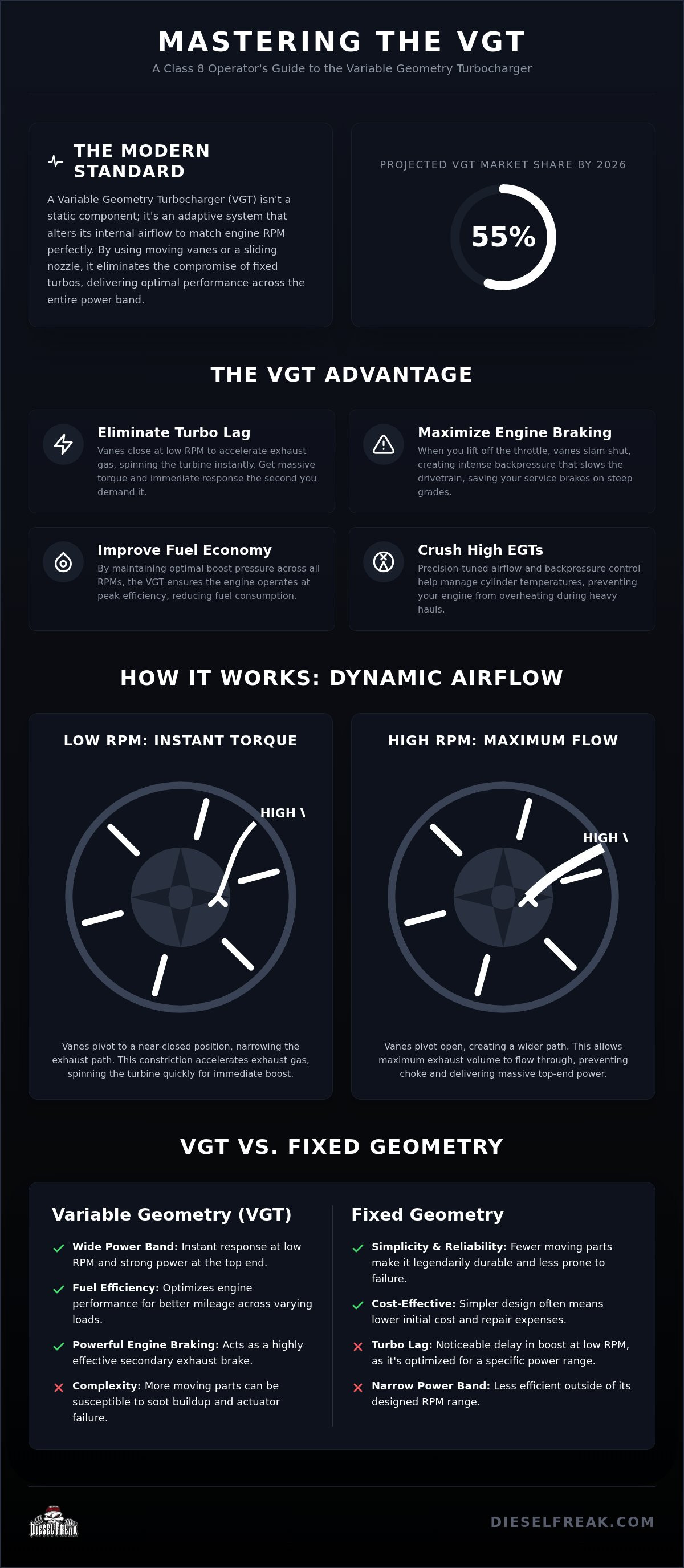
A Variable-geometry turbocharger is a precision weapon for your Class 8 engine. It isn't a static piece of cast iron. It's a living, breathing component that adapts to your right foot. Standard turbos are a compromise. They're either too small for the top end or too big for the start. A diesel semi truck variable geometry turbocharger solves this by altering its internal airflow to match engine RPM perfectly. It uses a series of moving vanes or a sliding nozzle to manage exhaust velocity. This technology is the modern industry standard. Experts project VGTs will hold a 55% market share by 2026. This isn't just about meeting EPA standards. It's about achieving maximum efficiency under every load.
The Death of Turbo Lag
Turbo lag is a performance killer. You've felt that gut-wrenching delay when pulling 80,000 pounds from a dead stop. You floor it. Nothing happens. Then, the boost finally hits. A VGT ends that cycle. When you're at low RPM, the internal vanes pivot to a closed position. This narrows the exhaust path and accelerates the gas. The turbine wheel spins up instantly. You get massive torque without the wait. This immediate response makes merging into highway traffic a breeze. It gives you the confidence to own the road. You aren't just driving; you're dominating. It improves driver comfort and keeps you moving when every second counts.
VGT and Engine Braking Power
Your turbo is your best friend on a descent. It acts as a powerful secondary exhaust brake. When you lift off the throttle on a grade, the electronic actuator slams the vanes shut. This creates intense backpressure inside the manifold. The engine has to work harder to push air out, which slows the entire drivetrain down. This braking effect is essential for heavy-duty hauling. It keeps your service brakes cool and ready for an emergency. You'll see fewer trips to the shop for brake jobs. You'll feel the difference in your pedal and your wallet. It's about raw mechanical dominance and keeping your rig in check on the steepest grades.
The Mechanics of Variable Geometry: Vanes, Nozzles, and Actuators
The diesel semi truck variable geometry turbocharger is a masterpiece of high-heat engineering. It doesn't just spin; it adapts. Inside the turbine housing, the geometry shifts in real time to squeeze every ounce of energy from your exhaust. This isn't just about raw power. It's about total engine efficiency and thermal management. Your ECM acts as the brain, monitoring boost and heat to protect your iron. For a technical deep dive, this in-depth review of VGT technologies highlights how these systems manage aerodynamic flow to crush emissions without sacrificing torque. By controlling backpressure, the VGT manages cylinder temperatures and prevents your engine from melting under a heavy haul.
Pivoting Vanes vs. Sliding Nozzles
Different manufacturers take different paths to dominance. Detroit Diesel and many Euro 7 compliant engines favor the Garrett-style pivoting vanes. These vanes tilt to change the angle of the exhaust hitting the turbine. Cummins relies on the Holset-style sliding nozzle. This design uses a single moving ring to choke or open the airflow. Sliding nozzles are legendary for durability. They have fewer moving parts to seize in high-soot environments. If you want a setup that survives a million miles of grit, the sliding nozzle is a heavy-duty favorite. Both designs aim for the same goal: maximum velocity at low RPM and maximum flow at the top end.
The Actuator: The Brain of the Boost
The actuator is the critical link between your truck's software and its hard parts. It translates digital commands into physical movement. By 2026, the industry has moved almost entirely to electronic actuators for faster response and tighter control. These units are more precise than old pneumatic setups. They allow the engine to react instantly to varying loads and integrate with modern hybrid architectures. Calibration is the most important step after any repair. If the actuator isn't calibrated to the turbo's physical limits, you risk mechanical failure or a limp-mode nightmare. Don't cut corners here. If you're building a beast, start with high-quality turbo chargers and components built to handle the pressure.
VGT vs. Fixed Geometry: Choosing Your Performance Path
Choosing your turbo is a battle between raw simplicity and high-tech dominance. A diesel semi truck variable geometry turbocharger is a complex beast. It offers a massive torque curve and better fuel economy across varying loads. This performance comes with a specific trade-off. Fixed geometry turbos are the old-school choice for reliability. They don't have moving vanes to clog with soot. They don't have expensive electronic actuators to fail. If your rig spends 99% of its life at a constant speed on flat ground, the trade-off for a VGT might not make sense. But for the modern fleet, the VGT is often the only path forward. It's essential for driving the Exhaust Gas Recirculation (EGR) systems required by current environmental mandates. The VGT creates the specific backpressure needed to force exhaust gases back into the intake, reducing NOx emissions while maintaining power.
When to Stick with a Wastegated Turbo
Simplicity is a virtue in rugged environments. A standard wastegated turbo uses a basic valve to bleed off excess boost. There are no pivoting vanes or sliding nozzles to seize. Maintenance is minimal. This setup is ideal for owner-operators who prioritize uptime over absolute efficiency. If you're hauling heavy on the open highway with few stops, a fixed geometry turbo provides a reliable, steady boost. It eliminates the complex plumbing and sensor arrays that can leave you stranded in the middle of nowhere. You lose the low-end snap, but you gain a component that is nearly bulletproof under constant high-speed hauling.
Why VGT Dominates the Modern Fleet
The industry is changing fast. On July 14, 2026, the EPA proposed even tighter amendments to heavy-duty engine compliance for model years 2027 and later. Meeting these standards requires the surgical precision of a VGT. These turbos deliver a superior torque curve that crushes stop-and-go lag. They make vocational trucks, like dumpers or mixers, feel like high-performance machines. You get better fuel economy because the turbo is always in its sweet spot. For a broader look at how these components fit into your build, check out our Diesel Performance Parts Guide for more context on heavy-duty power. Dominate the load. Don't let your turbo hold you back from peak efficiency.
Maximizing VGT Reliability and Performance
The "unreliable" label is a myth born from bad habits. A diesel semi truck variable geometry turbocharger isn't fragile. It's just demanding. Soot is the silent killer. It glues internal vanes in place and turns a high-performance component into scrap metal. You must stay ahead of the carbon buildup to keep your rig on the road. High-quality synthetic oil isn't a luxury; it's the lifeblood that keeps internal bearings from cooking under extreme heat. If you want maximum boost pressure, inspect your charge air cooler plumbing for leaks. Even a pinhole drop in pressure forces the turbo to overwork. This leads to premature failure and wasted fuel. Keep your plumbing tight to ensure every pound of boost reaches the cylinders.
Combating Soot and Carbon Buildup
Stop idling your rig to death. Excessive idling is a soot factory. It drops cylinder temperatures and creates thick, wet carbon that coats the turbo internals. You need to "exercise" the vanes regularly. This means getting the truck under load and letting the actuator move through its full range of motion. Heat is your friend. It burns off light deposits before they harden into stone. VGT cleaning is a critical preventative measure that involves using specialized solvents to strip carbon from the housing without a full teardown. Follow this checklist to prevent stuck vanes:
- Change oil every 15,000 to 25,000 miles based on your specific duty cycle.
- Avoid idling for more than 5 minutes whenever possible.
- Monitor boost levels for sudden drops or surging.
- Ensure the engine reaches full operating temperature under load daily.
Troubleshooting Actuator Failure
Actuators die in two distinct ways. You either have a mechanical jam or an electronic failure. If your engine braking suddenly vanishes, your actuator is likely the culprit. Sluggish boost response is another red flag. A mechanical jam happens when the vanes are physically stuck. The electronic actuator tries to move them, pulls too many amps, and fries its internal circuits. If the vanes move freely by hand but the actuator stays silent, the electronics are toast. Check out the Cummins Engine Performance Guide for specific tips on managing Holset-style systems. Don't let a dying actuator kill your efficiency. Address the symptoms before the hardware fails completely.
Dominating the Road with Diesel Freak Performance Parts
Diesel Freak isn't just a parts counter. We're your expert guide to mechanical superiority. Stock turbos are built for the average driver. You aren't average. You demand more. Our lineup of BorgWarner Turbo components delivers the durability your Class 8 rig needs to stay ahead. Choosing a diesel semi truck variable geometry turbocharger is a high-stakes decision. We help you master the specs to find the perfect match for your engine's duty cycle. From heavy hauls to high-speed runs, we provide the hardware that turns your truck into a precision weapon. It's about more than just boost. It's about owning the road with confidence. We understand the grit required to keep a rig running at peak potential.
Upgrading for Maximum Torque
OEM units are designed with compromises. Aftermarket VGT solutions push those boundaries. They offer better thermal management and faster spool times than standard factory hardware. You need more than just a bolt-on part. You need a system. Pairing a high-performance turbo with the right engine tuning is non-negotiable. This combination unlocks the full potential of your iron. Our expertise ensures you don't just buy a part; you buy a performance upgrade that works. We support your pursuit of peak mechanical potential with parts that handle the heat. Dominate every grade. Crush every deadline. Your truck should work as hard as you do. We provide the transformation your engine needs to dominate the competition.
The Diesel Freak Edge
We've been family-owned and operated since 2009. Grit is in our DNA. We don't just sell parts; we live the lifestyle. Our team specializes in performance tuning and heavy-duty hardware because we know what it takes to win on the road. We understand the thrill of high-performance machinery. It's a passion we share with every customer who visits our site. Our brand is built on strength and reliability. We provide a fellowship for those who value toughness and raw capability. Explore our full catalog of Class 8 Semi Truck Parts to find everything from turbos to charge air cooler plumbing. We balance reliability with a rebellious spirit that celebrates power. It's time to stop settling for generic components. You deserve hardware that reflects your drive. From the engine bay to the Diesel Freak apparel you wear, we represent the best in diesel performance. Upgrade your boost at Diesel Freak today and join a community that values mechanical dominance above all else.
Take Control of Your Boost
Your rig deserves more than factory-grade compromises. A diesel semi truck variable geometry turbocharger is the key to unlocking instant torque and massive engine braking power. You've learned how shifting vanes crush lag and why keeping your oil clean is the ultimate defense against soot buildup. Don't let a seized actuator or a pinhole leak in your plumbing rob you of Class 8 dominance. You need hardware that works as hard as you do. It is time to stop waiting for boost and start demanding it.
Diesel Freak has been family-owned and operated since 2009. We live for the thrill of high-performance machinery. Our team provides specialized performance tuning solutions and expert technical support for Class 8 rigs. We don't just sell parts; we build legends. Push your boundaries and achieve the highest level of performance possible. Shop High-Performance Class 8 Turbochargers at Diesel Freak and reclaim your power today. Keep the hammer down and stay gritty.
Frequently Asked Questions
What are the main symptoms of a failing VGT turbo?
Sluggish low-end response and a complete loss of engine braking are the primary red flags. You might also see a sudden spike in exhaust gas temperatures (EGTs) or a "limp mode" warning on your dash. If your diesel semi truck variable geometry turbocharger isn't spooling correctly, your fuel economy will plummet instantly. Watch for thick black smoke during acceleration. This signals that your air-to-fuel ratio is out of balance because the vanes are stuck.
Can a VGT turbo be replaced with a fixed geometry turbo?
You can swap a VGT for a fixed geometry turbo, but it requires a specialized conversion kit and custom software tuning. This process is often called a "VGT delete." While it simplifies the mechanical setup, you will lose the low-end torque and integrated engine braking that the VGT provides. You must also ensure the new setup remains compliant with local emissions regulations. Most modern rigs require the VGT to drive the EGR system properly.
How much does a VGT actuator repair typically cost?
Repair costs vary significantly based on whether you are replacing the electronic actuator or the entire turbo unit. Rebuilt components offer a more affordable path, while brand-new, high-performance models sit at the top of the price range. Labor costs at heavy-duty shops also fluctuate by region and engine complexity. Always factor in the cost of professional calibration. A miscalibrated actuator will lead to another failure and more downtime. Avoid cheap, unbranded actuators that lack durability.
Why is my VGT turbo making a high-pitched whistling sound?
A high-pitched whistle usually indicates a boost leak in your charge air cooler plumbing or a failing compressor wheel. Check all your boots and clamps for small tears or loose connections first. If the plumbing is tight, inspect the turbo inlet for "dusted" blades or shaft play. An exhaust leak at the manifold can also create a similar sound. Address this immediately. A small leak forces the turbo to overspin, which leads to a catastrophic mechanical meltdown.
How often should I clean the vanes on my variable geometry turbo?
Cleaning frequency depends entirely on your duty cycle and how much time you spend idling. High-idle applications may need a specialized VGT cleaning every 100,000 miles to prevent soot from seizing the vanes. Long-haul trucks that stay under heavy load often keep the internals cleaner through high exhaust heat. If you notice a slight delay in boost response, it's time for a service. Regular "exercising" of the vanes under load helps extend the cleaning interval.
Does a VGT turbo improve fuel economy on Class 8 trucks?
Yes, a VGT improves fuel economy by keeping the turbocharger within its most efficient operating map across the entire RPM range. Unlike fixed turbos that only peak at a specific speed, the VGT adapts to the load. This prevents the engine from lugging or over-fueling during low-speed starts. By optimizing airflow, you maximize the energy extracted from every drop of fuel. This is essential for maintaining profitability in modern, high-performance Class 8 operations.
What is the difference between a VGT and a VNT turbocharger?
Variable Geometry Turbocharger (VGT) is the broad industry term, while Variable Nozzle Turbine (VNT) is a specific trademarked design by Garrett. Both technologies achieve the same goal of altering exhaust flow to match engine demand. VGT often refers to the sliding nozzle designs used by Holset, whereas VNT typically describes the pivoting vane systems. Regardless of the name, the core purpose is providing a wide power band without the compromise of a fixed turbine housing.
Can I tune my VGT for more horsepower without breaking the engine?
You can absolutely tune your VGT for more horsepower, but it requires a precision touch to avoid melting your engine. Proper tuning coordinates the vane position with fuel delivery to maintain safe cylinder pressures. Diesel Freak specializes in these performance tuning solutions to ensure you get maximum torque without sacrificing reliability. Increasing boost without monitoring your EGTs is a recipe for disaster. Always pair hardware upgrades with professional-grade software to dominate the road safely.
Disclaimer
Diesel Freak LLC is in no way associated, sponsored, or affiliated with Any OEM manufacturer. Products from Diesel Freak LLC presented in this listing are not to be confused with any of the products or trademarks of any OEM company. All parts listed to fit these manufacturers are replacement aftermarket parts.