

Your engine’s biggest enemy isn’t the load in the trailer or the grade of the mountain pass. It’s the suffocating heat trapped inside your own iron. You didn’t buy a heavy-duty diesel to spend your Saturdays chasing coolant leaks or staring at a derated dash. We get it. Emissions hardware often feels like a leash on your raw horsepower. It is a gritty, complex reality that every driver has to face. When your egr cooler starts to fail, it doesn't just steal your throttle response. It threatens to blow your head gaskets and leave you stranded.
Most standard units only last about 80,000 miles before they start to crack under the pressure. You shouldn't have to guess when your hardware is about to quit. This guide is your tactical manual for heat management. We are going to help you master the mechanics of your cooling system and spot failure symptoms before they turn into a total engine meltdown. You will learn the difference between factory parts and high-performance upgrades that actually hold up. Stop letting unplanned downtime bleed your revenue dry. It’s time to take control of your engine’s durability and protect your power.
Key Takeaways
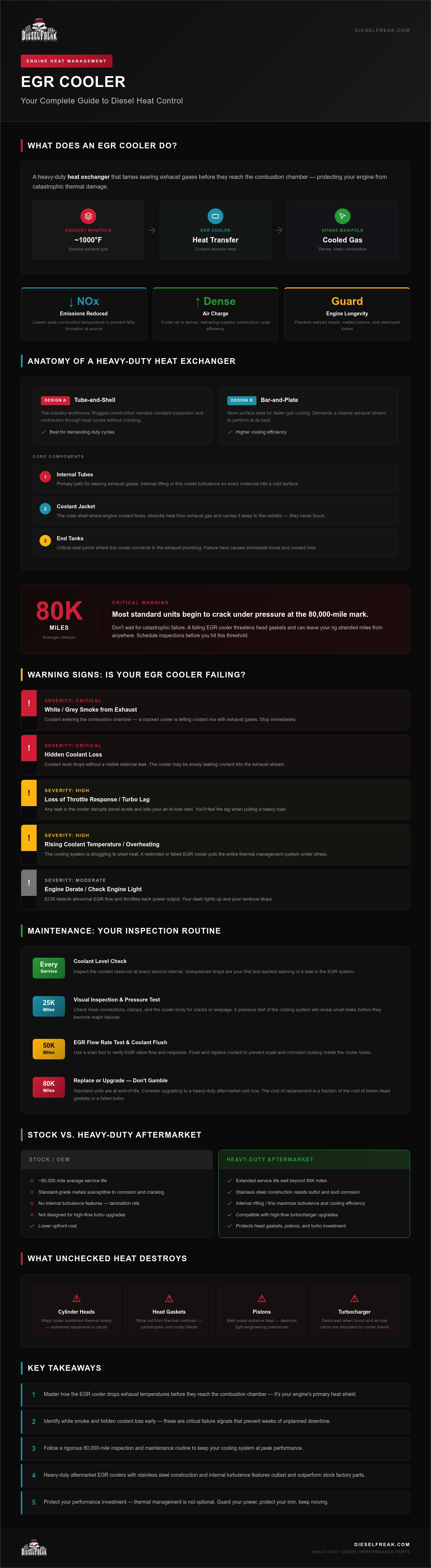
- Master the mechanics of how the egr cooler protects your engine by dropping exhaust temperatures before they reach the combustion chamber.
- Identify critical failure symptoms like white smoke and hidden coolant loss to prevent unplanned downtime and expensive repairs.
- Follow a rigorous 80,000-mile maintenance and inspection routine to keep your cooling system running at peak performance.
- Learn why upgrading to heavy-duty aftermarket components provides the durability that standard factory parts lack.
- Gain the confidence to manage engine heat effectively and ensure your diesel power stays reliable under the toughest loads.
What is an EGR Cooler and Why Does Your Rig Need One?
Think of your engine as a beast that breathes fire. But even the toughest iron has a breaking point. The egr cooler acts as a heavy-duty heat exchanger designed to tame that heat. It pulls searing exhaust gases away from the manifold. It drops their temperature fast. This cooled gas then flows back into the intake. Why does this matter? It's about physics. Cooler air is denser air. When you pack dense air into your cylinders, you get a superior combustion cycle. This results in lower NOx emissions and a more efficient engine. Without this part, your rig would run dangerously hot. We are talking about catastrophic internal damage. It sidelines your truck for weeks.
The Role of NOx Reduction in Modern Diesel Engines
Exhaust gases create a nasty byproduct called Nitrogen Oxides (NOx) during high-heat combustion. These are toxic pollutants that regulators hate. The Exhaust Gas Recirculation (EGR) system is the industry standard for keeping those levels in check. By diluting the fresh intake air with inert, cooled exhaust gas, the system lowers the peak temperature of the combustion event. This prevents the formation of NOx at the source. You stay compliant with national emissions standards. You don't have to sacrifice your torque to do it. It is a balancing act between environmental rules and the raw pulling power you need to get the job done.
Why Heat is the Enemy of Diesel Performance
Thermal loads are the primary enemy of every high-performance diesel engine. When temperatures go rogue, they break chemical bonds. They create engine-killing pollutants. This isn't just a minor issue. Excessive heat will warp cylinder heads. It will melt pistons. It will destroy your turbos. Your engine depends on tight tolerances to generate massive torque. Heat destroys those tolerances. A functional egr cooler protects your investment in diesel performance parts. You want your Cummins or Detroit Diesel to live a long, productive life. That requires managing the thermal load every single mile. Performance doesn't mean anything if your engine can't survive the heat. Guard your power. Protect your iron. Keep that cooling system in top shape.
How the EGR Cooling Process Actually Works
Exhaust gas leaves the manifold at temperatures that would melt a lesser machine. It enters the egr cooler through a series of hollow internal tubes. At the same time, engine coolant is pumped into a separate chamber surrounding those tubes. They never touch. They just fight. This is pure thermal transfer. The coolant absorbs the brutal heat from the gas and carries it away to the radiator. It is a high-speed trade. Heat leaves the gas. Coolness enters the mix. This ensures the air hitting your cylinders is ready for a clean, controlled burn. It keeps your combustion temperatures within a safe range for your iron.
The Anatomy of a Heavy-Duty Heat Exchanger
Stainless steel construction is the gold standard for these components. It resists the corrosive sulfur and soot that eat through cheaper metals. You will generally find two main architectures under the hood. The tube-and-shell design is the workhorse of the industry. It is rugged. It handles the constant expansion and contraction of heat cycles without cracking. The bar-and-plate design offers more surface area. It cools gas faster but demands a cleaner exhaust stream. High-performance egr cooler units often feature internal rifling or fins. These small details create massive turbulence. Turbulence prevents hot gas from "laminating" or sliding through the center of the tube without cooling. You want every molecule of gas to hit a cold surface before it moves on.
- Internal Tubes: The primary path for searing exhaust gases.
- Coolant Jacket: The outer shell where engine coolant flows to absorb heat.
- End Tanks: Critical seal points where the cooler connects to the exhaust plumbing.
Integration with the Turbo and EGR Valve
This component sits in the direct line of fire between your turbocharger and the intake manifold. The EGR valve is the brains of the operation. It uses precise timing to decide when to dump cooled gas back into the combustion chamber. If you’ve upgraded to a high-flow borgwarner turbo, this integration becomes even more vital. Any leak in the cooler disrupts your boost levels. It kills your air-to-fuel ratio. You’ll notice the lag immediately. It robs you of the torque you need to pull a heavy load.
Maintaining California Air Resources Board emissions standards isn't just about the environment. It’s about keeping your system sealed so your turbo can do its job. When the system is tight, your rig breathes better. It pulls harder. Don't settle for weak factory plumbing when you can run professional-grade Class 8 semi truck parts that are built for the long haul. Keep your plumbing sealed and your heat managed to ensure your engine stays in the fight.
Warning Signs: How to Tell if Your EGR Cooler is Failing
Your truck speaks a language of vibrations and smells. Ignore it, and you will pay the price in iron and sweat. A failing egr cooler is a silent assassin. It starts with small glitches. Then it drains your bank account. You need to know the red flags before the metal starts to scream. Iron doesn't lie. If something feels off, it usually is. Catching these symptoms early is the difference between a quick swap and a total engine rebuild. Don't let your rig lie to you. Watch the gauges. Smell the air. Stay ahead of the failure.
White smoke from the tailpipe is the classic warning. This isn't just steam on a cold morning. It is a thick, sweet-smelling cloud. It means coolant is leaking past the internal seals and burning in your cylinders. If your exhaust looks like a fog machine, your cooler is cooked. You should also watch your coolant reservoir. Mysterious coolant loss is a major red flag. If the level is dropping but there is no puddle on the pavement, your engine is drinking the fluid. The leak is internal. The heat is pushing that coolant straight into the combustion cycle.
Look for gooey black buildup in the intake. When carbon soot mixes with leaking coolant, it creates a thick sludge. This "black death" chokes your intake manifold and clogs your valves. It kills your airflow and kills your power. Finally, watch for engine overheating. When the egr cooler is blocked by internal scaling or soot, the exhaust heat has nowhere to go. It stays in the block. Your cooling system will struggle to keep up. The needle spikes. Your head gaskets are now in the line of fire. Many of these engineering failures are explained by the tight tolerances found in an EGR cooler design patent. These units are complex. One small crack ruins the whole ecosystem.
The Danger of Hydro-Locking Your Engine
Liquid does not compress. This is a hard rule of physics. If your internal leak is bad enough, coolant can fill a cylinder while your truck is parked. You turn the key. The piston rises and hits a wall of liquid. Something has to give. Usually, it is your connecting rods. They will snap or bend instantly. This turns your block into a very expensive paperweight. Identify the leak early. Save your cummins engine performance parts from a drowning death. High-performance iron deserves better than a catastrophic failure caused by a cheap seal.
Performance Loss and Limp Mode
Modern ECUs are designed to protect the engine from your own right foot. If the computer detects a cooling failure, it will throttle your power. This is limp mode. You will notice a massive drop in boost pressure. Your throttle response will feel sluggish and heavy. The "Check Engine" light isn't a suggestion. It is a warning. It is trying to save your paycheck. Don't try to power through it. A derated engine is telling you that the thermal load is too high. Pull over. Inspect the hardware. Protect your power before the computer shuts you down completely.
EGR Cooler Maintenance: Keeping the Heat Under Control
Maintenance is a survival strategy for your rig. It isn't a suggestion. Your engine is a high-pressure environment that demands respect. Stick to a strict 80,000-mile inspection interval for heavy-duty rigs. This is the verified danger zone for factory hardware. You need to pull the unit and inspect the core. Look for soot buildup. Look for internal dampness. If you ignore this window, you are just waiting for a massive tow bill. Monitor your oil for a "milkshake" consistency every time you pull the dipstick. If your oil looks like a latte, you have a cross-leak. Stop the engine immediately. That mixture will shred your main bearings in minutes. It turns a simple repair into a total loss.
Carbon coking is another silent killer. It is a thick, baked-on layer of soot that chokes your passages. It restricts flow. it builds up backpressure. Clean the EGR valve and the egr cooler passages every 50,000 miles to keep the air moving. A clean system is a cool system. When the air flows freely, your thermal loads stay manageable. This prevents the heat from soaking into the block and warping your iron.
Why Coolant Quality is Non-Negotiable
Cheap coolant is a death sentence for your heat exchanger. It is often full of minerals that create internal scaling. These deposits act as insulation on your stainless steel tubes. Heat can't escape the exhaust gas. It gets trapped. This leads to localized hotspots where the metal expands too far and snaps. Use only high-quality, manufacturer-approved coolant. It is the cheapest insurance you can buy for your egr cooler. Don't cut corners on the fluid that keeps your engine alive. Keep the chemistry balanced to prevent internal erosion.
Cleaning vs. Replacing Your Cooler
Sometimes you can save a clogged unit. Ultrasonic cleaning uses high-frequency sound waves to blast carbon out of the internal passages. It is effective for cores that are simply "sooted up." But it won't fix a structural failure. If you see any signs of internal pitting or corrosion, the unit is trash. Replacement is the only safe bet for a working truck. You don't want to risk hydro-locking your block over a salvaged part. Check out our guide on cummins x15 performance parts for more maintenance tips. We know what it takes to keep these machines in the fight. If your hardware is failing, don't wait for a breakdown. Grab the high-strength Class 8 semi truck parts you need to dominate the road and protect your power.
Performance Solutions: Beyond the Fragile Stock Cooler
OEM coolers are built for accountants. They are designed to meet a price point on an assembly line. They are not designed for the driver who pushes 80,000 pounds over a mountain pass in July. Standard factory units use thin-walled tubes and basic soldering. This is why they fail. Upgrading your egr cooler is a tactical choice for your engine’s survival. It is a proactive move that ensures long-term health. A high-performance unit doesn't just sit there. It supports better overall engine efficiency. It lowers your Exhaust Gas Temperatures (EGTs). It keeps your iron in the fight when others are pulled over with a steaming hood.
What Makes a Cooler 'Performance Grade'?
Performance grade hardware starts with the metal. Look for units built from high-grade stainless steel alloys like 304 or 316. These materials handle the brutal heat-cycling of long-haul trucking without becoming brittle. Engineering matters too. Aftermarket 'performance' coolers often feature thicker internal walls. They use TIG welding instead of furnace brazing. This creates a bond that resists vibration and thermal expansion better than any stock part.
Internal tube design is the secret to durability. Some high-end units use larger diameter tubes or internal rifling. This prevents soot from sticking to the walls. It stops the "coking" process before it starts. Better heat transfer rates are the result. This allows you to run more aggressive tuning without the fear of overheating. You get the torque you want. You get the reliability you need. It is the ultimate upgrade for any serious rig.
- Reinforced Welds: TIG welding prevents leaks at the end tanks.
- Thick-Walled Tubing: Resists cracking during extreme temperature swings.
- High-Flow Architecture: Reduces backpressure and improves turbo response.
The Future of Diesel Emissions and Performance
The industry is changing. Efficiency is no longer optional. Tuning your rig for maximum fuel economy and power requires a cooling system that can keep up. You cannot expect a fragile factory cooler to handle the increased thermal loads of a high-output tune. It won't happen. The smart play is to build a high-performance ecosystem. Combine a rugged egr cooler with a high-performance turbocharger and heavy-duty plumbing. This setup allows your engine to breathe. It allows it to dominate. Visit the Diesel Freak shop to find gear built for the gritty reality of the road. We don't do fragile. We do power. Get the parts that are as tough as the job you do every day.
Take Command of Your Engine’s Thermal Destiny
Your engine is built to work. Don't let a fragile factory component be its downfall. Mastering your egr cooler isn't just about passing an inspection. It is about protecting the iron that pays your bills. You now know the warning signs of white smoke and hidden leaks. You understand that maintenance at the 80,000-mile mark is non-negotiable. This knowledge keeps your rig out of the shop and on the pavement where it belongs. Every mile you drive is a testament to the durability of your machine. Keep it that way.
Performance doesn't happen by accident. It is the result of choosing hardware that can handle the grit and heat of the long haul. We provide expertly engineered performance diesel components that the enthusiast community trusts. With national shipping available, you can get the parts you need no matter where the road takes you. Dominate the road with high-performance Class 8 parts from Diesel Freak. Take pride in your machine. Push the boundaries of what your diesel can do. You have the tools. Now go out and own the road.
Exhaust Gas Management: Frequently Asked Questions
Is it safe to drive with a leaking EGR cooler?
It is absolutely not safe to drive with a leak in this system. You are playing a dangerous game with your engine's internal components every time you turn the key. Coolant entering the cylinders can cause hydro-locking because liquids don't compress. If a cylinder fills with fluid while you're parked, trying to start the engine will snap your connecting rods instantly. You risk turning a replaceable part into a total engine rebuild. Pull over and address the leak immediately.
Can a bad EGR cooler ruin my diesel engine?
A failed egr cooler can easily destroy your entire engine if left unchecked. The most immediate threat is hydro-locking, but there are other silent killers lurking in the system. Leaking coolant often mixes with your engine oil to create a "milkshake" consistency that provides zero lubrication for your bearings. Without an oil film, your main bearings will shred in minutes. Excessive heat from a blocked unit also warps cylinder heads and destroys turbos. Protect your iron by catching failures early.
How much does it cost to replace an EGR cooler in a semi truck?
Replacement costs for a heavy-duty rig vary depending on your specific engine layout and the complexity of the plumbing. You are looking at a combination of high-grade components and professional shop labor. While labor rates differ across the country, the total investment reflects the critical nature of the part. Investing in high-performance aftermarket options can often save you money in the long run by preventing the repeat failures that are common with fragile factory units.
What causes an EGR cooler to clog up with carbon?
Carbon buildup is caused by the constant flow of soot-heavy exhaust gas through narrow internal passages. Incomplete combustion and excessive idling are the primary culprits in most Class 8 engines. When soot mixes with moisture from condensation or a small coolant leak, it creates a thick sludge that hardens into a "coke" layer. This restricts airflow and kills your turbo response. Regular cleaning of the system is essential to maintain the high-performance breathing your rig needs to pull heavy loads.
Can I delete my EGR cooler instead of replacing it?
Deleting emissions hardware is a common choice for off-road and competition vehicles to maximize raw power. However, it is illegal for highway use under national regulations and can lead to massive fines. A better solution for most drivers is upgrading to a heavy-duty egr cooler. These performance units use thicker walls and better welds than stock hardware. You get the durability of a delete without the legal headaches. It is the smartest way to protect your torque and stay compliant.
How long do EGR coolers typically last in Class 8 trucks?
Standard units typically have an average lifespan of about 80,000 miles before they start to degrade. On high-mileage Class 8 trucks, failures are frequently reported between 100,000 and 160,000 miles depending on the engine model. Your specific duty cycle and maintenance habits will determine exactly how long your iron lasts. Heavy loads and extreme heat will shorten this window significantly. We recommend a strict inspection every 80,000 miles to catch cracks before they drown your cylinders.
Does a failing EGR cooler cause white smoke?
Yes, white smoke is the most common visual sign of a failing internal seal. This smoke is actually steam created when coolant enters the hot exhaust stream or the combustion chamber. Unlike the thin vapor you see on cold mornings, this smoke is thick and smells sweet like maple syrup. If you see this cloud following your trailer, your heat exchanger is likely cracked. Stop the engine immediately to prevent catastrophic hydro-lock damage to your pistons and rods.
What is the difference between an EGR cooler and an EGR valve?
The cooler and the valve are two different parts of the same system with very different jobs. The cooler is a metal heat exchanger that drops the temperature of exhaust gases using engine coolant. The valve is the electronic or mechanical gatekeeper that controls exactly how much of that cooled gas enters the intake. Think of the cooler as the radiator for your exhaust and the valve as the throttle. Both must work perfectly to maintain your diesel engine's performance and efficiency.
Disclaimer
Diesel Freak LLC is in no way associated, sponsored, or affiliated with Any OEM manufacturer. Products from Diesel Freak LLC presented in this listing are not to be confused with any of the products or trademarks of any OEM company. All parts listed to fit these manufacturers are replacement aftermarket parts.