

Your stock driveline is the weak link in your build. You added the big turbo. You flashed the heavy tune. Now, your U-joints are snapping like dry toothpicks under the strain. It's a brutal cycle. You built a beast for the open road, but you're stuck on the shoulder waiting for a tow. We know the grit it takes to push these machines. We also know the headache of high-speed vibrations shaking the entire cab. It's a clear signal that your drivetrain is overmatched and ready to quit. You need class 8 truck driveline upgrades that match your engine's raw aggression.
This guide transforms your rig into a high-torque powerhouse. We're showing you how to build a system that handles every pound-foot of torque you throw at it. We'll break down the technical differences between the 1710 and 1810 series components. You'll learn how to eliminate driveline vibrations for good. We're here to help you stop the mechanical failures and slash your downtime. It's time to stop worrying about your shafts and start dominating the pavement. Let's get to work on a driveline that handles the boost without flinching.
Key Takeaways
- Stop snapping shafts. Learn why stock drivelines fail the moment you add performance tuning and high-torque demand.
- Select the right class 8 truck driveline upgrades for your build. Identify the critical differences between 1710, 1810, and 1880 series components.
- Measure with precision. Master the center-to-center technique to ensure your new components handle the boost without a hitch.
- Kill the vibration. Understand driveline phasing and angle management to keep your rig smooth at high speeds.
- Protect your investment. Learn how a balanced driveline improves tire wear and maximizes the power from your Diesel Freak parts.
Why Your Stock Driveline Fails Under Performance Diesel Power
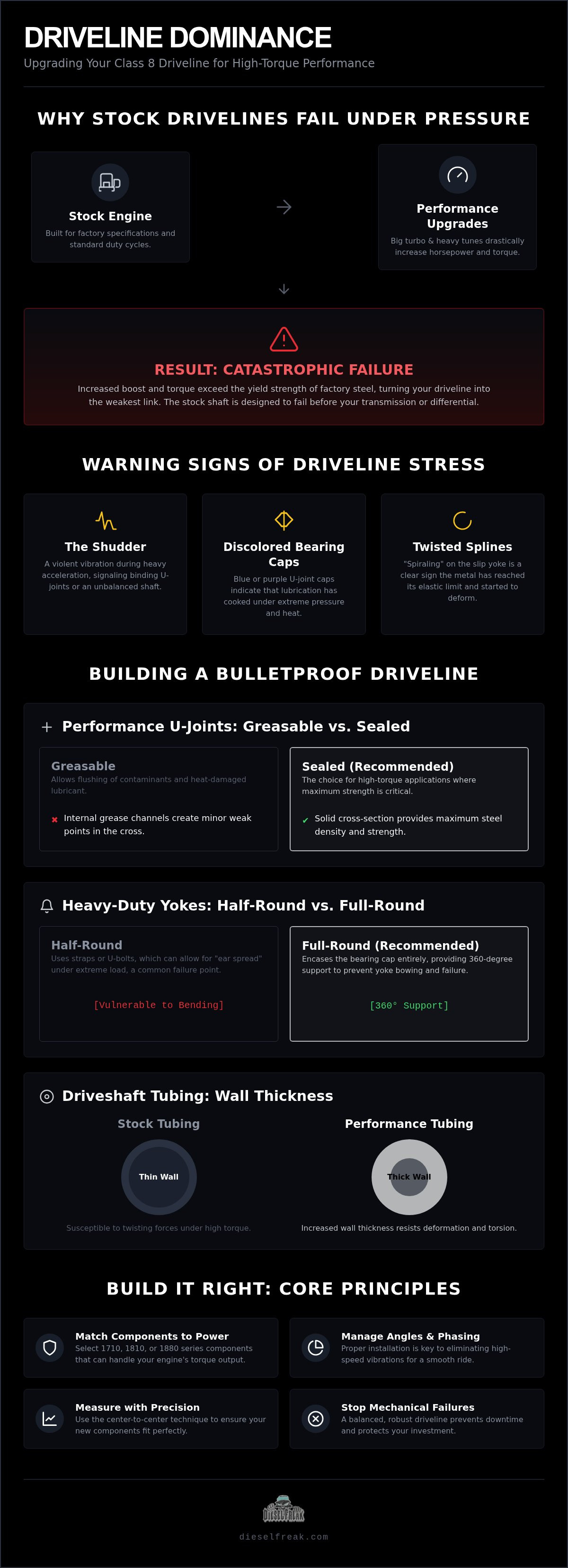
Horsepower sells trucks; torque snaps shafts. It's a hard truth in the heavy-duty world. Manufacturers build rigs for factory specs. They don't build them for the high-output monster you've created with a performance tune and a bigger turbo. When you crank the boost, you change the mechanical math. Your stock components become a "weak link" in a high-stakes game. Without class 8 truck driveline upgrades, you're running on borrowed time. Every hard launch puts a target on your U-joints and yokes.
The Physics of Performance Torque
Increased boost translates directly to driveline twist. Every time you roll into the throttle, your driveshaft acts like a torsion bar. It absorbs the shock of the engine's power. In a stock setup, this works. In a tuned rig, the torque load exceeds the yield strength of the factory steel. The shaft becomes a fuse. It's designed to fail before your transmission or differential explodes. Performance diesel demands higher yield-strength materials. You need metal that can handle raw, twisting force without deforming. If the material isn't up to the task, the shaft will eventually resemble a pretzel.
Symptoms of a Struggling Driveline
You'll feel the failure before you see the carnage. Pay attention to how the truck reacts under load. Vibrations aren't just annoying; they're destructive. They send shockwaves through the entire drivetrain. This often leads to catastrophic transmission tailshaft failure or rear-end damage. Watch for these specific red flags:
- The Shudder: A violent vibration during heavy acceleration. This usually means U-joints are binding or the shaft is out of balance.
- Discolored Bearing Caps: Heat is the ultimate enemy. If your U-joint caps look blue or purple, the lubrication has cooked under extreme pressure.
- Twisted Splines: Look for "spiraling" on the slip yoke. It's a clear sign the metal reached its limit and started to give.
Ignoring these signs is a death sentence for your rig. One snapped joint can whip around and take out air lines, wiring, and even your fuel tank. High-performance class 8 truck driveline upgrades solve these issues before they leave you stranded. You need parts built for dominance, not just daily duty. Build it once. Build it right. Keep the power on the ground where it belongs.
Breaking Down High-Performance Driveline Components
Your engine is a beast. Now, you need to build the backbone to support it. Stock components are designed for standard duty; they aren't meant for the aggression of a tuned rig. True class 8 truck driveline upgrades focus on raw capability and material density. Every part of the system must work in harmony to move your power from the flywheel to the pavement without snapping. If one piece is weak, the whole system is a liability. You're building for dominance, not just survival.
Performance U-Joints: Greasable vs. Sealed
The debate between greasable and sealed joints is a classic shop floor argument. Greasable joints allow you to flush out contaminants and heat-damaged lubricant; however, the internal grease channels can create minor weak points in the cross. Sealed units are often the choice for high-torque applications because the solid cross-section provides maximum steel density. Spicer Life series universal joints represent the industry benchmark for high-performance durability, featuring advanced sealing technology and a cold-forged design to maximize service life under heavy torque. When you're pushing serious boost, that extra metal matters. Research on Class 8 truck performance confirms that driveline integrity is the foundation of getting power to the wheels efficiently.
Heavy-Duty Yokes and Flanges
Precision-machined bearing surfaces are non-negotiable. If the fit isn't perfect, you're inviting vibration and premature wear. Full-round yokes are the gold standard for high-performance builds. Unlike half-round designs that use straps or U-bolts, full-round yokes encase the bearing cap entirely. This 360-degree support prevents "ear spread," which is a common failure where the yoke bows outward under extreme load. If you want to keep your rig on the road, look at the Class 8 semi truck parts we've selected for their ability to handle extreme stress.
Don't overlook the tubing and center bearings. Driveshaft tubing for a performance rig needs increased wall thickness to resist twisting forces. While rotational weight is a factor, durability always wins in a heavy-duty application. High-performance center bearings use reinforced rubber cushions and heavy-duty bearings to support the long-haul power. They keep the shaft stable when the RPMs climb and the torque hits. Every component must be a heavy-duty specialist. Invest in the best, or prepare for the tow bill.
How to Select and Measure for Class 8 Driveline Upgrades
Precision is the difference between a record-setting run and a heap of scrap metal. You've identified the failure points. Now, you need the blueprints for your class 8 truck driveline upgrades. Measuring isn't just about pulling a tape measure. It's about understanding the geometry of your rig under load. Metal doesn't lie. If your numbers are off by even a fraction, you're inviting disaster. Get it right the first time. Build it to last.
1710 Vs. 1810: Choosing Your Strength Level
The 1710 series is the industry workhorse. It handles standard loads with ease. But when you're pushing tuned power, you need to step up. The 1810 series offers a massive jump in torque capacity. It features larger trunnions and beefier bearing caps to absorb the shock of high-boost launches. If you're building a custom rig with extreme horsepower, consider the 1880 series. It's the nuclear option for raw strength. Always verify your transmission and axle yokes before ordering. An oversized shaft is a paperweight if it won't mate to your existing hardware. Compatibility is the foundation of your build.
The Pro's Measurement Checklist
Measuring at ride height is mandatory. Never measure a truck with the suspension hanging or the bags dumped. The shop floor measurement is a lie. It leads to bottomed-out splines and destroyed bearings. Use precision tools. Grab a digital inclinometer and high-quality calipers. You need exact data, not "close enough" guesses. Follow these steps for a perfect fit:
- Center-to-Center: Measure from the center of the front U-joint to the center of the rear U-joint. This is your static length.
- Suspension Travel: Account for the movement of your axles. You need enough spline engagement to handle the stretch without pulling apart.
- Tube Diameter: Larger diameters resist "whipping" at high road speeds. If you've changed your gear ratios for more speed, you need a tube that stays stable at high RPMs.
- Document Everything: Record your operating angles. Your class 8 truck driveline upgrades depend on these numbers to stay straight and vibration-free.
Ride height is your baseline. If your air bags aren't at operating pressure, your measurements are useless. A shaft that's too long will punch through your transmission tailshaft during a hard bump. A shaft that's too short will strip the splines under load. Measure twice. Verify your series. Build a driveline that can actually handle the power you've worked so hard to create. Don't settle for "good enough" when your livelihood is on the line.
Installation and Maintenance: Keeping Your Driveline Straight
Don't build a powerhouse and kill it with a sloppy install. Precision matters. You've invested in class 8 truck driveline upgrades; now you have to protect that investment. Alignment isn't a suggestion. It's a requirement for survival. If your geometry is off, your components will fight each other until something snaps. A bad install turns high-end parts into expensive scrap metal. Keep your head in the game and your tools sharp.
The Art of Driveline Phasing
Driveline phasing is the #1 mistake in semi-truck assembly. It's simple but deadly. Your yokes must be perfectly aligned on the same plane. A U-joint doesn't rotate at a constant speed; it speeds up and slows down twice per revolution. This is the physics of a universal joint. If your yokes are out of phase, these speed fluctuations don't cancel each other out. Instead, they compound. You'll feel a rhythmic vibration that tears through your carrier bearings and transmission seals. Look at your yokes. Ensure the "ears" are in the exact same position. If they're twisted, you're building a ticking time bomb.
Precision Angle Alignment
Grab a digital inclinometer. Don't guess. Your operating angles must be within the "Rule of 1 Degree" for vibration-free operation. This means the difference between your transmission angle and your driveshaft angle should be nearly identical to the difference at the axle end. Parallel angles are your best friend. If your angles intersect too sharply, the U-joint trunnions have to work too hard. This creates heat and premature failure. Adjust your air ride suspension to correct the geometry. A small change in ride height can fix a massive vibration issue. It's about finding the sweet spot where the power flows smooth.
Dynamic balancing is the final step. "Close enough" kills bearings. Every shaft needs dynamic balancing at actual operating speeds. If it's out of balance, it acts like a jackhammer hitting your drivetrain. Lubrication is your final line of defense. High-performance diesel applications generate extreme heat under load. Grease your joints every 5,000 to 10,000 miles if you're pushing heavy boost. Use a high-quality, extreme-pressure grease that won't liquefy and spin out of the caps. It's cheap insurance for your class 8 truck driveline upgrades. Take care of the gear, and the gear will take care of you.
Ready to build a rig that lasts? Get the right Class 8 semi truck parts to finish your build the right way.
Beyond the Shaft: Syncing Your Driveline with Diesel Freak Power
Power is addictive. But raw power without a delivery system is just a recipe for failure. Your class 8 truck driveline upgrades are the foundation for serious diesel performance parts. You can't just dump massive horsepower into a stock shaft and expect it to live. A balanced, high-strength driveline ensures that every ounce of energy reaches the wheels. It's the difference between a rig that works and a rig that wins. We build for those who demand more from their machinery.
A synchronized drivetrain does more than just survive. It improves your bottom line. Precision balance reduces parasitic drag. This leads to better fuel efficiency and significantly less tire wear. When the shaft isn't fighting itself, the whole rig runs cooler. You're protecting your transmission and differentials from the constant hammering of internal vibration. Pairing these upgrades with a high-flow BorgWarner Turbo creates a total performance package. You get the boost you want and the durability you need to actually use it. It's about raw capability and mechanical dominance.
Total Rig Optimization
Reduced rotational mass changes the game. High-performance tubing and high-strength yokes improve throttle response. The engine doesn't have to work as hard to spin the driveline mass. This makes the rig feel lighter and more reactive under your foot. Beyond the numbers, there's a psychological win. Driving a rig that is both smooth and powerful is a different experience. You feel the confidence of a machine that is built to handle the load. You aren't listening for the next snap or feeling for the next shudder. You're just focused on the road and the power at your command.
Next Steps for Your Build
Don't guess on your gear. Every build is unique. Consult with performance experts before you place your order. Ensure your class 8 truck driveline upgrades match your specific torque curve and gear ratios. Once the parts are in, integrate driveline checks into your regular PM schedule. Inspect the joints. Check the balance. Keep the lubrication fresh. Our philosophy is simple: build it once, build it right. This is the only way to ensure your rig stays on the road and out of the shop.
Stop settling for factory limitations. Your rig is capable of more. It's time to transform your drivetrain into a high-torque powerhouse that never flinches. Upgrade your gear. Protect your power. Dominate the road. We are here to help you push the boundaries of what a Class 8 truck can do. Get the right parts and get back to work with a rig that finally matches your ambition.
Build for Dominance and Leave the Weakness Behind
Your rig is only as strong as its weakest link. We've shown you why stock parts fail the moment you crank the boost. You now have the blueprint for class 8 truck driveline upgrades that actually hold up under fire. Precision measurement at ride height is your only defense against vibration. Phasing your yokes isn't a suggestion; it's a requirement for a smooth, high-speed haul. Syncing your drivetrain with your engine's torque curve protects your transmission and keeps your wheels turning. It's about raw capability and mechanical superiority.
Since 2009, we've delivered industry-leading expertise to truckers who refuse to settle for average. We offer specialized Class 8 performance parts that thrive under extreme pressure. This is rugged gear for real truckers who value grit and performance. Stop the downtime. Start the domination. Build a machine that handles every bit of boost you throw at it. Build Your Performance Rig at Diesel Freak today. Push the boundaries. Get back on the road and show them what real power looks like. You've earned the right to own the pavement.
Frequently Asked Questions
What is the most common cause of driveline vibration in Class 8 trucks?
Improper phasing is the most frequent culprit for cab-shaking vibrations. If your yokes aren't aligned on the same plane, the U-joints fight each other's rotational speeds. This creates a rhythmic shudder that destroys bearings. Another common cause is incorrect operating angles between the transmission and the shaft. Use a digital inclinometer to verify your geometry. Even a small deviation at ride height creates massive harmonic issues at highway speeds.
Can I upgrade from a 1710 series to an 1810 series driveline?
You can definitely upgrade from a 1710 to an 1810 series, but it requires swapping your transmission and axle yokes. The 1810 series features larger trunnions and beefier caps designed for high-torque applications. This is a critical move for anyone running aggressive engine tunes. Ensure your new yokes match the spline count of your output and input shafts. These class 8 truck driveline upgrades provide the raw strength needed to survive extreme boost.
How do I know if my driveshaft is out of phase?
A quick visual inspection of your slip joint will tell you if the shaft is out of phase. Look at the "ears" of the yokes on both ends of the shaft section. They must be in perfect alignment on the same horizontal or vertical plane. If one yoke is rotated even a few degrees off from the other, the shaft is out of phase. You'll feel a low-frequency vibration that gets worse as your RPMs climb.
What is the difference between a half-round and a full-round yoke?
Full-round yokes encase the U-joint bearing cap entirely for 360-degree support. This design is superior for performance rigs because it prevents "ear spread" under extreme torque loads. Half-round yokes use straps or U-bolts to hold the caps in place. While half-round designs make servicing faster, they are the weak link in high-horsepower builds. If you want maximum durability, full-round is the only choice for your drivetrain backbone.
How often should I grease my high-performance U-joints?
Grease your high-performance U-joints every 5,000 to 10,000 miles to flush out heat-damaged lubricant. Performance diesel engines put immense pressure on trunnion bearings, which generates significant friction. Use a high-quality, extreme-pressure grease that won't liquefy under load. If you operate in harsh conditions or pull heavy grades frequently, shorten this interval. Regular maintenance ensures your class 8 truck driveline upgrades last for the long haul without premature needle bearing failure.
Does a driveline upgrade improve fuel mileage?
A precision-built driveline improves fuel mileage by reducing parasitic power loss. When your shafts are perfectly balanced and phased, the engine doesn't waste energy overcoming internal vibrations or friction. A smooth-running system allows more torque to reach the wheels with less effort. While the gains might seem small per mile, they compound over thousands of miles on the road. Efficiency and power always go hand in hand in a high-performance setup.
What happens if my driveline angles are incorrect?
Incorrect driveline angles cause the U-joint trunnions to oscillate violently during every rotation. This creates massive amounts of heat and friction within the bearing caps. You'll experience severe vibrations that eventually take out your transmission tailshaft or differential pinion bearings. If the angles are too sharp, the joints can even bind and snap under load. Always verify your angles at ride height to ensure a parallel or intersecting geometry that works.
Is it worth upgrading to a larger diameter driveshaft tube?
Upgrading to a larger diameter tube is essential for preventing "shaft whip" at high rotational speeds. Larger tubes have a higher critical speed, meaning they stay stable at higher RPMs without bowing or vibrating. This is especially important if you've changed your rear-end gears or frequently run at high highway speeds. While a thicker wall adds some weight, the stability and safety gains are worth the investment for any serious performance build.
Disclaimer
Diesel Freak LLC is in no way associated, sponsored, or affiliated with Any OEM manufacturer. Products from Diesel Freak LLC presented in this listing are not to be confused with any of the products or trademarks of any OEM company. All parts listed to fit these manufacturers are replacement aftermarket parts.