

Your turbocharger isn't just an engine part; it's the lungs of your rig. When those lungs start to wheeze, your entire haul is at risk. You know the feeling of a heavy load behind you and the sudden, gut-wrenching loss of boost. It's frustrating. It's expensive. You work hard to keep that Class 8 machine screaming, but ignoring the signs of a failing semi truck turbo can turn a simple fix into a $25,000 engine overhaul. We understand the grit it takes to stay on the road. You can't afford to sit in a shop while your profit evaporates.
This 2026 guide is your tactical roadmap to spotting trouble before it sidelines your truck. We'll help you identify red flags early, eliminate confusing diagnostic signs, and restore that raw diesel performance. We're breaking down everything from oil leaks and screeching sounds to the exact components needed for a high-performance rebuild. Get ready to reclaim your boost pressure and lower those EGTs. It's time to stop guessing and start dominating the pavement again.
Key Takeaways
- Spot the early signs of a failing semi truck turbo to avoid catastrophic engine damage and five-figure repair bills.
- Decode exhaust smoke colors and power loss to pinpoint whether you're facing oil contamination or boost leaks.
- Perform the shaft play test to determine if a high-performance rebuild kit is the tactical move for your rig.
- Secure the right parts for your Cummins, Detroit, or Cat engine by matching specific turbo models and serial numbers.
- Boost your efficiency by pairing turbo maintenance with upgraded charge air cooler plumbing for maximum durability.
Identifying the Red Flags: Common Signs of a Failing Semi Truck Turbo
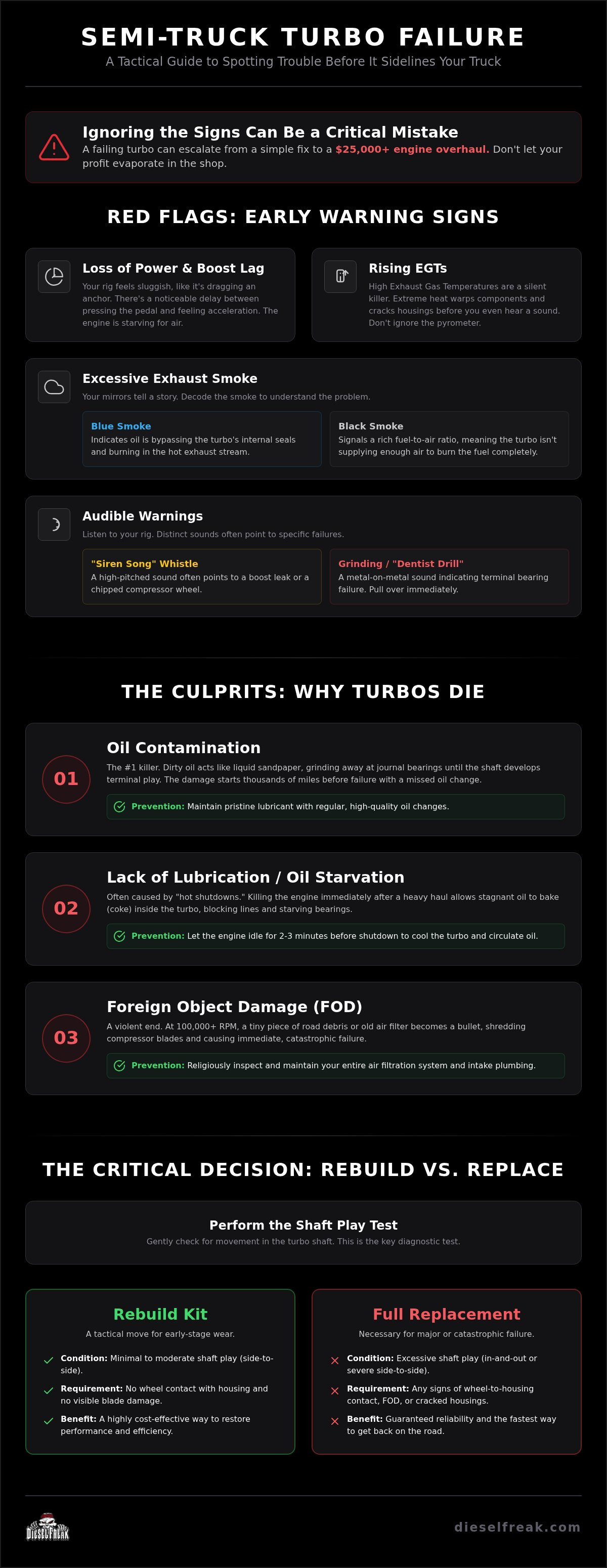
Loss of power hits you first. Your rig feels like it's dragging an anchor on every grade. You mash the pedal; nothing happens. This sluggish acceleration is one of the most common signs of a failing semi truck turbo. It means your engine isn't getting the compressed air it needs for efficient combustion. To understand the mechanics of this failure, it helps to know what is a turbocharger and how it forces oxygen into the cylinders. When the unit fails, that vital force vanishes. Your engine starves. Your productivity dies.
Watch your mirrors for excessive exhaust smoke. It tells a specific story about your engine's health. Blue smoke indicates oil is bypassing the internal seals and burning in the hot exhaust stream. Black smoke signals a rich fuel-to-air ratio because the turbo isn't providing enough oxygen to burn the diesel. Keep an eye on your pyrometer. Rising Exhaust Gas Temperatures (EGTs) act as a silent killer. Extreme heat warps components and cracks housings before you even hear a mechanical sound. Don't ignore the heat.
Listen for the "Siren Song." A high-pitched whistling often points to a boost leak or a chipped compressor wheel. Pull over if that whistle turns into a grinding metal-on-metal sound. That's terminal bearing failure. It's the sound of your investment being shredded into the intake. Catching these signs of a failing semi truck turbo early saves the rest of your engine from debris.
Visual and Audible Warning Signs
Pop the hood and get dirty. Look for oil streaks in the compressor inlet or your charge air cooler plumbing. Wetness here means the internal seals are shot. Listen for the "dentist drill" sound. This high-frequency scream happens when the compressor wheel makes contact with the housing. Your dash won't stay silent either. Watch for check engine lights and boost-related fault codes like "low boost pressure." These are digital screams for help. Ignore them at your own peril.
Performance Degradation on the Road
Your wallet feels the failure through poor fuel economy. A dragging turbo forces the engine to burn more fuel just to maintain cruising speed. You'll notice a frustrating gap between hitting the pedal and feeling the power. Boost lag is the primary indicator of VGT vane sticking. This delay ruins your rhythm and makes heavy hauls a nightmare. Fix it now or pay the price later on the side of the road. For drivers who need a professional inspection to address these performance issues, learn more about IQ Truck Center and their specialized heavy-duty services.
Turbos don't just die; they are murdered. Most failures stem from neglected maintenance or operational abuse. Oil contamination is the primary suspect. Think of dirty oil as liquid sandpaper. It grinds against journal bearings until the shaft develops terminal play. You might notice the signs of a failing semi truck turbo like a sudden drop in boost, but the damage started thousands of miles ago with a missed oil change. Keep your lubricant pristine or prepare for a massive tow bill.
Lack of lubrication is the second silent killer. This often happens during "hot shutdowns." You pull off the highway after a heavy haul and kill the ignition immediately. The turbo is still spinning at incredible speeds without fresh oil flow. The stagnant oil in the center section bakes. This creates oil coking, which acts like a dam in your oil lines. Eventually, the bearings starve and seize. Give your engine two minutes to idle before you shut it down. Protect your investment.
Foreign Object Damage (FOD) is a violent end for any turbocharger. At 100,000 RPM, even a tiny piece of road debris or a fragment of an old air filter becomes a bullet. It shreds the compressor wheel blades instantly. This mechanical trauma causes immediate vibration and failure. If you find metal shavings in your intake, the turbo is gone. Check your air filtration system religiously to avoid this carnage.
The Role of Oil and Maintenance
Precision machines demand precision care. High-performance cummins engine performance parts require clean, high-grade lubrication to survive the 2026 hauling season. Restricted oil drain lines are another common culprit. When oil can't exit the turbo fast enough, it backs up and forces its way past the seals. This leads to the blue smoke we discussed earlier. Ensure your lines are clear to keep the pressure balanced and the bearings cool.
External Factors and Air System Integrity
Your turbo doesn't live in a vacuum. Boost leaks in the charge air cooler plumbing force the unit to over-speed to compensate for lost pressure. This extra stress wears the bearings at an accelerated rate. Air filter neglect is equally dangerous. It leads to compressor wheel erosion, also known as "dusting," which ruins the aerodynamic profile of the blades. Clogged DPF systems also create excessive exhaust backpressure. This heat and pressure bake the internal O-rings until they turn brittle and fail. If you want to keep your rig running hot, you need Class 8 performance parts built to handle the pressure.
The Critical Decision: Rebuild Kit vs. Full Turbo Replacement
You've identified the signs of a failing semi truck turbo. Now you face a fork in the road. Do you drop $350 on a rebuild kit or invest $3,500 in a complete unit? This isn't just about the money in your pocket. It's about the metal in your engine. Start with the shaft play test. Pull the intake boot and grab the shaft nut. A slight radial wiggle is normal for journal bearings because they need oil clearance. Any axial play, moving the shaft in and out, means the thrust bearing is toast. If the wheel has already kissed the housing, a rebuild kit is a waste of time.
Examine the housing integrity next. Look for spiderweb heat cracks in the exhaust manifold mounting area. Check the compressor side for scoring. If the housing is gouged, the aerodynamic efficiency is gone. You're losing boost before you even start. Weigh the ROI carefully. A kit saves thousands in parts but demands 4 to 6 hours of precision bench work. If you're under a tight deadline in 2026, a new BorgWarner turbo gets you back on the road with a fresh warranty and zero doubts.
When a Rebuild Kit is the Right Move
Choose the kit when your housings are pristine and the wheels show no signs of "dusting." It's the smart move for performance-minded drivers who spot the signs of a failing semi truck turbo early. This is your chance to upgrade. Swap out factory components for high-performance brass or steel internals. These materials handle the heat of long-haul runs far better than stock parts. If you have the mechanical grit to handle a precision assembly, you can restore raw diesel performance for a fraction of the cost.
When to Walk Away and Buy New
Walk away if the center section (CHRA) is warped from severe oil coking. Heat soak ruins the metallurgy over time. If your VGT vanes are sticking or the electronic actuator has fried, a simple seal kit won't fix the underlying problem. The most dangerous scenario is total compressor failure. If metal shavings have entered the intake path, the turbo is a paperweight. Buy new. Don't risk sending shrapnel into your cylinders just to save a buck today. Focus on long-term reliability and engine safety.
Matching Solutions to Your Rig: Cummins, Cat, and Detroit
Not all turbos are built the same. Your rig demands a specific solution. Identifying the right unit starts with the manufacturer. Cummins leans on Holset. Detroit often runs Garrett. Caterpillar trusts BorgWarner. Don't guess on fitment. Spotting the signs of a failing semi truck turbo early is half the battle; the other half is matching the fix to your specific iron. Use your Engine Serial Number (ESN) to cross-reference parts before you order. A 100% match is the only way to ensure your rig stays on the road in 2026. Some high-performance rebuild kits even allow for boost levels that exceed factory specs. This is where you transform a repair into a tactical advantage. Integrating these fixes with a broader diesel performance parts strategy ensures your engine breathes better and lasts longer.
Cummins ISX and Holset Diagnostics
Focus on the HE451VE and HE561VE VGT components. These are the workhorses of the Class 8 world. They are complex. The nozzle ring and actuator sync are critical during any rebuild. If they are off by even a fraction, your boost response will be sluggish. Look for oil leak points near the center housing. These high-mileage Holset units often weep before they fail. Catch it early. If you ignore the signs of a failing semi truck turbo on an ISX, you're looking at a clogged DPF and a massive headache. Precision assembly is the only way to restore that Cummins grunt.
Caterpillar C15 and Detroit Series 60
Managing heat is the name of the game for Cat ACERT twin-turbo setups. These units live in a constant oven. The primary turbo feeds the secondary, creating a high-pressure environment that bakes seals faster than single-turbo rigs. Watch for oil migration between the stages. Conversely, the Detroit Series 60 is a model of simplicity. It's built for the million-mile haul. However, if you've tuned your Detroit for more power, thrust bearing upgrades are mandatory. Factory bearings can't handle the increased axial load of high-horsepower tunes. Strengthen the core to dominate the road. Grab your Class 8 performance turbo parts today and stop the failure before it starts.
Dominating the Road: The Diesel Freak Performance Edge
Stop settling for "good enough." Your rig deserves better. When you spot the signs of a failing semi truck turbo, you're standing at a crossroads. You can patch the problem with inferior aftermarket seals, or you can build for dominance. Diesel Freak has been the expert guide for the enthusiast community since 2009. We don't just stock parts. We engineer solutions for the long-haul grind. Our family-rooted reliability meets a gritty, performance-driven edge that leaves competitors in the dust. We understand the thrill of high-performance machinery because we live it every single day. Fix it. Build it. Dominate the pavement.
Trust the experts who know Class 8 iron inside and out. We've spent years perfecting the balance between raw power and mechanical durability. Our team provides the support you need to make the right call for your engine. We speak your language. We value the hard work that goes into keeping a rig on the road in 2026. Don't let a failing component slow your momentum. Use this diagnostic period to transform your truck into a high-performance beast.
The Full Air System Approach
Your turbo diagnostic is the perfect time to audit your entire setup. Check your charge air cooler plumbing while the turbo is off the bench. A fresh turbo is only as good as the pipes feeding it. Boost leaks force your new internals to overwork. They kill your efficiency. They waste your fuel. Eliminate those leaks now. Combine your rebuild with high-flow plumbing to maximize your rig's torque through a holistic air system strategy. This ensures your engine breathes deep and stays cool under load. Maximize your ROI by doing the job right the first time.
Join the Diesel Freak Community
Join a movement that celebrates mechanical superiority. This is an insider's brand for those who value toughness and grit. Grab a fresh diesel hoodie for the shop. It's rugged gear for people who aren't afraid to get their hands greasy. We are built by enthusiasts, for enthusiasts. We offer unapologetic power for the long haul. You've identified the signs of a failing semi truck turbo and you've done the work. Now, show the road who's in charge. Your rig is your legacy. Protect it with parts that work as hard as you do.
Shop Class 8 Semi Truck Turbo Parts at Diesel Freak
Reclaim Your Power and Hit the Road
Identifying the signs of a failing semi truck turbo is the first step toward reclaiming your rig's dominance. You've learned how to spot the red flags before they turn into a catastrophic engine failure. You know the difference between a simple rebuild and a total replacement. Don't let a wheezing turbo dictate your schedule or drain your bank account. It's time to take action. Diesel Freak has provided expert Class 8 support since 2009. We offer rugged, shop-tested durability that stands up to the grittiest hauls. Our components are built for those who value mechanical superiority and raw capability. With national shipping, we ensure your downtime is kept to a minimum so you can keep moving. You work hard to keep your machine screaming; we work hard to provide the parts that make it happen. Secure Your High-Performance Turbo Rebuild Kit at Diesel Freak and get back to peak performance. Stay bold. Stay powerful. We'll see you on the open road.
Frequently Asked Questions
How do I know if my semi truck turbo needs a rebuild kit?
You need a rebuild kit when you find oil weeping from the seals or slight radial play in the shaft. This is the tactical response to the early signs of a failing semi truck turbo. If the compressor wheels haven't contacted the housing, a kit restores your boost without the cost of a full unit. Inspect the housings for cracks. If the iron is solid, rebuild it and save your core.
Can I rebuild a VGT turbocharger myself using a kit?
Rebuilding a VGT is possible but demands extreme attention to detail. You must sync the nozzle ring and actuator perfectly for the variable vanes to function. It is a more technical process than a standard wastegate turbo. Use a high-quality kit built for 2026 performance standards. If you have the mechanical grit, you can save thousands while boosting your rig's reliability. Don't rush the synchronization process.
What is the difference between a minor and major turbo rebuild kit?
Minor kits focus on the basics like O-rings and seals. Major kits provide a complete overhaul with new journal bearings and thrust bearings. We always recommend the major kit for Class 8 iron. It replaces the high-wear components that cause catastrophic failure. Don't settle for a partial fix. Give your engine the durability it needs for the heavy hauls ahead. Invest in the full major kit components.
How much time does it typically take to rebuild a Class 8 turbo?
Expect to spend 4 to 6 hours on the bench for a precision rebuild. This estimate covers teardown, cleaning, and assembly. It does not include the labor to remove the turbo from the engine or the time needed for a deep soak in solvent. Set aside a full day to ensure every clearance is checked. Precision is the key to long-term performance. Rushing only leads to avoidable mistakes.
Will a rebuild kit fix a turbo that is making a loud whistling or grinding noise?
A kit won't save a turbo that is already grinding. Grinding indicates the wheels have made contact with the housing, which ruins the aerodynamic tolerances. Whistling often signals a chipped blade or a housing crack. A rebuild kit replaces bearings and seals, but it cannot fix structural metal damage. If you hear metal-on-metal, it's time to shop for a new high-performance unit. Don't waste money on a dead core.
Do I need special tools like a dynamic balancer for a turbo rebuild?
You can skip the dynamic balancer if you are only replacing seals and bearings. Mark the shaft, nut, and compressor wheel before you take them apart. Realign those marks during assembly to preserve the original factory balance. However, if you install a new compressor or turbine wheel, balancing is mandatory. Spinning at 100,000 RPM requires perfect weight distribution to prevent immediate bearing failure. Accuracy is your best friend here.
What happens if I don't clean the turbo housing during the rebuild?
Skipping the cleaning phase is a death sentence for your new parts. Carbon deposits and oil coking will break loose and shred your new seals instantly. These contaminants act like sandpaper on your precision journal bearings. You must use a dedicated solvent to strip the housing to bare metal. A clean environment is the only way to ensure your rebuild lasts for the long haul. Cleanliness equals longevity.
Is it better to buy a rebuild kit or a remanufactured turbocharger?
Choose a rebuild kit if you want the highest ROI and have a solid core. It allows you to upgrade to superior brass or steel internals while saving on the housing cost. Opt for a remanufactured unit if your current turbo has housing cracks or wheel damage. Remans offer a faster turnaround when downtime is your biggest enemy. Both paths beat ignoring the signs of a failing semi truck turbo.
Disclaimer
Diesel Freak LLC is in no way associated, sponsored, or affiliated with Any OEM manufacturer. Products from Diesel Freak LLC presented in this listing are not to be confused with any of the products or trademarks of any OEM company. All parts listed to fit these manufacturers are replacement aftermarket parts.