

A blown boot at 45 PSI isn't just a part failure. It’s a roadside disaster that kills your torque and burns your profit. You’ve felt that turbo spool, heard the whistle, and then felt the gut-wrenching pop that leaves your rig gasping for air. It’s frustrating. It’s avoidable. High-pressure diesel engines demand hardware that handles the heat without flinching. That’s why semi truck silicone boost boots are the standard for serious haulers. These aren't soft factory replacements. They’re built for raw capability and absolute durability.
You know that a truck is only as strong as its weakest link. If your custom 24-inch plumbing runs are leaking, you’re bleeding power. We’ll show you how to master the technical specs of 2.75-inch diameter silicone to eliminate those leaks for good. This guide promises to give you the installation secrets needed to maximize your rig’s torque. We’re breaking down everything from multi-ply reinforcement to constant-torque clamping. Get ready to build a charge air system that survives the toughest grades and the highest boost levels.
Key Takeaways
- Master the 2.75*24 blueprint to optimize airflow and reach for custom intercooler routing.
- Learn why 4-ply and 5-ply reinforcement is the only way to prevent blowouts under high-PSI loads.
- Secure your system with professional-grade bead rolling and constant-tension clamping techniques.
- Use heavy-duty semi truck silicone boost boots to survive the extreme heat and pressure of a high-performance turbo.
- Identify when to use hump boots or reducers to maintain a reliable seal in complex engine bay layouts.
Why the 2.75*24 Spec Defines Boost Integrity in Class 8 Rigs
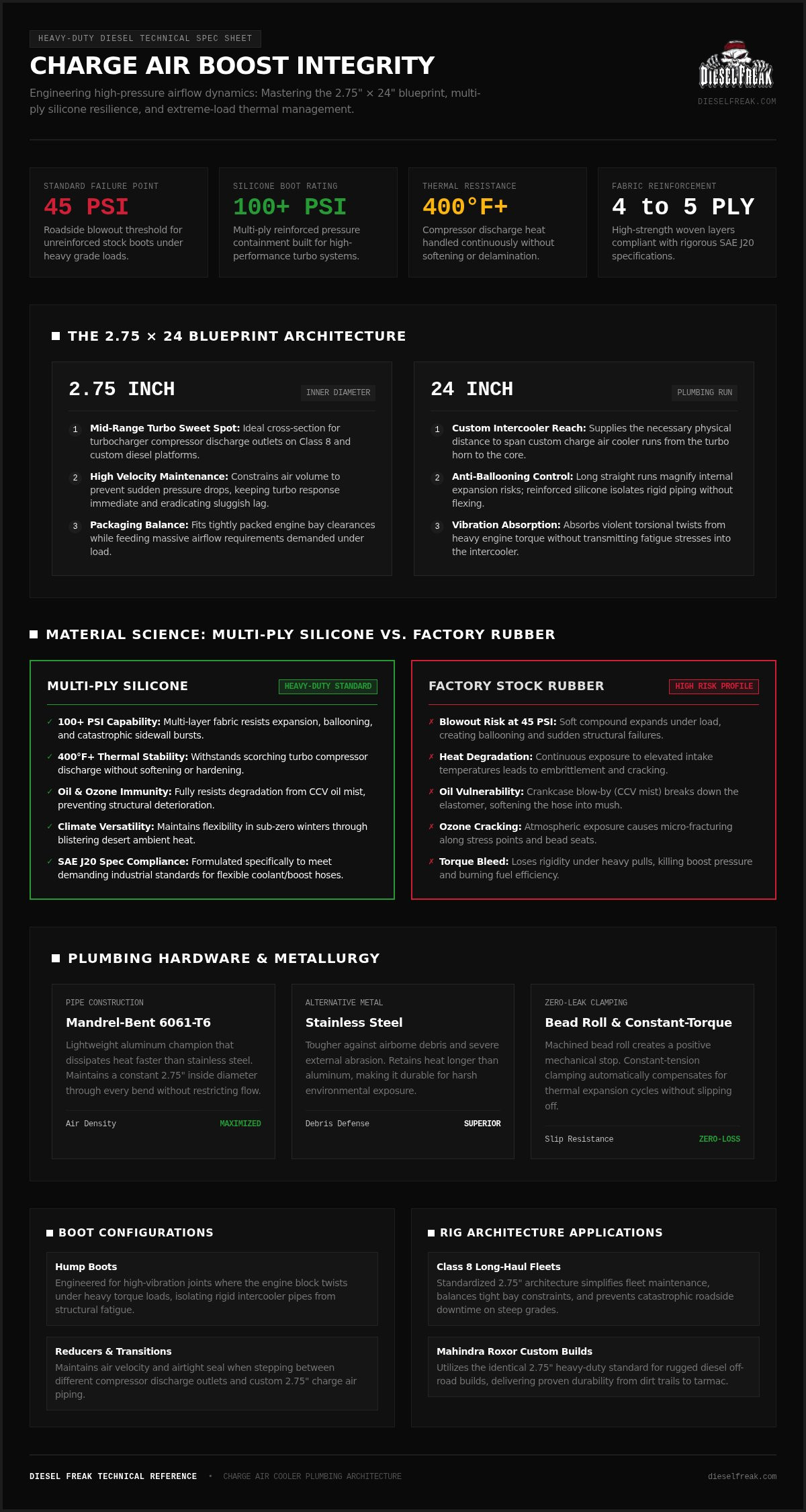
The 2.75*24 specification isn't just a set of numbers. It’s a performance blueprint for high-velocity air management. In heavy-duty diesel applications, 2.75 inches is the sweet spot for mid-range turbocharger outlets. This diameter keeps air velocity high. It prevents the pressure drops that cause sluggish turbo lag. When you pair this with 24-inch plumbing runs, you have the reach needed for custom intercooler routing. Semi truck silicone boost boots are the critical link in this chain. They bridge the gaps between rigid pipes. They handle the violent vibrations of a working engine. They stop the leaks that kill your torque when you're pulling a heavy grade.
The Role of Charge Air Cooler Plumbing
Your charge air cooler plumbing has one job. It moves compressed air from the turbo to the intercooler. It must do this with zero loss. High-pressure air is aggressive. It looks for any exit. If your 24-inch pipes aren't perfectly secured, you’re losing boost. This makes your borgwarner turbo work harder for less gain. A 24-inch plumbing run is a long distance for pressurized air to travel. Any expansion in the pipe walls or soft connections will lead to a ballooning effect. This kills throttle response. You want a system that feels immediate. Boost boots are the heavy-duty flexible connectors that seal these pipes and prevent total system failure during high-load pulls.
Class 8 and Roxor Applications
Standardization matters on the road. Many Class 8 fleets use the 2.75-inch spec to keep maintenance simple. It balances tight engine bay space with massive airflow requirements. This setup isn't limited to the highway. The mahindra roxor often uses these same 2.75-inch specs for custom performance builds. You need hardware that won't quit. We rely on high-temperature silicone rubber for its extreme thermal stability. It handles the heat soak that destroys standard rubber. It stays flexible while the engine block twists under load. This keeps your semi truck silicone boost boots tight when the EGTs climb and the pressure hits 45 PSI. Reliability is the goal. A blown boot on a long-haul route means downtime. Downtime means lost money. By using 2.75-inch architecture, you're choosing a proven standard. It's rugged. It's effective. It works in the dirt and on the asphalt.
Material Science: Multi-Ply Silicone vs. Heavy-Duty Plumbing
Build for the extreme or don't build at all. Standard rubber fails when the boost climbs. You need 4-ply or 5-ply reinforcement. This is non-negotiable for high-pressure rigs. These layers of high-strength fabric prevent ballooning under load. They keep the 2.75-inch air path consistent. We look to SAE J20 engineering specifications to ensure these boots don't burst when you’re pinned. Your borgwarner turbo generates massive heat. Compressor discharge can easily exceed 400 degrees. Multi-ply silicone handles it. It doesn't soften or delaminate like cheap alternatives.
For those long 24-inch straight runs, 6061-T6 aluminum is the lightweight champion. It dissipates heat faster than stainless steel. Stainless is tougher against road debris, but aluminum keeps the intake air cooler. Cooler air means more density. More density means more power. It’s about finding the balance between raw durability and thermal efficiency.
Why Silicone Beats Rubber
Rubber is for stock rigs and grocery getters. It cracks under ozone exposure. It turns to mush when oil mist from the CCV hits it. Semi truck silicone boost boots resist oil degradation. They stay flexible in sub-zero winters and blistering desert heat. They are rated for 100+ PSI. That is raw capability. You won't find that in a factory hose. Silicone keeps its shape. It keeps its seal. It keeps you on the road.
Plumbing Specs for High Performance
Don't settle for crush-bent pipes. Use mandrel-bent 6061-T6. This process maintains a constant 2.75-inch diameter through every curve. It keeps airflow unrestricted and velocity high. Wall thickness matters for bead retention. You need enough meat for a proper bead roll but not so much that it adds dead weight. Weight considerations are critical for high-efficiency diesel performance parts. Every pound counts when you’re chasing peak output. If you’re ready to upgrade, find the right charge air cooler plumbing for your specific build. Semi truck silicone boost boots paired with mandrel pipes create a system that won't quit. It’s a setup built for the gritty and the rugged.
Fitment Analysis: Matching Boots to Your Rig Architecture
Precision is power. Getting the right fitment for your semi truck silicone boost boots isn't just about matching the diameter. It’s about understanding the geometry of your engine bay. Straight boots work for simple joiners. They provide a rock-solid connection for short spans. But when you’re managing a custom 24-inch plumbing route, you need to account for chassis rub. A long aluminum pipe vibrating against the frame will eventually fail. Use 90-degree elbows to navigate around obstructions. These elbows must maintain their inner diameter throughout the bend to keep air velocity high. If you’re upgrading to a 3-inch intercooler, reducer boots are your best friend. They transition your 2.75-inch turbo outlet to the larger core without creating massive turbulence.
Stay compliant while you push for performance. Modern rigs must follow federal heavy-duty OBD boost monitoring standards. These rules require the system to detect even small leaks. A loose boot or a bad fitment triggers a derate. That kills your efficiency and your schedule. Build it right the first time to keep the sensors happy and the torque high. It’s about professional-grade reliability on every mile.
Hump Boots and Vibration Management
Engines move. Chassis flex. If your plumbing is rigid, something will snap. Hump boots are the solution. The extra bellows in a hump boot allows for multi-directional movement. This is critical when the engine torques under a heavy load. Without this flex, the stress transfers directly to your intercooler tanks. Cracked tanks are expensive and avoidable. Place at least one hump boot in every 24-inch run. This isolation protects your hardware from the violent harmonics of a high-boost diesel engine.
Custom Sizing for Specialized Builds
Custom builds demand specialized hardware. Many enthusiasts integrate these 2.75*24 specs into their cummins engine performance parts setups. It’s a proven combination for Stage 2 and Stage 3 turbo upgrades where airflow volume is king. You have to watch your clearances. High-performance plumbing takes up space. Ensure your routing doesn't interfere with your windshield washer reservoir or other critical accessories. Ruggedness matters. Choose semi truck silicone boost boots that fit the first time and stay tight for the long haul. Don't compromise on the architecture of your boost system. Build it for the gritty reality of the road.
Zero-Leak Installation: Securing Your Boost System
Installation is the thin line between a trophy-winning pull and a roadside breakdown. You can buy the best hardware, but a sloppy setup will blow out every time. Semi truck silicone boost boots need a mechanical lock to stay seated. This starts with the pipe surface. Clean every mating surface with a degreaser. Remove the oil mist and shop grime. Friction is your ally here. If the surface is slick, the boot will walk off the pipe as soon as the turbo spools. Don't cut corners on the prep work.
The Art of the Bead Roll
Smooth pipes are a liability under high boost. Pressure pushes against the internal surface of the boot, trying to slide it off the end. Bead rolling is the #1 defense against leaks. It creates a physical ridge that the clamp locks behind. Use a manual bead roller on your 2.75-inch aluminum plumbing. It takes effort. It takes grit. But it ensures that your 24-inch runs stay connected when the pressure hits 45 PSI. A proper bead roll turns a friction fit into a mechanical lock.
Clamping for Raw Power
Standard worm gear clamps are for radiator hoses on a sedan. They don't belong on a Class 8 rig. They suffer from elastomer cold flow. This causes them to lose up to 80% of their initial clamping torque after a few heat cycles. Upgrade to T-bolt clamps. Better yet, use Belleville spring constant-torque clamps. These active clamps adjust as the silicone expands and contracts. They maintain a zero-leak seal through extreme temperature cycles.
Torque specs are critical. Don't just crank it until it stops. For heavy-duty T-bolts, aim for 50 to 90 in-lbs. If you’re running larger commercial sizes, you can go up to 120 in-lbs. Too much force will extrude the silicone plies or deform the aluminum pipe. Find the balance. Stay within the limits. If you need the right hardware to finish the job, grab your charge air cooler plumbing supplies from a source that knows high-boost engineering. Secure your semi truck silicone boost boots and dominate the grade.
Diesel Freak Hardware: Built for the Gritty and the Rugged
We don't do corporate fluff. We do raw capability. At Diesel Freak, we build for the guys who keep the world moving. Our hardware isn't designed in a boardroom by people who’ve never seen a grease stain. It’s forged in the shop. It’s tested on the dyno. We know what happens when a boot fails on a 6% grade with 80,000 pounds behind you. We’ve seen the results of heat-soaked intake air killing your fuel mileage. That’s why our semi truck silicone boost boots are built to a higher standard. We prioritize grit. We prioritize performance. We prioritize your ability to stay on the road without a derate. This is gear for those who live the high-performance lifestyle.
Tested in the Shop, Proven on the Road
Our history started in 2009. Since then, we’ve been performance-driven and family-owned. We are specialists in Class 8 and Roxor hardware. We don't just sell parts; we engineer solutions for high-PSI environments. This expertise is why we only source multi-ply silicone and 6061 aluminum. These materials handle the heat. They survive the vibration. They keep your rig dominated. We’ve spent years refining our inventory to ensure every component meets our rugged standards. You won't find weak links here. You can find our full range of gear in our heavy-duty hardware catalog. It’s the same hardware we use on our own builds.
Join the Performance Community
Performance is a lifestyle. It’s about more than just the engine bay. It’s about the pride of the build and the thrill of the pull. Match your engine’s grit with a diesel hoodie from our collection. It’s gear built for the enthusiast who values mechanical superiority. If you have questions about your specific 2.75*24 plumbing route, talk to us. Consult with experts who know every bolt on your rig. We’ve spent years mastering charge air cooler plumbing for both long-haul trucks and off-road Roxors. We’re here to be your ally in the pursuit of peak potential.
Don't settle for "good enough" when your livelihood is on the line. Your rig deserves hardware that can handle the pressure. Eliminate the leaks. Maximize the torque. Build your boost system today with semi truck silicone boost boots that won't quit. Gear up with Diesel Freak and push the boundaries of what your engine can do. Let’s get to work.
Dominate the Grade with Unstoppable Boost
Your rig is a machine built for dominance. Don't let a cheap factory hose kill your momentum. You now know why 4-ply and 5-ply reinforcement is the standard for high-PSI loads. You understand the importance of bead rolling and constant-torque clamping to maintain a zero-leak seal. These technical details separate the gritty enthusiasts from the roadside casualties. High-quality semi truck silicone boost boots ensure your turbo energy translates into raw pulling power. It’s about building a system that handles the heat and the vibration of the long haul.
We provide expert-selected Class 8 hardware and proven performance in Roxor builds. This is rugged gear for the gritty enthusiast who refuses to compromise. If you’re ready to stop the leaks and start winning, we have the hardware you need. Build your boost system with Diesel Freak performance plumbing and secure your victory on the asphalt. Keep the hammer down. Your next heavy pull is waiting.
Frequently Asked Questions
What does 2.75*24 mean in a diesel plumbing context?
In diesel plumbing, 2.75*24 represents a 2.75-inch inner diameter pipe or boot cut to a 24-inch length. This specific dimension is a standard for mid-range turbocharger outlets and long-reach intercooler routing. It balances high air velocity with enough reach to navigate complex engine bays. Choosing this spec ensures your system maintains pressure integrity across long spans without sacrificing flow volume. It’s a blueprint for efficiency and raw capability.
Can I use a 2.75-inch silicone boot on a 3-inch pipe?
Don't force a 2.75-inch boot onto a 3-inch pipe. You’ll overstretch the reinforcement plies and cause a premature blowout. Use a dedicated reducer boot instead. Reducers are engineered to transition between different diameters safely. They maintain a consistent seal while protecting the structural integrity of the silicone. If you’re upgrading your system, always match the boot size to the specific pipe diameter. It’s the only way to ensure a leak-proof fit.
Is aluminum or stainless steel better for 24-inch boost pipes?
Aluminum 6061-T6 is the preferred choice for most 24-inch boost pipes. It’s lightweight and dissipates heat much faster than stainless steel. Cooler intake air means more density and better combustion. Stainless steel offers superior resistance to road debris and corrosion, but it’s significantly heavier and holds more heat. For high-performance Class 8 rigs, aluminum provides the best balance of efficiency and rugged durability. Choose the material that matches your performance goals.
How do I prevent my boost boots from blowing off?
Prevent blowouts by bead rolling your pipes and using high-quality semi truck silicone boost boots. Clean all mating surfaces with a degreaser to remove oil film. Friction is essential for a secure grip. Use constant-torque T-bolt clamps rather than standard worm gear versions. These specialized clamps maintain pressure during thermal expansion. Secure the hardware to 50-90 in-lbs to ensure the boot stays locked behind the bead ridge.
What is the difference between a hump boot and a straight boot?
Hump boots feature a built-in bellows that allows for multi-directional movement and vibration isolation. They prevent stress from transferring to your intercooler tanks when the engine torques under load. Straight boots are rigid joiners used for simple connections where movement isn't a factor. Use at least one hump boot in any long 24-inch plumbing run. This protects your hardware from the violent harmonics of a high-boost diesel engine. Build for the grit.
How much boost can a 4-ply silicone boot handle?
A high-quality 4-ply silicone boot is rated to handle 100+ PSI under normal operating temperatures. These boots are engineered to meet SAE J20 R1 Class A standards for burst strength. The multiple layers of fabric reinforcement prevent the silicone from ballooning or delaminating. If you’re pushing 45 PSI or more on a heavy grade, 4-ply is the minimum requirement for professional-grade reliability. It’s hardware built to handle the pressure without flinching.
Do I need to bead roll my aluminum intake pipes?
Yes, bead rolling is mandatory for any high-boost application. Smooth pipes provide no mechanical lock for the boot to grip. Under pressure, the air will push the boot right off the end of the pipe. Rolling a bead creates a physical ridge that prevents the clamp from sliding. It’s the most effective way to eliminate boost leaks. Never skip this step if you want a system that won't quit when the turbo spools.
Where can I find 2.75-inch OD plumbing for my Class 8 truck?
You can find professional-grade 2.75-inch plumbing and semi truck silicone boost boots at Diesel Freak. We specialize in heavy-duty charge air cooler plumbing for Class 8 rigs and Roxor builds. Our inventory is expert-selected and tested in the shop to handle the grittiest road conditions. We focus on raw capability and rugged durability. Gear up with the best in the business. Build a boost system that dominates the grade every single time.
Disclaimer
Diesel Freak LLC is in no way associated, sponsored, or affiliated with Any OEM manufacturer. Products from Diesel Freak LLC presented in this listing are not to be confused with any of the products or trademarks of any OEM company. All parts listed to fit these manufacturers are replacement aftermarket parts.