
![Heavy-Duty Diesel Cooling Systems: The Ultimate Performance Guide [2026] - Diesel Freak](http://dieselfreak.com/cdn/shop/articles/heavy-duty-diesel-cooling-systems-the-ultimate-performance-guide-2026-1500038.jpg?v=1789790478&width=1600)
Heat is the enemy of torque. If you're pushing a Class 8 rig to its absolute limit, your stock setup is a ticking time bomb. You've felt the gut-punch of watching boost levels drop as heat soak takes over during a heavy haul. You know the brutal cost of a cracked EGR cooler and the frustration of sitting on the shoulder while the competition hauls past. It's time to stop playing defense. Mastering heavy duty diesel cooling systems is the only way to protect your iron and unlock the raw power your engine was built to deliver.
We're providing the blueprint to prevent catastrophic failure and ensure consistent, bone-shaking performance every time you hit the throttle. This guide breaks down the mechanics of high-flow components and the science of heat dissipation. You'll learn how to stabilize your temps to extend engine life and slash those soul-crushing maintenance costs. We're diving deep into the hardware that keeps your turbo screaming and your rig running cool. It's about more than just survival; it's about mechanical dominance. Let's get to work.
Key Takeaways
- Heat kills torque. Learn how thermal management serves as the ultimate gatekeeper for your engine's horsepower and long-term durability.
- Master the mechanics of heavy duty diesel cooling systems to eliminate hotspots and prevent catastrophic failures during extreme hauls.
- Identify critical red alerts like rapid temperature swings and hidden coolant loss before they turn into expensive roadside disasters.
- Boost circulation velocity with high-flow water pumps and multi-core radiators to keep your engine running cold under heavy loads.
- Secure your performance with engineered plumbing and charge air cooler upgrades that refuse to quit when the pressure is on.
Why Your Heavy-Duty Diesel Engine Lives or Dies by Its Cooling System
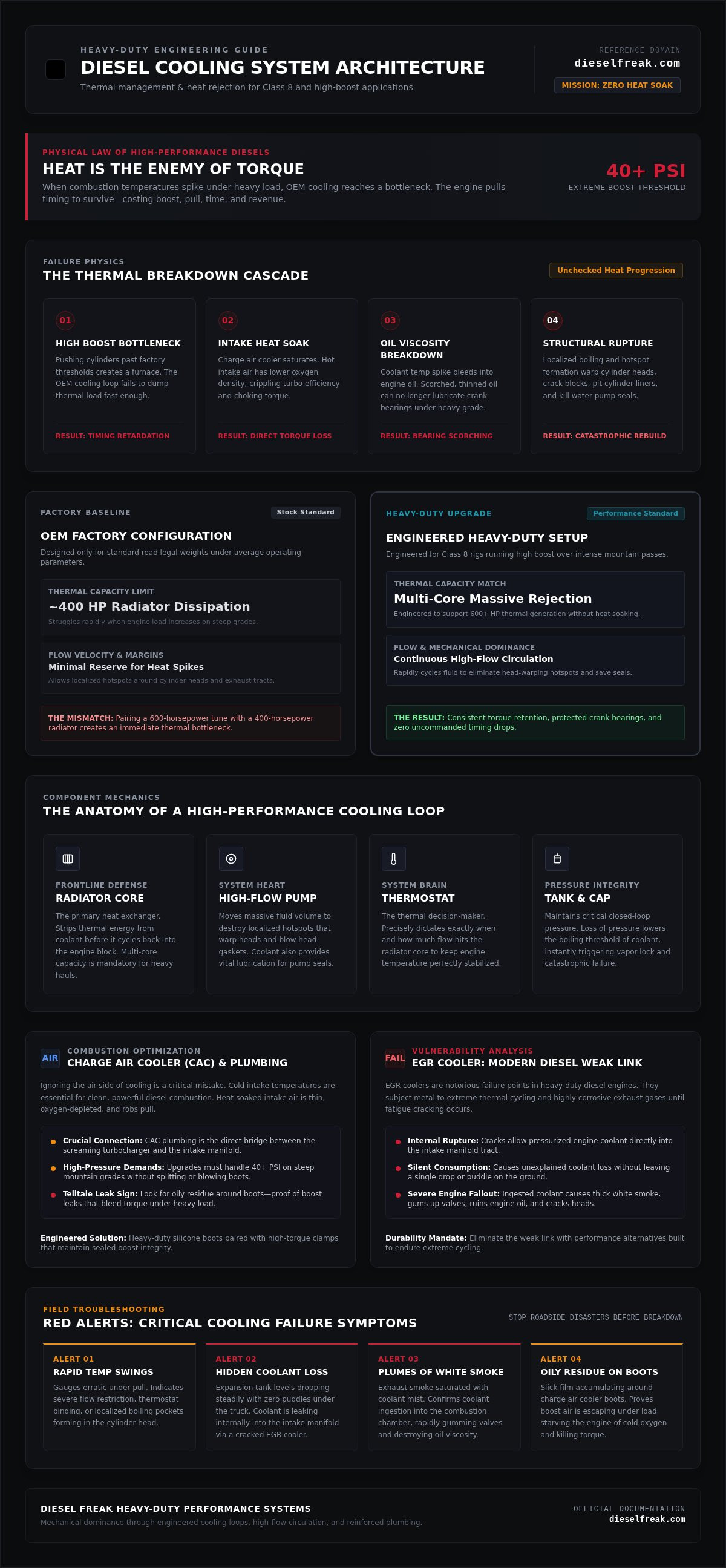
Power creates heat. It is a physical law. Your heavy duty diesel cooling systems stand between a record-breaking haul and a melted block. Think of thermal management as the gatekeeper of your rig's horsepower. When combustion temperatures spike, your cooling loop must strip that energy away instantly. If it fails, the engine pulls timing to save itself. You lose pull. You lose time. You lose money. High-performance diesels generate extreme heat that OEM systems simply cannot dump fast enough.
The Science of Heavy-Duty Heat Rejection
High-boost applications create a massive thermal bottleneck. You are cramming more air and fuel into the cylinders than the factory ever intended. This creates a furnace. Understanding cooling system fundamentals is vital for anyone pushing beyond stock limits. Without massive heat rejection, you face cylinder head cracking and liner pitting. These aren't just repairs. They are catastrophic rebuilds. Coolant also acts as a lubricant for your water pump seals. If the chemistry or temperature is off, the pump dies. Then the engine follows.
There is a direct link between coolant temp and oil health. When your coolant stays too hot, your oil viscosity breaks down. Thin, scorched oil can't protect your crank bearings under heavy load. Heat soak is the silent killer here. It saturates your intercooler and intake tract. This ruins turbocharger efficiency. Hot air is less dense. Less density means less oxygen. Less oxygen means less torque. You need a system that dominates the heat before it dominates you.
Performance vs. OEM Cooling Standards
Factory standards are built for average conditions. They assume you are driving a stock truck at stock weights. But you aren't average. Performance tuning increases the thermal load exponentially. Pushing a heavy load over a mountain pass requires more than what the OEM radiator can dump. You need a setup that thrives on the edge. Upgrading your heavy duty diesel cooling systems is a non-negotiable prerequisite for installing high-end diesel performance parts. Don't build a 600-horsepower engine and keep a 400-horsepower radiator. It's a recipe for disaster. Grit and mechanical superiority start with how you manage the fire under the hood.
The Anatomy of a High-Performance Cooling Loop
Your engine is a beast. It needs a cooling system that can keep up with the raw power you demand. The radiator is your frontline defense. It acts as the primary heat exchanger, stripping thermal energy from the coolant before it cycles back into the block. High-flow water pumps are the heart of the system. They move massive volumes of fluid to prevent localized hotspots that warp heads and blow gaskets. Don't overlook the thermostat. It is the brain. It dictates exactly when and how much flow hits the radiator. Finally, the expansion tank and pressure cap maintain system integrity. Without that pressure, your coolant boils at a lower temperature. That leads to vapor lock and total engine failure.
Charge Air Cooler (CAC) and Plumbing
Most guys ignore the air side of cooling. That's a massive mistake. Cold air intake temperatures are non-negotiable for clean, powerful combustion. Heat-soaked air is thin and weak. Your charge air cooler plumbing is the bridge between the turbo and the cylinders. Boost leaks here are performance killers. Look for oily residue at the boots. That is a clear sign of a leak. Upgrade to heavy-duty silicone boots and high-torque clamps. They won't blow off or split when you are pushing 40+ PSI on a steep grade. If you want to ensure your setup is rock solid, check out the charge air cooler plumbing we engineered for high-pressure runs.
EGR Coolers: The Weak Link in Modern Diesels
EGR coolers are notorious failure points in heavy duty diesel cooling systems. They subject metal to extreme thermal cycling and corrosive exhaust gases. Eventually, they crack. When that happens, coolant enters the intake manifold. You will see white smoke or experience "unexplained" coolant loss without a puddle on the ground. This contamination gums up your valves and ruins your oil. Performance alternatives focus on durability and better flow. A cleaner engine runs cooler. A cooler engine lives longer. Dominating your rig's thermal profile means fixing these weak links before they leave you stranded on the shoulder. Build for strength. Drive with confidence.
Red Alerts: Symptoms of a Failing Heavy-Duty Cooling System
Your rig is trying to tell you something. Listen before it screams. Ignoring the early warning signs of failing heavy duty diesel cooling systems is a fast track to a seized block. You need to be tuned into the machine. Watch the gauges. If you see rapid temperature fluctuations during gear changes, your system is struggling to manage the load shift. It can't dump the heat fast enough. This isn't just a glitch. It's a signal that your flow is restricted or your radiator is reaching its thermal limit.
Unexplained coolant loss is another massive red flag. If the reservoir is low but there are no puddles on the ground, the engine is eating it. Look for white smoke from the exhaust. That is the classic white flag of a cracked EGR cooler or a failing head gasket. You might also notice a sweet smell inside the cab or around the engine bay. That is ethylene glycol vaporizing. It means you have a leak, even if it is a pinhole. Don't ignore a cold heater during a winter haul either. If the cab won't get warm, you likely have an air pocket or a water pump that has stopped moving fluid.
Visual Inspections for the Professional Driver
Get under the hood and look for "blooming" on your radiator. These are white, crusty deposits that form where coolant has seeped through the fins and evaporated. It blocks airflow and eats the aluminum. Squeeze your radiator hoses when the engine is cool. Spongy hoses are rotting from the inside out. Brittle, hard hoses are ready to snap under pressure. Check your pressure cap too. If the seal is cracked or the spring feels weak, you will lose system pressure. Without that pressure, your coolant will boil and cause immediate overheating.
Diagnostic Fluids: What Your Coolant is Telling You
Pop the cap and look at the fluid. If it looks like a chocolate milkshake, you have oil in the coolant. That is a dead giveaway for an oil cooler failure. It is a mechanical disaster that will ruin every seal in the loop. Look for sludge or a gritty texture. This indicates cavitation. Cavitation occurs when tiny bubbles implode against the cylinder liners with enough force to pit the metal. It eventually eats holes right through the iron. Use test strips to check your SCA or DCA levels. This chemistry is the only thing protecting your liners from these microscopic explosions. Maintain the chemistry. Protect the iron. Keep the power moving.
Performance Upgrades: Keeping Your Rig Cool Under Heavy Load
Stop settling for factory limits. If you want to push more boost and haul heavier loads, you must evolve. Standard components cannot handle the thermal chaos of a tuned engine. Upgrading your heavy duty diesel cooling systems is the only way to stay in the fight. Start with a high-efficiency, multi-core aluminum radiator. These units offer superior heat rejection compared to traditional brass or copper. Pair it with a high-flow water pump. Increasing circulation velocity ensures that heat does not linger in the cylinder head. You need that fluid moving fast. Don't forget the fan clutch. An aggressive, performance-oriented clutch engages sooner and harder. It pulls the air you need before the needle even moves.
Your air side needs help too. Upgrading your charge air cooler plumbing is vital for managing increased boost. Factory hoses expand and lose seal under high pressure. You want rigid, engineered plumbing that holds the line. It is about maintaining intake density to keep the fire hot but the metal cool. When the pressure is on, every connection must be rock solid.
Optimizing for Cummins and Detroit Engines
Big power requires big cooling. When you install cummins engine performance parts, you are changing the thermal map of your engine. You need a system that anticipates that heat. The same applies to a Series 60 Detroit rebuild. These engines are workhorses, but they run hot when pushed. High-performance BorgWarner turbo upgrades demand a cooling loop that can dump the extra energy they generate. Don't let your turbo's potential get throttled by a weak radiator.
Custom Cooling for the Mahindra Roxor
Off-road environments are brutal. Low speeds and high RPMs mean your Roxor is not getting the ram-air cooling a semi truck enjoys. Mud clogs the fins. Airflow stalls. You need every advantage. Inspect your engine bay and consider upgrading the windshield washer reservoir and surrounding components to ensure they can take the heat of a custom tune. A proper Roxor tune makes incredible power, but it requires a cooling system that won't quit when the trail gets tough. Keep the mud out and the coolant moving. Build it for the dirt, but keep it cold.
Ready to dominate the road? Explore our full line of Class 8 Semi Truck Parts to build a rig that never backs down.
Dominate the Road with Diesel Freak Cooling Solutions
Power is nothing without control. You've seen how heat kills torque. You've felt the frustration of a rig that can't handle the mountain. It's time to stop compromising. Diesel Freak gear is forged for the gritty, high-performance lifestyle. We don't do "good enough." Our heavy duty diesel cooling systems are engineered to dominate the most brutal conditions on the planet. We've been pushing machines to the limit since 2009. We know what it takes to keep a Class 8 beast screaming under pressure. We don't just sell parts; we provide the hardware for mechanical dominance.
Our engineered plumbing solutions refuse to quit. When the boost hits 40 PSI, you need a setup that holds. We specialize in charge air cooler plumbing that eliminates the weak points of OEM designs. You get consistent power delivery. You get mechanical superiority. This isn't just about parts. It's about the confidence that comes from family-owned, expert-driven service. We are fellow participants in the lifestyle. We value grit. We value strength. We understand that every minute of downtime is a minute of lost profit. That's why we build for the long haul.
Why Settle for Stock When You Can Have Superior?
Factory parts are built for the average driver. You aren't average. Our components are tested in real-world, heavy-duty conditions. We push them until they break, then we build them stronger. The Diesel Freak promise is simple: durability, power, and raw capability. Join a community of enthusiasts who value mechanical dominance above all else. Don't let an OEM radiator be the reason you're sitting in the shop while others are earning. We provide the expert support you need to choose the right parts for your Class 8 rig. We've seen every failure point. We know every fix.
Next Steps: Refresh Your System Today
Don't just slap new parts on a dirty engine. You need a plan to ensure your heavy duty diesel cooling systems perform at their peak. Start by performing a full system flush. Clear out the sediment and old chemistry before you install performance hardware. Audit your plumbing for boost leaks and wear. Look for those soft spots and oily residues that signal a coming failure. Finally, consult with our specialists. We'll help you build a custom performance cooling plan tailored to your specific rig and load requirements. It's time to take the lead.
- Perform a full system flush to protect new components from old contaminants.
- Audit your charge air cooler plumbing for leaks that rob you of boost and power.
- Consult with our specialists to develop a custom cooling strategy for your engine.
- Inspect all clamps and boots to ensure they can handle high-pressure runs.
Take the lead. Build a machine that doesn't just survive the haul. Build one that dominates it. Your engine deserves the best. You deserve the power. Let's get your rig running cold and pulling hard.
Master the Heat and Lock in Your Performance
You've seen the science. Thermal management is the only way to protect your torque and keep your rig out of the shop. Mastering heavy duty diesel cooling systems ensures your engine survives the mountain and the boost. High-flow hardware and engineered plumbing aren't just options. They are the foundation of mechanical dominance. Don't wait for the white smoke to tell you that your OEM setup failed. Proactive upgrades are the difference between a record haul and a total rebuild.
Take control of your machine's destiny. We've been family-owned and performance-driven since 2009. Every component we sell is tested for high-performance durability and expertly engineered for Class 8 rigs. You demand mechanical superiority. We deliver the hardware that makes it possible. Don't let heat soak steal your momentum when the haul gets heavy. Upgrade Your Rig with Diesel Freak High-Performance Parts and feel the difference of a system built for grit. Build for strength. Drive with raw capability. Your engine is a beast. Give it the cooling it needs to dominate the road.
Frequently Asked Questions
How often should I flush my heavy-duty diesel cooling system?
Flush your system every 300,000 miles or three years. Don't wait for the fluid to turn brown or smell burnt. Old coolant loses its ability to fight corrosion and catastrophic liner pitting. A full flush clears out the grit and sediment that clogs your radiator cores. It's cheap insurance against a melted block on a steep grade. Maintain your chemistry to protect your iron. Clean fluid moves heat faster. Keep your rig in the fight.
What are the most common causes of overheating in Class 8 trucks?
Restricted airflow and internal clogs top the list. Road debris and "blooming" corrosion kill your radiator's efficiency. A seized thermostat or a slipping fan clutch spikes your temps under load. Don't overlook your heavy duty diesel cooling systems plumbing. A collapsed hose or a leaking water pump seal starves the engine of flow. Check your pressure cap. If it doesn't hold, your coolant boils early. Fix it before it breaks you.
Can a bad charge air cooler cause my engine to overheat?
Yes, a leaking or clogged charge air cooler (CAC) drives up exhaust gas temperatures (EGTs). Hot intake air is less dense. This forces your engine to work harder to maintain power. That extra effort generates more heat for the coolant loop to dump. If your CAC plumbing is leaking, you lose boost. Your turbo works overtime. The resulting heat soak eventually overwhelms your radiator. Fix the air side to save the water side.
What is the difference between red and green coolant for diesel engines?
Red coolant is usually Extended Life Coolant (ELC). It uses organic acid technology to protect for 600,000 miles or more. Green coolant is a standard inorganic formula. It requires frequent testing of Supplemental Coolant Additives (SCAs) to prevent liner pitting. Never mix them. Mixing creates a gel that clogs your oil cooler. Red is the industry standard for modern, high-performance heavy duty diesel cooling systems. Stick to one formula and stay consistent.
How do I know if my EGR cooler is failing internally?
Look for white smoke from the stack and a sweet smell in the exhaust. If your reservoir is low but you don't see puddles, the engine is burning it. An internal crack lets coolant leak into the intake stream. Check your EGR valve for "steam cleaned" looks or gummy residue. This failure contaminates your oil and ruins your turbocharger. Act fast. A failing EGR cooler can hydro-lock your engine and end your haul.
Does performance tuning require a radiator upgrade?
Yes, if you're pushing significant horsepower gains. Tuning increases the thermal energy your engine produces. Stock radiators are built for stock power levels. When you add a bigger turbo or a Stage 2 tune, you're creating a furnace. An aluminum, multi-core radiator dumps heat faster than OEM units. Don't let your tune get throttled by heat soak. Match your cooling capacity to your horsepower. Build for dominance and keep the needle steady.
Why is my coolant reservoir pressurizing even when the engine is cold?
Combustion gases are leaking into your cooling loop. This is a classic sign of a blown head gasket or a cracked cylinder head. Air stays trapped in the system even after the engine cools down. Pop the cap on a cold engine. If it hisses like a soda bottle, you have a problem. This air displaces coolant and causes massive hotspots. Stop driving and get a block test immediately. Don't risk the iron.
What is cavitation and how does it damage diesel engine liners?
Cavitation is the implosion of microscopic vapor bubbles against your cylinder liners. These bubbles form during the intense vibration of the combustion stroke. When they collapse, they hit the metal with thousands of pounds of pressure. This erodes the iron over time. Eventually, it pits a hole right through the liner into the oil pan. Maintain your SCA levels to create a protective barrier. Protect your iron from the inside out with proper chemistry.
Disclaimer
Diesel Freak LLC is in no way associated, sponsored, or affiliated with Any OEM manufacturer. Products from Diesel Freak LLC presented in this listing are not to be confused with any of the products or trademarks of any OEM company. All parts listed to fit these manufacturers are replacement aftermarket parts.