

A bigger oil cooler isn’t automatically the fix for rising oil temperatures. A Class 8 diesel engine oil cooler upgrade may help when sustained heat exceeds what the engine’s existing setup can manage, but it won’t correct every cooling fault. The wrong setup can create new problems.
High oil temperatures deserve attention, as does the cause behind them. Before choosing parts, confirm the readings and check whether another engine or cooling-system issue is driving the heat. Then match any replacement or upgrade to your engine’s requirements, not size alone.
This guide explains when an upgrade may be justified and how stock-style replacements compare with higher-capacity or auxiliary cooler setups. You’ll learn what to verify for engine-specific fitment, oil pressure, coolant compatibility, installation complexity, and warranty considerations. Workload, heavy hauling, high ambient temperatures, and engine changes can all affect the decision. The goal is a cooling plan built for your truck, your engine, and the work it has to handle.
Key Takeaways
- Compare a stock-style replacement, a verified higher-capacity cooler, and auxiliary cooling only when the engine maker approves the setup.
- Choose a Class 8 diesel engine oil cooler upgrade based on confirmed engine requirements and measured heat load, not cooler size alone.
- Use the engine serial number and service information to verify fitment, connections, mounting points, and clearance before purchase.
- Check how the proposed setup could affect oil pressure, coolant compatibility, installation, serviceability, and warranty coverage.
- Bring symptom records and a fitment checklist to your mechanic or parts supplier to build a plan around your engine and workload.
When Does a Class 8 Diesel Engine Oil Cooler Upgrade Make Sense?
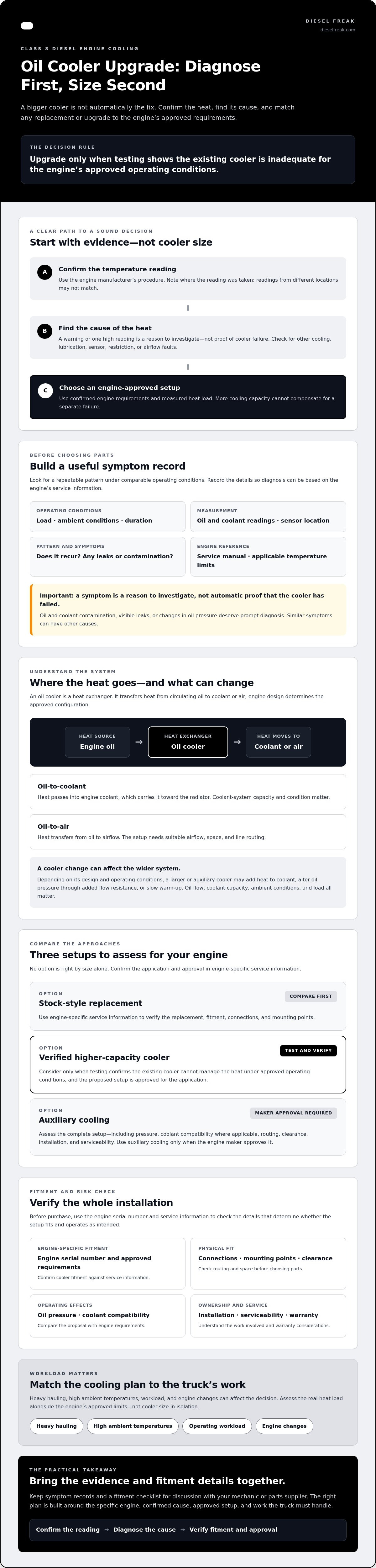
Diagnose abnormal oil temperatures before buying a higher-capacity cooler. A Class 8 diesel engine oil cooler upgrade makes sense only when testing confirms the existing cooler is inadequate for the engine’s approved operating conditions. A single high reading is not enough to justify an upgrade.
Oil temperature depends on engine design, load, ambient conditions, and where the temperature is measured. A sensor reading in one location may not match a reading taken elsewhere, so compare measurements using the engine manufacturer’s procedure. Check the service information for the applicable temperature limits. Don’t rely on a generic threshold from another engine or truck.
An oil cooler transfers heat from engine oil to another medium, commonly coolant in oil-to-coolant systems. The basic purpose of oil cooling is to help manage heat, but the correct operating range and system design are engine-specific.
Which symptoms justify investigating the oil cooler?
Look for a pattern. Recurring high oil temperatures under comparable loads, ambient conditions, and operating durations deserve investigation. One spike or a dashboard warning is a reason to check the truck, not proof that the cooler is faulty. Confirm the reading and identify the conditions that triggered it.
Oil and coolant contamination, visible leaks, or changes in oil pressure also warrant prompt diagnosis. These are reasons to investigate, not automatic proof of cooler failure. Similar symptoms can stem from a thermostat, radiator, sensor, lubrication issue, restricted passages, or airflow problem. Replacing the cooler without isolating the cause can leave the original fault in place.
What should be checked before replacing or upgrading?
Build a useful record before choosing parts. Note oil and coolant readings alongside the truck’s load, ambient conditions, operating duration, and measurement location. Record whether the symptom repeats. Then have inspections and tests performed using procedures approved for that engine.
- Check for oil or coolant leaks and signs of cross-contamination.
- Investigate restrictions and verify sensor accuracy using approved procedures.
- Compare results with the engine-specific service manual and temperature limits.
- Consider other cooling, lubrication, and airflow faults before blaming the cooler.
Make the decision based on evidence. An upgrade is justified only after you’ve verified the cause, confirmed the engine’s limits, and established that the proposed setup is approved for that application. If the fault points elsewhere, fix that first. More cooling capacity won’t compensate for a separate failure.
How a Class 8 Engine Oil Cooler Works and What an Upgrade Changes
An engine oil cooler is a heat exchanger. It moves heat from circulating oil to coolant or air, helping keep oil within the operating conditions specified for that engine. Those limits matter. Oil that runs too hot or too cold can affect lubrication, while a cooler that restricts flow can create its own risks.
Many heavy-duty engines use oil-to-coolant designs, but don’t assume every Class 8 engine shares the same configuration. Engine design, oil flow, coolant capacity, and workload all shape how heat moves through the system. A report from Argonne National Laboratory discusses increasing heat-rejection requirements in heavy-duty engines. Cooling needs must therefore be assessed for the specific application, not answered with a one-size-fits-all part.
Oil-to-coolant and oil-to-air designs: what differs?
In an oil-to-coolant cooler, heat passes from the oil into engine coolant, which then carries it toward the radiator. This design connects oil cooling to the engine’s coolant system, so that system’s capacity and condition matter. An oil-to-air cooler transfers heat from oil to airflow. It needs suitable airflow, space, and line routing. Neither approach is universally better. Verify the engine family’s approved configuration and requirements in the service documentation.
How can an upgraded cooler affect the wider system?
A larger or auxiliary cooler may change oil temperatures, but it can also add heat to the coolant system, alter oil pressure through added flow resistance, or slow warm-up. The result depends on cooler design, oil flow, coolant capacity, ambient conditions, and operating load. More cooling isn’t automatically better. The engine maker’s temperature and pressure requirements are the guardrails.
Check the whole path, not just the heat exchanger. Hose routing must avoid kinks, abrasion, and hot or moving components. Fittings must match, seals must hold, and the cooler must support the required flow without unacceptable pressure drop. Changes to the system can also affect service access. Any claimed temperature or performance improvement needs validation on the intended engine and workload. Don’t assume results from another setup will carry over.
Before selecting a Class 8 diesel engine oil cooler upgrade, confirm that the design is compatible with the engine and cooling system. For broader heavy-duty parts research, browse Class 8 semi-truck parts, then verify current availability and exact fitment for any candidate part before purchase.
Which Class 8 Oil Cooler Upgrade Approach Fits Your Engine?
Choose the least disruptive option that meets the engine’s verified needs. A replacement that looks right or fits a familiar engine family is not necessarily compatible. Match the part to the engine serial number, production details, approved references, cooling-system design, and truck duty cycle.
Use this comparison to frame the decision. Exact fitment and acceptable changes must come from engine-specific service information and the part documentation.
| Approach | Fitment and heat transfer | System changes | Serviceability and documentation |
|---|---|---|---|
| Like-for-like OEM-spec replacement | Matches the approved configuration when verified for the engine and application. | Generally aims to restore the existing system, not redesign it. | Confirm the serial number, production details, replacement references, and service procedures. |
| Verified higher-capacity replacement | Requires documented fitment and evidence that it suits the engine’s thermal needs. | May affect oil flow, pressure drop, coolant heat load, mounting, or clearance. | Check design data, approved application, maintenance access, and any system requirements. |
| Auxiliary cooling, where approved | Adds another heat-transfer component. Compatibility depends on the engine and application. | Can introduce additional lines, fittings, routing, mounting, and service points. | Require manufacturer guidance, installation details, and a plan for inspection and servicing. |
When is an OEM-spec replacement the smarter choice?
If diagnosis confirms cooler failure and the factory configuration meets the truck’s operating requirements, restoring that configuration is often the direct path. Verify the engine serial number and production details, then cross-reference the approved replacement in engine-maker documentation. Don’t choose by appearance or family name alone. Returning the system to its intended design avoids adding changes that may not solve the actual problem.
When should higher capacity or auxiliary cooling be considered?
Consider added capacity only when operating records show sustained thermal demand, fitment is validated, and the manufacturer’s guidance supports the change. Check how the proposed setup affects coolant heat rejection, oil flow, mounting, routing, and maintenance access. A larger core or extra cooler isn’t proof of a better result. Don’t count on horsepower gains or a particular temperature drop without evidence for that exact application.
Bottom line: The right Class 8 diesel engine oil cooler upgrade must match the engine, cooling system, and duty cycle. Confirm compatibility with documentation, not assumptions based on the truck’s appearance or a broad engine-family label.
How to Verify Fitment, Installation Needs, and Upgrade Risks
A cooler that bolts up may still be wrong for the engine. Verify the application before ordering, then confirm installation and post-install checks against the manufacturer’s service information. Use this sequence to keep assumptions out of the parts decision.
- 1. Identify the engine. Record the make, model, serial number, build details, and truck configuration. Find any identification on the existing cooler, but don’t rely on appearance or a broad engine-family match.
- 2. Document the symptoms. Note oil and coolant readings, operating conditions, warning signs, and diagnostic findings. Include when the issue occurs and whether it repeats.
- 3. Confirm the specifications. Check the engine service manual and approved parts references for the required cooler design, operating limits, and application-specific instructions.
- 4. Verify the complete part and installation. Match connections, mounting points, dimensions, and clearance. Confirm with the seller whether hoses, seals, fittings, or mounting hardware are included, and verify that each item suits the application.
What information should you gather before ordering?
Give the parts supplier enough detail to check the exact application: engine make and model, serial number, build details, and existing cooler identification. Add your symptom record and diagnostic results. Ask for fitment confirmation using those details, not a visual match or general engine-family listing. Clarify which supporting parts are included and which, if any, must be sourced separately.
What should a qualified installer verify afterward?
Installation requirements vary. Depending on the approved setup, work may involve draining and refilling fluids, bleeding a circuit, inspecting related components, or following other engine-specific procedures. Confirm the correct process in the service manual. Labor and supporting parts depend on the truck and approved configuration, so establish the scope before work begins.
After installation, have a qualified installer check connections and seals for leaks, confirm fluid levels, and verify pressure and temperature readings using approved procedures. Recheck performance under controlled operating conditions and compare results with the engine maker’s specifications. Record the findings. If a safety-critical warning or fault appears, stop operation and follow the manufacturer’s diagnostic guidance before putting the truck back to work.
Use the engine details and verified fitment requirements to guide your Class 8 diesel engine oil cooler upgrade. To research related heavy-duty parts, browse Class 8 semi-truck parts and confirm current availability and exact fitment before ordering.
Choose a Class 8 Oil Cooler Upgrade with Confidence
Make the decision in sequence: verify the fault, identify the exact engine, match the part to its specifications, and validate the complete system. That process helps separate a confirmed cooling need from a guess based on a hot reading or a part that appears to fit.
A final buyer checklist for the right upgrade
Take this checklist to your mechanic or parts supplier. Confirm each item before ordering:
- Diagnosis: Is the underlying problem confirmed, and have other likely causes been checked?
- Operating limits: Have you checked the engine manufacturer’s oil temperature and pressure limits for this exact application?
- Engine identification: Do you have the engine make, model, serial number, and relevant build details?
- Part fitment: Does the part match the approved application, including every oil and coolant connection, mounting point, and clearance requirement?
- System compatibility: Are any changes to oil flow, coolant heat rejection, routing, or mounting approved and documented?
- Installation and service: Are installation procedures, required supporting parts, inspection needs, and future service access understood?
If any answer is unclear, pause and verify it against the service information or with a qualified parts professional. An attractive listing or broad engine-family match isn’t enough. Keep the documentation with the truck’s maintenance records, including the part identification and post-install inspection findings.
Where to go next for engine-specific parts research
For broader heavy-duty upgrade context, consult the Diesel Performance Parts guide. If your truck has a confirmed Cummins application, the Cummins Engine Performance Parts guide may help you research related engine-specific options. Treat either guide as a starting point, then verify every candidate part against the engine serial number and manufacturer documentation.
A well-chosen Class 8 diesel engine oil cooler upgrade addresses a verified need and works within the complete system’s requirements. It’s not automatically the biggest cooler or the most extensive modification. Match the setup to the engine and the work it does.
Diesel Freak is a family-owned parts resource focused on Class 8 semi-truck parts and diesel performance components. Explore Diesel Freak’s Class 8 semi-truck parts for broader parts research. Confirm current oil cooler availability and exact engine fitment before making a purchase decision.
Build a Cooling Plan That’s Ready for the Road
The right Class 8 diesel engine oil cooler upgrade starts with a confirmed diagnosis, not a guess. Verify the engine’s temperature and pressure requirements, then match the cooler to its exact configuration and the demands of the work. A like-for-like replacement may be the right call. Higher-capacity or auxiliary cooling needs verified fitment and approval for the complete system.
Before ordering, gather the engine serial number, service information, symptom records, and details about connections, mounting, and installation requirements. Afterward, check the system using approved procedures. Solid documentation helps your mechanic or parts supplier make a better-informed decision.
Diesel Freak is a family-owned business founded in 2009, focused on Class 8 semi-truck parts. Browse the broader parts range and confirm current oil cooler availability and exact engine fitment before purchase. Explore Diesel Freak’s Class 8 semi-truck parts.
Make the choice with evidence. Your engine and workload deserve a setup built to handle the miles ahead.
Frequently Asked Questions
Can an upgraded oil cooler lower a Class 8 diesel engine’s oil temperature?
Yes, if the existing cooler can’t manage the engine’s verified heat load and the replacement is approved for that application. A lower reading isn’t guaranteed. Results depend on engine design, workload, ambient conditions, coolant capacity, oil flow, and measurement location. First confirm the temperature reading and diagnose the cause. Compare post-install readings under similar operating conditions with the engine manufacturer’s specifications.
How do I know if my truck’s oil cooler is failing?
Recurring abnormal oil temperatures, oil or coolant contamination, visible leaks, or pressure changes can justify an inspection, but none confirms cooler failure by itself. A thermostat, radiator, sensor, lubrication fault, restriction, or airflow issue can produce similar symptoms. Record when the warning or reading occurs, then have the system checked using engine-approved procedures. Don’t replace the cooler until diagnosis points to it.
Is a larger oil cooler always better for a Class 8 diesel?
No. A larger cooler may change oil flow and pressure drop, add heat to the coolant system, affect warm-up, or create mounting and service-access issues. More cooling capacity is useful only if it addresses a verified need and works within the engine’s approved temperature and pressure limits. Check fitment and system requirements in engine-specific service information. Cooler size alone doesn’t establish compatibility or performance.
What information do I need to confirm oil cooler fitment?
Gather the engine make, model, serial number, and relevant build details, plus the truck’s existing cooler identification if available. Use these details to check approved parts references and engine service information. Confirm connections, mounting points, dimensions, clearance, and any supporting hoses, seals, fittings, or hardware. A broad engine-family match or similar appearance isn’t enough. Ask the parts supplier to verify the exact application before ordering.
Can an oil cooler upgrade increase diesel engine horsepower?
An oil cooler upgrade shouldn’t be treated as a horsepower modification. Its job is to manage oil temperature within engine-specific operating conditions, not directly add power. If a truck has a power or temperature concern, diagnose it separately and review changes with a qualified technician using engine-maker guidance. Don’t assume a cooler will increase horsepower or improve performance without credible evidence for that exact engine and setup.
How much does a Class 8 diesel oil cooler upgrade cost?
The total depends on the exact engine and approved setup, the cooler and supporting parts required, access to the component, and installation procedures. A like-for-like replacement may involve different work than an auxiliary system. Get a parts and labor estimate based on the engine serial number and diagnosis, and ask what fluids, seals, fittings, or other components are included. Verify current part availability and fitment before committing.
Can I install an upgraded engine oil cooler myself?
Possibly, if you have the required tools, experience, and access to the engine-specific service procedures, but don’t treat the job as a universal bolt-on. Depending on the setup, installation may involve draining and refilling fluids, bleeding a circuit, checking seals, and verifying pressure and temperature readings. Follow approved procedures and inspect for leaks before returning the truck to work. If you’re unsure, use a qualified installer.
Disclaimer
Diesel Freak LLC is in no way associated, sponsored, or affiliated with Any OEM manufacturer. Products from Diesel Freak LLC presented in this listing are not to be confused with any of the products or trademarks of any OEM company. All parts listed to fit these manufacturers are replacement aftermarket parts.