

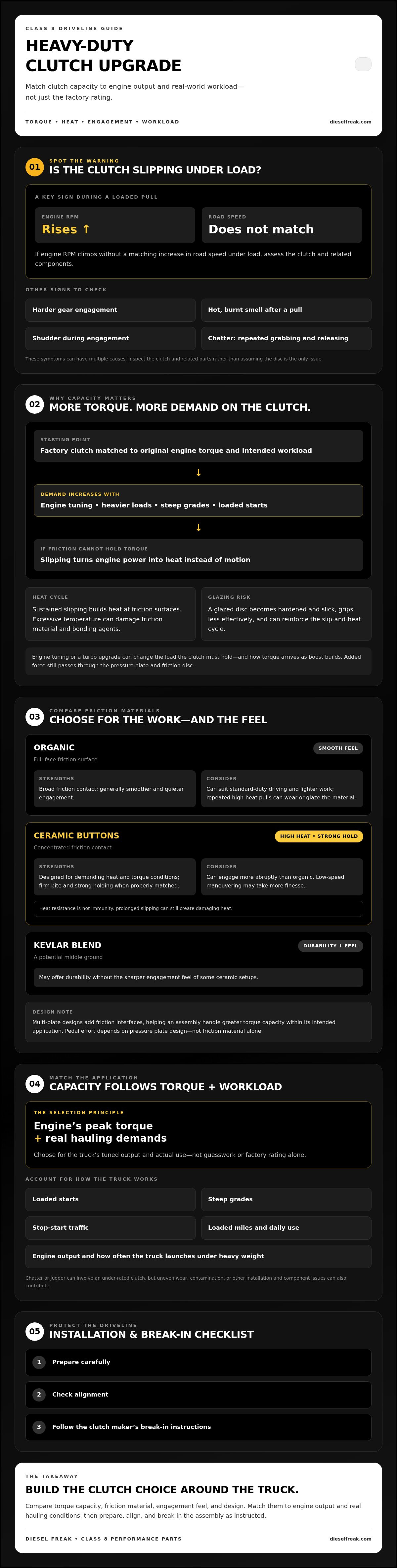
What good is more horsepower if the clutch slips when a loaded trailer hits a steep grade? A stock clutch is matched to a particular engine output and workload, so tuning or demanding operating conditions can push it beyond its intended capacity. A heavy duty semi truck clutch upgrade can help transfer engine torque while reducing the slipping that creates heat and wear. If engine RPM rises without a matching increase in road speed under load, it’s time to assess the clutch and related components.
This guide covers the specifications that matter, including torque capacity, friction materials, and single-disc versus twin-disc designs. You’ll learn how organic and ceramic friction surfaces differ, what to consider about engagement feel, and how to match a clutch to your engine and application. The goal is to make a considered choice based on the truck’s output and workload, not guesswork.
A clutch upgrade should be part of the wider performance plan whenever engine modifications increase torque. Diesel Freak is an online retailer specializing in high-performance parts for Class 8 semi trucks, including turbochargers and charge air cooler plumbing. Use the guidance below to assess what your driveline needs before selecting components.
Key Takeaways
- Watch for clutch slip under load before heat and wear lead to further problems.
- Compare ceramic and organic friction materials for their differences in heat tolerance and engagement feel.
- Use your engine’s peak torque and hauling demands to guide a heavy duty semi truck clutch upgrade.
- Prepare carefully, check alignment, and follow the clutch maker’s break-in instructions.
- Match clutch capacity to your engine’s output and real-world workload, not just its factory rating.
Stop the Slip: Why Your Stock Class 8 Clutch Can’t Keep Up
A factory clutch is matched to the engine’s original torque output and intended workload. Add engine tuning, pull heavier loads, or spend more time on steep grades, and the clutch may face demands beyond its design. A clutch is the mechanical linkage between the engine and transmission. If it cannot maintain enough friction to transfer torque, some engine power becomes heat instead of motion.
Look for warning signs under load: engine RPM climbs without a matching increase in road speed, gear engagement becomes harder, or a hot, burnt smell appears after a pull. Shuddering as the clutch engages can also indicate a problem. These symptoms can have several causes, so inspect the clutch and related components rather than assuming the disc is the only issue.
The Limits of Organic Friction Materials
Organic discs generally offer smoother, quieter engagement, which can suit standard-duty driving. But sustained slipping on a steep grade builds heat at the friction surfaces. Excessive temperature can damage the friction material and its bonding agents. A glazed disc develops a hardened, slick surface that grips less effectively, allowing slipping and heat to reinforce each other. Smooth engagement has value, but organic material may have less tolerance for repeated high-heat, high-torque demands than material designed for tougher work.
Torque Spikes and Driveline Stress
Engine tuning changes the load the clutch must hold. A turbo upgrade can also change how torque arrives as boost builds. For example, a BorgWarner turbo paired with a tuned engine can deliver stronger acceleration, but that added force still passes through the pressure plate and friction disc. If clutch capacity does not match the engine’s output and hauling demands, the disc can slip while the pressure plate struggles to maintain grip.
Chatter is another warning sign. It feels like repeated grabbing and releasing as the clutch engages. An under-rated clutch may contribute, but uneven wear, contamination, or other installation and component issues can also cause it. Repeated judder can make controlled starts difficult and put extra strain on the driveline.
A weak clutch can limit the benefit of an engine tune. More engine power won’t reach the transmission reliably if the clutch cannot hold torque. A heavy duty semi truck clutch upgrade should be matched to the engine’s tuned output and the truck’s real workload. That means accounting for more than peak power: consider loaded starts, grades, and how the truck is used day to day.
The Anatomy of Strength: Ceramic vs. Organic Performance Materials
Clutch material affects how the truck holds torque, manages heat, and feels during engagement. Full-face organic discs provide broad friction contact and generally smoother, quieter engagement. That can suit daily driving and lighter work, but repeated high-heat pulls can wear or glaze the material. Ceramic button discs are designed to tolerate demanding heat and torque conditions, making them a common choice for high-performance and heavy-haul applications. For an overview of heavy-duty clutch design factors, consider how friction material, clamp load, and operating conditions work together.
Ceramic Clutch Buttons: Maximum Bite
Ceramic buttons concentrate contact into smaller friction areas, delivering a firm bite and strong holding capability when properly matched to the clutch assembly. Their heat tolerance can help them withstand repeated engagement in demanding conditions, including stop-and-go hauling. Heat resistance does not make a clutch immune to overheating, however. Prolonged slipping still creates damaging heat. Ceramic engagement can feel more abrupt than organic, so frequent low-speed maneuvering may require more finesse from the driver. Pedal effort depends on the pressure plate design, not friction material alone.
Ceramic friction is a high-heat, high-holding option for torque-heavy rigs that need a clutch built for demanding work.
Hybrid and Kevlar Options
Kevlar-blend materials may offer a middle ground for drivers seeking durability without the sharper engagement feel of some ceramic setups. Multi-plate designs add friction interfaces, helping an assembly handle greater torque capacity within its intended application. The right choice depends on more than material. Consider loaded miles, steep grades, stop-start traffic, engine output, and how often the truck launches under heavy weight.
There’s no reliable one-size-fits-all mileage promise. A research benchmark compares ceramic button discs at 4,500 operating hours with organic discs at 1,800 hours, or about 2.5 times the operating life in that comparison. Those figures aren’t guaranteed service life, and operating hours can’t be converted to miles without knowing the truck’s speed, duty cycle, and conditions. Treat them as a comparison between materials, then match the clutch to the job.
A heavy duty semi truck clutch upgrade should balance holding power with the way you drive. For a tuned Class 8 engine, don’t choose by friction material alone. Check the complete clutch’s torque capacity and engagement characteristics against your engine and hauling demands. Explore Class 8 semi truck performance parts as you plan a driveline that can put added power to work.
Calculating Torque Capacity for a Heavy Duty Semi Truck Clutch Upgrade
Choose a clutch for the engine’s actual output, not its factory rating. Start with the engine builder’s or tuner’s peak torque figure after modifications. Confirm whether it’s measured at the crankshaft or wheels, then compare it with the clutch manufacturer’s rated capacity on the same basis. Don’t estimate from horsepower alone. Torque delivery, gearing, vehicle weight, and the demands of loaded starts and steep grades all affect what the clutch has to hold.
As a sizing target, this guide’s recommended 20% capacity margin means multiplying peak engine torque by 1.20. For example, if verified peak torque is 1,800 lb-ft, a clutch rated for at least 2,160 lb-ft would meet that target. Treat this as a planning guideline, not a universal rating standard. Confirm the manufacturer’s rating method and application guidance before choosing a clutch.
Apply the same checks across engine platforms. Whether you’re evaluating Cummins engine performance parts or upgrades for Detroit and Cat engines, match the clutch to the specific build’s peak torque and duty cycle. A tune changes the load the driveline must manage, so include clutch capacity in the power plan.
Pressure Plate Clamp Load Explained
Clamp load is the force the pressure plate applies to hold the clutch disc against the flywheel. More clamping force can increase the assembly’s ability to resist slipping, provided the components are designed to work together. But higher clamp load can also increase pedal effort and affect engagement feel. Choose a heavy-duty pressure plate rated for the engine and application. A stiff pedal alone does not mean the setup is right for the truck.
Flywheel Compatibility and Resurfacing
A new clutch needs a flywheel surface that meets the clutch maker’s requirements for flatness, finish, and condition. Don’t install a clutch against a damaged or out-of-spec surface. Have the flywheel inspected and follow the manufacturer’s instructions on resurfacing or replacement. Machining isn’t suitable for every flywheel.
Check for heat cracks, blue spots, scoring, and uneven wear. These marks can signal excessive heat or poor contact, so assess the flywheel before reassembly. A compatible steel flywheel may suit some demanding builds, but material alone doesn’t guarantee better performance. Verify fit, specifications, and compatibility with the clutch system. A heavy duty semi truck clutch upgrade works as a system: torque rating, pressure plate, disc, and flywheel all need to match the tuned engine and the haul.
Installation and Break-In: Protecting Your Driveline Investment
A heavy duty semi truck clutch upgrade performs as intended only when the installation is clean, aligned, and matched to the transmission and flywheel. Before the swap, verify that the clutch assembly fits the truck and engine, review its installation and break-in instructions, and inspect the flywheel and release components. Follow the specified fastener sequence and torque values. Never force the transmission into place; misalignment can damage the disc hub, input shaft, or pilot bearing.
- Inspect the flywheel and replace or resurface it only as the clutch maker allows.
- Use the correct alignment tool and confirm the disc faces the right direction.
- Check the pilot bearing, release bearing, fork, pivot, and linkage or hydraulic components for wear.
- After installation, adjust the release system to the manufacturer’s specifications.
The 500-Mile Break-In Rule
Break-in lets new friction surfaces bed against their mating surfaces. Some clutch makers specify a 500-mile break-in, but requirements vary by clutch design. Follow the instructions supplied with the assembly rather than treating that distance as universal. During any required break-in, avoid heavy loads, aggressive launches, prolonged slipping, and high-heat pulls. These conditions can overheat the friction surfaces before they’ve seated properly and may glaze the disc.
During the specified break-in period, use frequent, deliberate gear changes to help seat the clutch discs without prolonged slipping.
Check the Release Mechanism
A new clutch won’t correct worn release hardware. Inspect the clutch fork and pivot ball for wear or damage, and confirm the linkage or hydraulic system is adjusted and operating correctly. Incorrect free play or release travel can cause incomplete engagement or keep the clutch partially released, creating heat and premature wear.
Inspect the throw-out bearing whenever the transmission is removed. Replacing it during the clutch job is often practical because the transmission is already out, but follow the clutch manufacturer’s guidance and use compatible parts. Document the installation and keep the supplied instructions. Incorrect parts, poor alignment, improper adjustment, or skipped break-in requirements may affect performance and could jeopardize warranty coverage, depending on its terms.
Protect the work from the first bolt to the first loaded haul. Review Class 8 performance parts as you plan a driveline setup for tuned power and long-haul demands.
Diesel Freak Parts for Class 8 Builds
More engine power means more demand on the driveline. A clutch upgrade isn’t an afterthought when a build needs to transfer tuned torque through hard pulls and loaded starts. Diesel Freak is an online retailer specializing in high-performance parts for Class 8 semi trucks, with offerings that include turbochargers and charge air cooler plumbing.
When planning engine upgrades, consider how changes to torque delivery affect the clutch and the rest of the driveline. Match clutch capacity to the engine’s actual output and the truck’s hauling conditions. Diesel Freak’s Class 8 parts can be part of a broader performance build, while clutch selection should be based on the truck’s specifications and the clutch maker’s fitment guidance.
Diesel Freak is family-owned and operated and was founded in 2009. The company focuses on high-performance diesel parts for Class 8 trucks and Mahindra Roxor vehicles. A heavy duty semi truck clutch upgrade is a foundational consideration for drivers building beyond stock, but the right choice still depends on torque, transmission compatibility, and real-world duty cycle.
Total Rig Optimization
Think in systems, not isolated parts. Before selecting hardware, confirm the engine’s tuned peak torque, clutch capacity, transmission fitment, and how the truck spends its working hours. A setup for frequent heavy-haul starts may need different friction characteristics from one used mainly for steady highway miles. Check manufacturer specifications and compatibility details before committing to components. Diesel Freak also offers branded apparel for diesel enthusiasts.
Built Around the Application
Durability depends on how well components match the job, not on a bold claim on a box. Choose parts for the engine, load, terrain, and operating conditions, then protect the investment with correct installation and the clutch maker’s break-in instructions. Diesel Freak’s Class 8 parts offering supports performance builds, but clutch fit and capacity still need to match the truck and its work.
Build beyond stock with purpose. Match the hardware to the haul, and make sure the driveline can handle the power you add.
Build a Driveline That’s Ready for the Next Haul
Power only pays off when the driveline can put it to work. Choose clutch capacity for your tuned engine’s peak torque and real hauling demands, then match friction material to the heat and engagement your application requires. Proper installation and the clutch maker’s break-in directions help protect that investment from the start.
A heavy duty semi truck clutch upgrade is part of a broader performance plan, not a decision to make by guesswork. Diesel Freak specializes in high-performance parts for Class 8 trucks, including turbochargers and charge air cooler plumbing. Match any engine upgrades with a careful assessment of clutch capacity, transmission compatibility, and workload.
Ready to plan your next build? Explore Class 8 performance parts at Diesel Freak and choose components with your engine, driveline, and workload in mind.
Frequently Asked Questions
How much torque can a heavy-duty semi truck clutch upgrade handle?
Torque capacity depends on the specific clutch assembly, not just whether it’s labeled heavy-duty. Check the manufacturer’s rating and confirm whether it’s measured at the engine or wheels, then compare it with your engine’s peak torque after tuning. Include the truck’s load and duty cycle in the decision. As a planning target, this guide recommends a 20% capacity margin, but verify the right rating with the clutch manufacturer.
What is the difference between a ceramic and an organic clutch disc?
Ceramic discs are designed to withstand higher heat and demanding torque, while organic discs generally offer smoother, quieter engagement. That difference affects both hauling performance and driver feel. Ceramic may engage more abruptly, which can take adjustment in stop-start driving, while organic material may suit lighter-duty use. Neither material is right for every rig. Match the disc to engine torque, hauling conditions, and the clutch maker’s application guidance.
How long does a heavy-duty clutch break-in period last?
Follow the break-in instructions for your exact clutch, because the required period varies by design and friction material. Some setups specify a period around 500 miles, but that isn’t a universal rule. During the prescribed break-in, avoid heavy loads, aggressive launches, prolonged slipping, and high-heat pulls. These conditions can overheat new friction surfaces before they bed in. Use deliberate gear changes and let the clutch engage cleanly.
Do I need to replace my flywheel when upgrading my clutch?
Not necessarily. The flywheel must be compatible and within the clutch manufacturer’s limits for condition, surface finish, and flatness. Have it inspected for cracks, blue heat marks, scoring, and uneven wear. Resurface it only if the manufacturer permits it and the flywheel remains within specification; otherwise, replacement may be needed. Don’t install a new clutch against a damaged or out-of-spec surface, since poor contact can contribute to judder, heat, and wear.
Will a heavy-duty clutch make my pedal harder to push?
It can, but pedal effort depends on the complete clutch design, especially pressure plate spring force and release-system setup. A higher clamp load may help the assembly resist slipping, yet it can also increase pedal effort. Ceramic friction material alone doesn’t determine how heavy the pedal feels. Before choosing, check the clutch maker’s information about pedal feel, pressure plate compatibility, and required linkage or hydraulic adjustments for your truck.
What are the signs that my current semi truck clutch is slipping?
Engine RPM rising without a matching increase in road speed is a common sign, especially under load or during a climb. You may also notice a burnt smell after pulling, weak acceleration, or difficulty maintaining gear under torque. Chatter or shudder during engagement can indicate a clutch or related component issue, though it has other possible causes. Reduce strain and arrange an inspection rather than continuing to make hard pulls.
Can I use a performance clutch for standard long-haul applications?
Yes, if the clutch is compatible with the truck and suited to its torque and working conditions. A high-capacity setup may be unnecessary for a stock engine on lighter duty, and some performance materials engage more abruptly than organic discs. Consider loaded miles, grades, stop-start work, and driver preference. Check the manufacturer’s fitment and application details so the clutch delivers the holding power you need without creating an unsuitable engagement feel.
Why is ceramic better for heat dissipation in heavy-duty trucks?
Ceramic is better described as heat-resistant, not as a material that automatically dissipates heat more effectively in every clutch design. Its ability to tolerate demanding temperatures can benefit high-torque hauling, but prolonged slipping still generates damaging heat in the clutch assembly. Good application matching and proper engagement matter. Choose ceramic for the operating demands it’s designed to handle, and follow the maker’s installation and break-in instructions to protect the friction surfaces.
Disclaimer
Diesel Freak LLC is in no way associated, sponsored, or affiliated with Any OEM manufacturer. Products from Diesel Freak LLC presented in this listing are not to be confused with any of the products or trademarks of any OEM company. All parts listed to fit these manufacturers are replacement aftermarket parts.