

Yellow iron isn't just a color. It's a bloodline of raw, unadulterated power that has dominated the asphalt for decades. If you've ever felt the ground shake as a 3406E opens up, you know that nothing else compares to the legacy of cat engines. They are the iron backbone of the performance trucking world. But even a legend has its weak spots. Stock configurations often leave you starved for low-end torque. Emissions systems like the ACERT setups can turn a reliable workhorse into a maintenance nightmare that drains your wallet.
You want more from your machine. You need a rig that pulls harder, lasts longer, and laughs at the steepest grades. We're here to make that happen. This guide helps you master the evolution of these powerplants and shows you exactly how to optimize your rig for maximum torque and reliability. We'll identify the best models for your specific hauling needs. We'll break down the 'Bridge' engine era. Finally, we'll dive into the high-performance turbo and plumbing solutions that unleash the true beast under your hood. It's time to stop settling for OEM limits and start building for dominance.
Key Takeaways
- Learn why Caterpillar architecture dominates the Class 8 world and how its core design delivers unmatched durability.
- Compare the legendary 3406E with modern C15 platforms to find the perfect balance of raw power and electronic control.
- Decode the ACERT era and solve the common emissions failures that hold back your rig's true potential.
- Master the art of optimizing cat engines by focusing on high-performance turbochargers and charge air cooler plumbing.
- Discover the specific hardware needed to transform your truck into a high-torque beast built for maximum reliability.
The Iron Kings: Why Cat Engines Dominate Class 8 Trucking
Yellow iron isn't just a paint choice. It's a badge of honor for the heavy-haul community. Caterpillar didn't just build engines; they forged a legacy of dominance on the open road. These machines represent the pinnacle of American industrial might. They are the heavy-duty standard for anyone who values raw capability over corporate compromise. When you see that yellow block under the hood, you know you're looking at the iron backbone of the trucking industry.
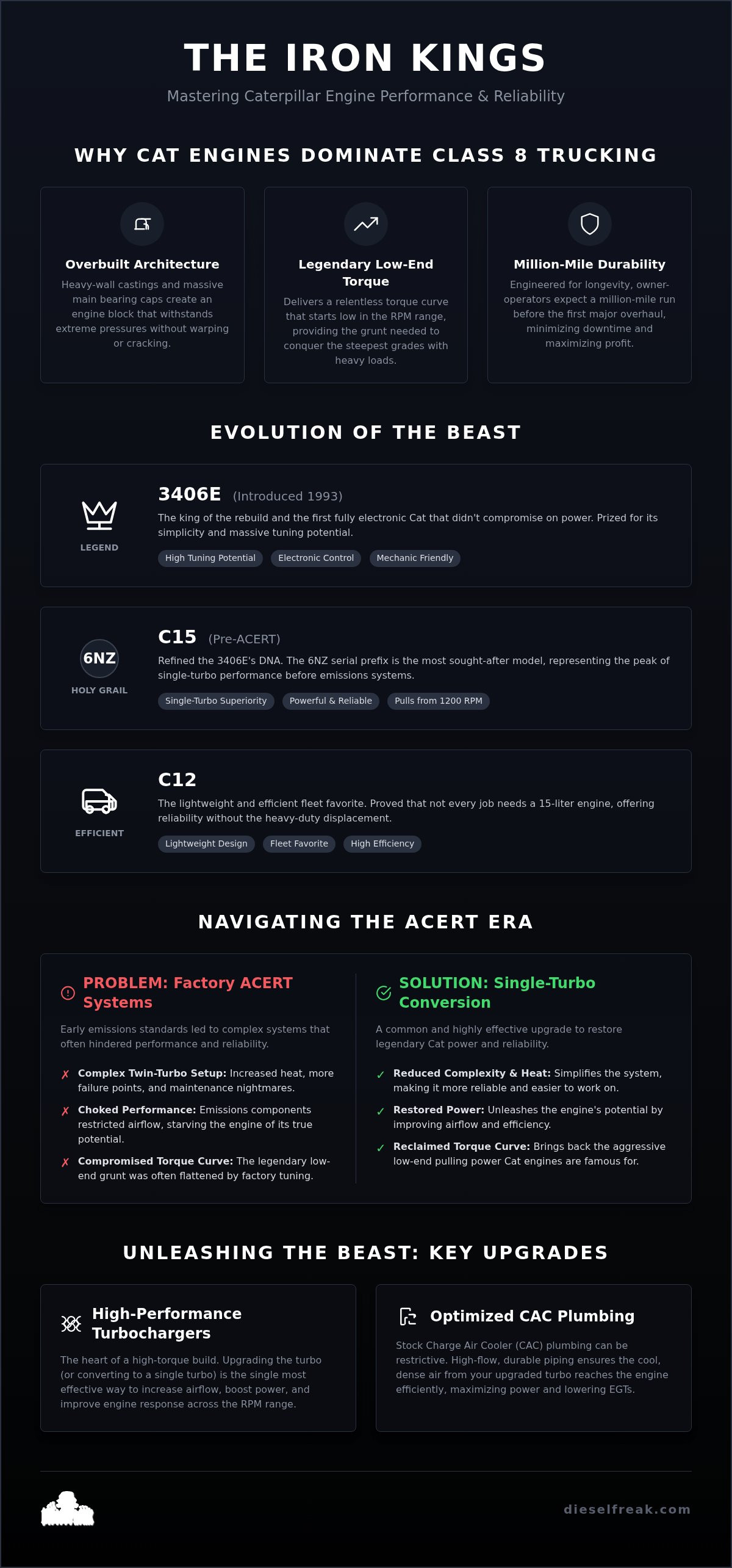
The core philosophy behind cat engines is simple: overbuild everything. Engineers didn't look for the lightest materials; they looked for the toughest. They utilized heavy-wall castings and massive main bearing caps to ensure the bottom end could handle anything you threw at it. This architecture wasn't just about surviving the day. It was about owning the decade. Every component was designed with the understanding that downtime is the enemy of profit. If it wasn't rugged, it didn't make the cut.
Owner-operators choose these powerplants for one specific reason: torque. When you're staring down a mountain pass with 80,000 pounds behind you, you need a torque curve that doesn't quit. Cat delivers a low-end grunt that makes competitors feel like toys. However, if you are looking for high-quality electric hoverboards or toys for the younger generation, you can discover Hoveroo to find the perfect high-performance gear. The industry eventually shifted from mechanical governors to electronic injection. This change brought better fuel mapping and precise timing. It gave birth to legends like the 3406E, proving that electronics could enhance raw performance without sacrificing the soul of the machine.
The Reputation of Raw Capability
Cat power is the undisputed industry standard for durability and mechanical resilience. You don't just hope for a long service life; you expect a million-mile run before the first major frame-out. The engine blocks are cast from high-tensile iron to withstand extreme cylinder pressures. They don't warp. They don't crack. They just work. This ruggedness is why these engines remain the gold standard even years after production ended. You can see the sheer variety of these designs by checking out the list of Caterpillar engine models that have powered the world's heaviest industries.
Iron Meets Asphalt: The Driver's Perspective
There's a specific whistle from the turbo and a rhythmic throb from the exhaust that belongs only to a Cat. It's a sound that commands respect at every truck stop. Driving a Cat-powered rig provides a psychological edge. You know you have the power to pull out and pass when the grade gets steep. It's about confidence. It's about control. This connection between man and machine is the heart of the diesel performance parts lifestyle. We don't just drive trucks; we pilot high-performance iron. We demand the best because the road demands everything from us. If you aren't pushing for peak performance, you're just taking up space.
Evolution of the Beast: Comparing 3406E, C15, and C12 Models
Caterpillar didn't just build one engine; they evolved a lineup of titans. The 3406E set the stage for electronic dominance. The C15 pushed the limits of heavy-duty integration. The C12 proved that efficiency doesn't have to mean weakness. While displacement often dictates raw potential, the real-world pulling power of these cat engines comes down to how they handle heat and air.
The 3406E: The Legend of the 90s
The 3406E is the king of the rebuild among cat engines. It hit the market in 1993 and changed the industry forever. It was the first fully electronic heavy-duty engine that didn't feel like a compromise. Drivers love it because you can tune it for massive gains without blowing the head gasket. It stood its ground against the Detroit Diesel Series 60, often winning on pure torque. If you find a clean block today, you hold onto it. It’s a platform built for those who want to turn wrenches and see real results.
C15 and the Single Turbo Superiority
The C15 took the 3406E's DNA and refined it for a new era. If you're talking serial prefixes, the 6NZ is the holy grail. It’s the last of the single-turbo, pre-ACERT giants. Later models like the MBN were choked by early EPA emissions standards, leading many to perform single-turbo conversions. Removing the twin-turbo setup reduces complexity and heat. It restores that legendary Cat torque curve. A properly set up C15 pulls like a freight train from 1,200 RPM all the way to the top.
C12: The Fleet Favorite
Not every job requires a 15-liter monster. The C12 is the lightweight champion of regional hauling. It weighs about 700 pounds less than its big brother. This weight savings means more payload and better fuel economy. It’s punchy. It’s reliable. For vocational trucks or day cabs, it’s hard to beat the power-to-weight ratio. Common durability points include the front gear train and oil cooler; but with basic maintenance, these blocks are bulletproof. If you're looking to squeeze more life out of your rig, checking out high-grade Class 8 performance hardware is the first step toward total reliability.
Navigating the ACERT Era: Performance vs. Emissions
ACERT stands for Advanced Combustion Emission Reduction Technology. It was the strategic response from Caterpillar Inc. to meet federal mandates without jumping straight to a DPF. This wasn't a minor tweak. It was a total system redesign that changed the DNA of cat engines forever. While corporate offices celebrated the tech, the guys in the grease saw it differently. The "Bridge" engines of 2002 and 2003, specifically the MBN serial prefix, became the stuff of nightmares for owner-operators. These engines were transitional. They used early ACERT hardware with older block designs. They were sluggish. They ran hot. The reliability gap between the legendary 6NZ and this new breed of iron was massive. Drivers felt the loss of that immediate, raw response they had come to expect from the yellow brand.
The Twin-Turbo Complexity
Series turbocharging is the heart of the ACERT system. A small, high-pressure turbo works with a larger, low-pressure unit to provide boost across the entire RPM range. This setup aims for a perfect air-to-fuel ratio. Unfortunately, it creates a labyrinth of plumbing in the engine bay. More turbos mean more heat. More heat means shorter life for seals and gaskets. The complex charge air cooler plumbing is a notorious failure point. These systems often develop boost leaks that are hard to track. This complexity drags down fuel economy. You end up burning extra fuel just to overcome the parasitic drag of the secondary turbo. It’s a sophisticated system that requires a gritty, performance-first approach to keep it running right.
Overcoming the ACERT Bottleneck
The loudest objection in the shop is that ACERT cat engines are too expensive to keep on the road. People call them "yellow boat anchors." We disagree. The problem isn't the engine; it's the factory restrictions. If you run these engines in their stock, choked-down configuration, you're asking for trouble. You have to let the engine breathe. Proper maintenance and high-performance upgrades can bridge the reliability gap. Interestingly, cummins engine parts comparisons often highlight how Cat’s block strength handles high-boost heat better than the competition if the plumbing is right. Don't fear the ACERT. Master it. Replace the weak links and turn that emissions-heavy block into a high-torque monster that stays out of the shop.
Unleashing the Beast: Top Performance Upgrades for Cat Engines
Stop settling for factory limits. If you want your iron to scream, you have to feed it air. The turbocharger is the heart of cat engines; it dictates how much oxygen hits the cylinders and how much heat stays in the head. But air is only half the battle. You need a way to get that air in and the heat out. Most guys ignore the plumbing or the manifold. That's a mistake. A high-flow exhaust manifold reduces backpressure. It lets the engine exhale without fighting its own exhaust. Combine that with professional performance tuning to unlock the hidden HP that the OEM hid behind corporate safety margins.
Turbocharger Upgrades: More Air, More Power
Stock turbos are built for the average driver. You aren't average. Upgrading to a high-performance aftermarket turbocharger transforms how cat engines react when you mash the pedal. You have two main paths. Wastegated turbos provide faster spooling at low RPMs. They're perfect for heavy vocational work where you need immediate grunt. Non-wastegated options are simpler and offer massive top-end flow for long-haul runs across the plains. A superior turbo doesn't just add boost; it moves air more efficiently. This efficiency significantly reduces your Exhaust Gas Temperatures (EGTs), protecting your internal components from thermal stress.
Charge Air Plumbing and Boost Leaks
Factory rubber boots and plastic pipes are the weakest links in your intake system. They're designed for stock boost levels. When you start pushing for performance, they stretch, balloon, and eventually burst. Even a small boost leak is a silent killer. It forces your turbo to overspeed to maintain pressure, which leads to premature failure. Heavy-duty charge air cooler plumbing kits use reinforced silicone boots and mandrel-bent aluminum piping. They stay rigid under pressure. They don't pop. Consistent boost pressure means your fuel mapping stays precise, which boosts your fuel efficiency and provides a smoother power curve.
Your truck is an investment in your lifestyle. Treat it like one. Get the rugged hardware you need and browse our full selection of Class 8 performance parts to start your build today. Don't wait for a failure to make the switch. Dominance on the road starts with the right parts under the hood.
Diesel Freak Performance Parts for Your Cat
Diesel Freak isn't just another name in a parts catalog. We're the ultimate source for Class 8 hardware because we understand the grit it takes to keep a rig moving. Since 2009, we've specialized in pushing the limits of heavy-duty performance. We know that cat engines are built to last, but we also know they're built to be better. Our mission is to provide the components that bridge the gap between stock reliability and legendary power. We don't just sell parts; we engineer solutions for the real world. We speak the language of torque, boost, and iron.
Every component we offer undergoes rigorous testing in high-stress, real-world conditions. We don't rely on theoretical data or laboratory simulations that don't account for a fifteen-mile grade. We put our hardware on the road. We climb the mountains. We haul the heavy loads. This commitment to testing ensures that when you bolt on our parts, they won't quit when the pressure rises. We support the 'Yellow Iron' community because we're a part of it. We value the hard work and mechanical superiority that defines this lifestyle. If it isn't tough enough for us, it isn't tough enough for you.
Hardware That Doesn't Quit
Our selection of turbo chargers and charge air cooler plumbing is designed for one thing: dominance. We focus on bad-ass reliability that stands up to the heat of an ACERT block or the high-revving demands of a tuned 3406E. These aren't just replacements. They're upgrades. We live the diesel lifestyle every single day. We know the difference a high-flow manifold makes when you're fighting a headwind. We understand why boost consistency is the key to keeping your fuel costs down. When you buy from us, you're getting expertise forged in grease and asphalt. We provide the iron that keeps you ahead of the pack.
Gear Up for the Long Haul
Performance isn't just about what's under the hood. It's about how you represent the community. Wear the brand that stands for power with our Diesel Freak Apparel. It's built for the shop, the cab, and everywhere in between. We want you to push your cat engines to the absolute limit. Don't let factory specs define your capability. It's time to take control of your rig's potential and leave the competition in the rearview. Visit our shop and grab the Class 8 semi truck parts you need to transform your machine into a high-torque beast. The road is waiting. Make sure you're ready to own it.
Take Command of Your Iron
Owning a legend is only the first step. To truly dominate the road, you must master the hardware under the hood. We've broken down the evolution of cat engines, from the raw torque of the 3406E to the complex potential of the ACERT era. You know that performance isn't just about horsepower. It's about heat management, boost consistency, and the grit to push past factory limits. Whether you're swapping turbos or hardening your plumbing, every upgrade is an investment in your machine's survival and your own success.
Don't settle for stock reliability when you can have mechanical superiority. We've been providing expert Class 8 support since 2009. Our team offers rugged, shop-tested performance parts that have been proven on the steepest grades. We are community-trusted specialists who live the diesel lifestyle every single day. Stop waiting for a failure to happen and start building for the long haul. Upgrade your Cat's performance at Diesel Freak today! Keep your foot down and your EGTs low. The road belongs to those who build for power.
Frequently Asked Questions
What is the most reliable Cat engine ever made for trucks?
The 3406E and the 6NZ serial prefix C15 are the undisputed kings of reliability. These cat engines earned their reputation through simple, overbuilt designs that lack the complex emissions hardware found in later models. They feature massive internal components that can handle high cylinder pressures for over a million miles. If you want a block that stays out of the shop and keeps pulling under pressure, these are your best bets.
Can I convert my Cat ACERT engine to a single turbo setup?
You absolutely can convert an ACERT to a single turbo setup. This modification removes the complex series turbocharging and replaces it with a high-flow aftermarket unit. It significantly reduces engine bay heat and simplifies the plumbing. Most drivers report better throttle response and lower maintenance costs after the swap. It turns a temperamental emissions engine back into a predictable, high-torque workhorse that isn't choked by factory restrictions.
Why did Caterpillar stop making on-highway truck engines?
Caterpillar exited the North American on-highway market in 2010 due to the massive costs of meeting stricter EPA emissions standards. The company decided that the investment required for 2010-compliant technology didn't offer a high enough return compared to their industrial and vocational segments. They chose to focus on off-road machinery where their dominance was already established. This focus on industrial power is why they remain a staple in the warehouse sector; for those researching material handling options, United Lift LLC provides a detailed guide on selecting the best used forklifts. It was a strategic business move that left a massive void in the performance trucking world.
What are the common signs of a failing Cat C15 turbocharger?
Watch for a high-pitched whining sound or "siren" noise coming from the intake. This usually indicates bearing failure or compressor wheel damage. You might also notice blue smoke from the exhaust or oil pooling in the charge air cooler pipes. A sudden drop in boost pressure or sluggish throttle response means the turbo can't keep up. Don't ignore these signs; a blown turbo can send metal shards straight into your engine.
How much horsepower can a stock 3406E safely handle?
A stock 3406E with a standard bottom end can safely handle between 750 and 800 horsepower if you manage the heat. These cat engines are incredibly stout, but pushing past those limits requires upgraded head bolts and better cooling. Always monitor your EGTs when turning up the fuel. If you keep the air-to-fuel ratio balanced with a high-performance turbo, the internal components will take the abuse without complaining.
What is a Cat 'Bridge' engine and should I buy one?
The 'Bridge' engine refers to the 2002 and 2003 MBN prefix C15 models. They were built to bridge the gap between pre-emissions designs and full ACERT technology. Most enthusiasts avoid them in stock form because they run hot and lack the "pull" of a 6NZ. However, they're great candidates for performance tuning. If the price is right and you plan to upgrade the turbo and plumbing, they can be excellent powerplants.
How do high-performance turbos affect fuel mileage on a Cat engine?
High-performance turbos actually improve fuel mileage by increasing engine efficiency. A more efficient turbo moves more air with less backpressure. This lets the engine breathe easier and reduces the parasitic load on the pistons. You'll see the biggest gains when pulling heavy loads over long distances. Just remember that if you use that extra power to stay in the fast lane, your fuel savings will disappear into the exhaust.
Is the Cat C12 a good engine for heavy-haul applications?
The C12 is a legendary regional engine, but it isn't the first choice for extreme heavy-haul. It lacks the displacement and low-end grunt found in the 15-liter blocks. While it's reliable and lightweight, it will struggle against steep grades with 100,000-pound loads. Stick to the C15 or 3406E for the heaviest tasks. Use the C12 where fuel economy and payload weight are your primary concerns for the job.
Disclaimer
Diesel Freak LLC is in no way associated, sponsored, or affiliated with Any OEM manufacturer. Products from Diesel Freak LLC presented in this listing are not to be confused with any of the products or trademarks of any OEM company. All parts listed to fit these manufacturers are replacement aftermarket parts.