

The toughest-looking CAC boot is useless if it doesn’t match your truck’s piping. Heavy duty charge air cooler boots class 8 must fit the engine and charge-air setup first, then suit the heat, pressure, and vibration of the application. A mismatch can make the boot difficult to seat or keep it from sealing properly.
If you’re unsure whether to trust a listed size or a broad “universal” fitment claim, check the details before ordering. Measure the pipe connections and confirm the truck and engine application. Then compare the boot’s documented construction and operating limits with your setup. Fitment matters more than broad performance claims.
This guide covers what to measure, which application details to gather, and how to assess materials and construction without guessing. You’ll also learn what to check in a product listing and during installation, including clamp condition and clean pipe surfaces. Diesel Freak specializes in Class 8 parts, including charge air cooler plumbing. Review current product details to confirm exact fitment before ordering.
Key Takeaways
- Understand how a charge air cooler boot helps maintain a sealed connection in the charge-air system.
- Use your truck and engine configuration to check application fitment, connection dimensions, and boot shape.
- Compare documented material, reinforcement, and operating limits instead of relying on broad performance claims.
- Follow service documentation and inspect the mating pipes and clamps for damage or contamination before installation.
- Use this checklist to evaluate Heavy duty charge air cooler boots class 8 and verify current listing details before ordering.
Why Class 8 Charge Air Cooler Boots Matter to Boost-System Reliability
Boost-system reliability depends on more than the turbocharger and cooler. Every charge-air connection needs to keep compressed air moving along its intended path. A boot that splits, slips, or loses its seal can let pressure escape before the air reaches the engine. That makes Heavy duty charge air cooler boots class 8 functional parts of the system, not just flexible sleeves between pipes.
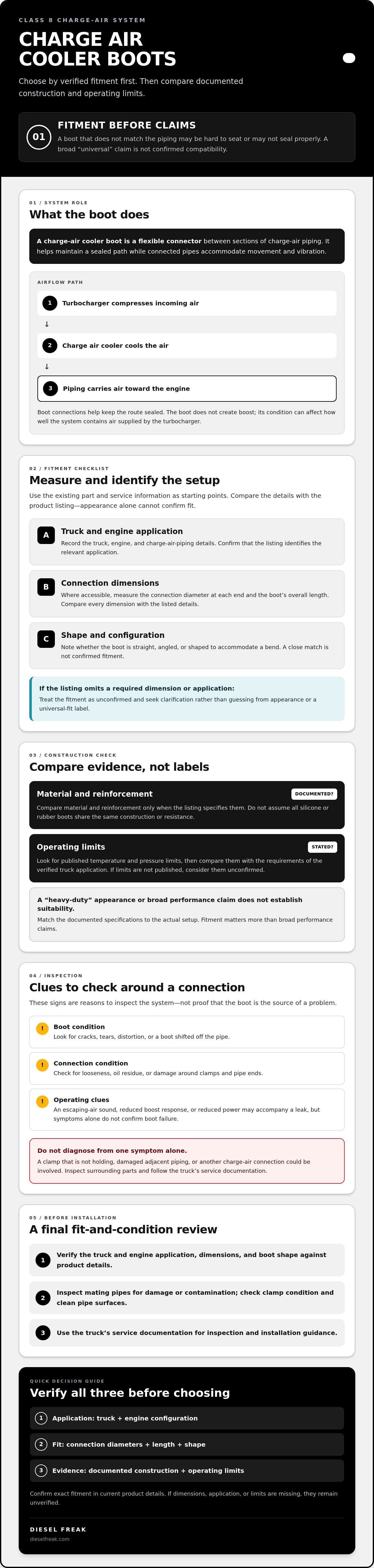
The airflow path explains their role. The turbocharger compresses incoming air, the charge air cooler cools it, and the piping carries it toward the engine. Boot connections help keep that route sealed as operating conditions change.
What does a charge air cooler boot do?
A charge air cooler boot is a flexible connector that joins sections of charge-air piping and helps maintain a sealed path from the turbocharger, through the cooler, toward the engine. Its flexibility lets connected pipes accommodate movement and vibration without relying on a rigid joint. When the connection stays sound, pressurized air can travel through the system as intended.
Class 8 plumbing is exposed to heat, engine movement, and road vibration. A boot needs to stay seated at its pipe connections as those parts move. If it loosens or gets damaged, the joint may leak. The boot doesn’t create boost, but its condition can affect how well the system contains the air supplied by the turbocharger.
What signs can point to a leaking or damaged boot?
Look for visible splits, a boot that has shifted or feels loose, and oil residue around the connection. A hiss or escaping-air sound during operation can also be a clue. Reduced boost response or power may accompany a leak, but those symptoms alone don’t confirm that the boot has failed.
- Inspect the boot: Check for cracks, tears, distortion, or signs that it has moved off the pipe.
- Check the connection: Look for looseness, residue, or damage around the clamps and pipe ends.
- Listen for air: Treat an escaping-air sound as a reason to inspect, not proof of the source.
Don’t replace a boot based on a single symptom. A clamp that isn’t holding, damaged adjacent piping, or another charge-air connection could be involved. Inspect surrounding parts and follow the truck’s service documentation to diagnose the system before choosing a replacement. This helps target the actual fault instead of replacing parts based on a guess.
Which Boot Specifications Matter for Heavy-Duty Charge Air Cooler Plumbing?
Start with fitment, not color, finish, or a bold “heavy-duty” label. A boot that doesn’t match the pipe diameters or connection shape can be difficult to seat and may not seal properly. Confirm the truck and engine application as well. Similar-looking charge-air setups aren’t proof of compatibility.
For Heavy duty charge air cooler boots class 8, verify each dimension and performance claim against your specific setup. Don’t assume a common size, universal-fit claim, or tougher appearance means the boot is right for your truck.
How do you confirm the right dimensions and configuration?
Use the existing part and service information as starting points. Where accessible, measure the connection diameter at each end and the boot’s overall length. Note whether the connection is straight, angled, or shaped to accommodate a bend. Record the truck, engine, and charge-air-piping details so you can compare them with the listing.
Compare your measurements and application notes with the seller’s product details. If the listing doesn’t identify the required dimensions or application, ask for clarification instead of relying on appearance. A close match isn’t confirmed fitment.
How should you compare boot construction and operating limits?
Compare construction only when the listing documents it. If material or reinforcement is specified, use those details to distinguish the boot from one described only in general terms. Don’t assume all silicone or rubber boots share the same construction or resistance to heat, pressure, oil, or other fluids.
Look for stated temperature and pressure limits, then compare them with the requirements for your truck’s verified application. If those limits aren’t published, treat them as unconfirmed. A performance claim without supporting specifications can’t establish whether the boot suits the operating conditions.
- Fitment: Confirm truck and engine application.
- Dimensions and shape: Match each connection diameter, length, and configuration.
- Construction: Verify material and reinforcement in the listing.
- Limits: Check documented temperature, pressure, and fluid-resistance ratings against application requirements.
Before you buy, confirm the truck and engine application, both connection diameters, overall length and shape, documented material and reinforcement, and stated temperature, pressure, and fluid-resistance limits.
Diesel Freak carries Class 8 parts, including charge air cooler plumbing. Review current listing details and verify fitment before ordering.
How to Compare Class 8 Cooler Boots Without Guessing at Performance
A useful product comparison separates confirmed specifications from unanswered questions. For Heavy duty charge air cooler boots class 8, record what each listing documents and flag anything missing. Don’t treat “heavy-duty,” “high-performance,” or a large boost claim as a substitute for truck-specific fitment details. A pressure rating alone can’t confirm that the boot’s dimensions, shape, construction, or other operating limits suit your setup.
What should a charge air cooler boot comparison table include?
Use a table to compare documented specifications and identify what still needs checking. Enter information only when the product listing or its documentation confirms it. Otherwise, mark it “Not stated.”
| Specification | What to record from each listing | If not documented |
|---|---|---|
| Vehicle application | Confirmed truck and engine fitment | Not stated; verify before ordering |
| Dimensions and shape | Connection size at each end, overall dimensions, and boot configuration | Not stated; compare with the existing setup |
| Material | Material identified in the product documentation | Not stated; don’t infer from appearance |
| Reinforcement | Construction details explicitly listed | Not stated; don’t assume reinforced construction |
| Operating limits | Documented pressure, temperature, and fluid-resistance limits | Not stated; confirm against application requirements |
This format keeps specifications separate from sales language. “Built for tough use” may sound convincing, but it doesn’t tell you the compatible engine, connection dimensions, or rated operating limits. A higher claimed boost rating alone doesn’t establish fitment or prove durability in your truck’s conditions.
When is an upgraded boot the right choice?
Compare a potential replacement with the conditions and configuration the truck actually runs. Look for documented construction and operating limits that suit verified requirements, rather than relying on an upgrade label. If the charge-air piping or related components have been modified, check the complete setup. Changes elsewhere in the system may affect the dimensions or application match the boot needs.
Evaluating a related turbo-system component too? The BorgWarner turbo guide offers another reference point. Keep the decision grounded in your setup: confirm application, dimensions, documented construction, and stated limits before choosing a replacement.
How to Inspect, Fit, and Verify Replacement Charge Air Cooler Boots
A sound replacement starts before installation. Match the part to the truck, check the complete connection, and follow the applicable service documentation. For Heavy duty charge air cooler boots class 8, don’t rely on visual resemblance or a generic fitment label when measurements or application notes don’t line up.
What should you check before ordering?
Record the existing setup before selecting a replacement. Use the truck’s service information and the removed boot, where available, to confirm the configuration.
- Record the application: Note the truck and engine identifiers, along with relevant charge-air-piping details.
- Capture the boot configuration: Measure connection diameters and overall dimensions where accessible. Record the connection orientation and shape.
- Compare the listing: Check the application notes and measurements against your records. If they differ, pause and request clarification instead of guessing.
- Check package contents: Confirm whether clamps or other hardware are included. Don’t assume the listing includes them.
Settle fitment first. A boot that looks right can still have the wrong configuration.
What should you verify after installation?
Before fitting the replacement, inspect the mating pipes and clamps alongside the boot. Look for damage, residue, or other contamination that could interfere with the connection. Follow the vehicle and component instructions for preparation, boot placement, and clamp positioning. Don’t substitute guessed torque values or installation steps for the specified procedure.
After installation, check that the boot sits evenly and that the connected parts follow the component instructions. Recheck nearby pipes and clamps for visible issues, then use the approved procedure to check for leaks. If a connection doesn’t seat as directed or the check indicates a leak, stop and consult the applicable service documentation rather than assuming the boot is the only cause.
- Verify the part and hardware match the confirmed application.
- Inspect pipe ends and clamps before assembly.
- Follow vehicle and component instructions throughout installation.
- Check the completed connection using the approved leak-check method.
For related boost-leak troubleshooting, see the charge air cooler plumbing guide. Diesel Freak carries Class 8 parts, including charge air cooler plumbing. Explore charge air cooler plumbing and review current listing details before ordering.
Find the Right Heavy-Duty Charge Air Cooler Boots for Your Class 8 Setup
The right boot matches the truck’s actual configuration and has specifications you can verify. Don’t buy based on a “heavy-duty” label alone. Confirm application, dimensions, construction, and stated operating limits, then check the listing’s exact details and package contents before ordering.
Diesel Freak is a family-owned retailer specializing in Class 8 semi-truck parts, including charge air cooler plumbing. Review current listings to confirm the specific boot’s fitment, materials, and other product details before choosing.
What information should you have ready when sourcing a boot?
Gather details that let you compare your existing setup with the product information. Clear records make it easier to spot a mismatch before purchase.
- Truck and engine details: Record identifiers and configuration information from the vehicle and its service documentation.
- Existing part information: Note any markings or identifying details on the boot you’re replacing.
- Measurements and orientation: Have connection diameters, overall dimensions, and connection shape or direction ready.
- Photos: Capture the boot and surrounding charge-air connections, if useful for confirming configuration.
Ask the seller to confirm the truck and engine application, exact dimensions, documented construction, operating limits, and included hardware. If a key detail is unclear, request clarification before ordering. For broader context on Class 8 components, see the heavy-duty diesel performance parts guide.
How can you make the final buying decision?
Choose the option with clearly documented compatibility and specifications that match your complete setup. A vague fitment claim or unsupported performance promise can’t replace those details. Before ordering, recheck the current listing’s product name, application notes, dimensions, construction, operating limits, and package contents.
Use that process to narrow down Heavy duty charge air cooler boots class 8 without assuming every listed boot fits every truck. If a specification or fitment detail remains uncertain, pause and verify it rather than gambling on a close match.
Explore Diesel Freak's Class 8 parts and review current product details to find charge air cooler plumbing for your setup.
Choose Your Next CAC Boot With Confidence
The right replacement starts with a confirmed match, not a bold label. Check your truck and engine application, measure the connections, and compare the boot’s documented construction and operating limits with your setup. If a listing leaves key details unclear, verify them before ordering.
Use the same care during installation. Inspect the connected pipes and clamps, follow the applicable service and component instructions, and check the finished connection using an approved procedure. These steps help you make an informed choice when comparing Heavy duty charge air cooler boots class 8.
Diesel Freak specializes in Class 8 semi-truck parts, with charge air cooler plumbing among its product categories. Check current listings and confirm exact product specifications and fitment for your truck.
Find the right Class 8 parts for your setup. Confirm the details, make the match, and get your charge-air plumbing ready for the work ahead.
Frequently Asked Questions
What does a charge air cooler boot do on a Class 8 truck?
A charge air cooler boot joins sections of charge-air piping and helps keep the airflow path sealed. Compressed air travels from the turbocharger through the cooler and toward the engine, and the boot connects pipe sections along that route. Its flexibility accommodates movement and vibration between connected components. The boot doesn’t create boost, but a damaged or poorly seated connection can let pressurized air escape before it reaches the engine.
How can you tell if a charge air cooler boot is leaking?
Look for a split, a loose or shifted boot, oil residue near a connection, or a sound of escaping air. Reduced boost response may also be a clue, but none of these signs alone proves the boot is leaking. Check the clamps, mating pipes, and nearby charge-air connections too. If the source isn’t clear, use the truck’s service documentation or an approved diagnostic procedure before replacing parts.
How do you choose the right charge air cooler boot for a Class 8 truck?
Choose a boot that matches the confirmed truck and engine application, pipe dimensions, and connection shape. For Heavy duty charge air cooler boots class 8, compare documented material, reinforcement, and operating limits with the requirements for the actual setup. Check whether the listing specifies clamps or other hardware. Don’t rely on a generic “heavy-duty” claim or a boost rating alone to establish compatibility or durability.
Are all heavy-duty charge air cooler boots made from silicone?
No. Don’t assume every heavy-duty boot uses silicone or the same construction. Materials and reinforcement can vary, and appearance alone won’t reliably confirm what a boot is made from. Check the product listing or manufacturer documentation for material details and stated resistance to operating conditions. If the listing doesn’t identify the material or construction, treat that information as unverified and ask for clarification before ordering.
Can a leaking charge air cooler boot affect engine performance?
Yes. If a boot leaks, compressed air can escape from the charge-air system, which may contribute to reduced boost response or engine power. Those symptoms aren’t proof of a failed boot, though. Other charge-air connections or system issues may be involved. Inspect the boot, clamps, and nearby pipes, then follow the vehicle’s approved diagnostic procedure to identify the source before deciding what needs replacement.
Should I replace the clamps when replacing a charge air cooler boot?
Not automatically. Inspect each clamp for damage, distortion, or other issues that could prevent it from securing the connection, and follow the vehicle and component instructions on reuse or replacement. Confirm whether replacement clamps are included with the boot, since package contents can differ. Position and tighten clamps according to the applicable instructions, not a guessed torque value or a general rule that may not suit your setup.
How do I confirm charge air cooler boot fitment before ordering?
Gather the truck and engine details, existing part information, and measurements for each connection, including the boot’s shape and orientation. Photos of the boot and surrounding piping can help clarify the setup. Compare those details with the current listing’s application notes and exact specifications. If dimensions or fitment details don’t match, ask the seller to confirm compatibility and package contents before placing the order.
Disclaimer
Diesel Freak LLC is in no way associated, sponsored, or affiliated with Any OEM manufacturer. Products from Diesel Freak LLC presented in this listing are not to be confused with any of the products or trademarks of any OEM company. All parts listed to fit these manufacturers are replacement aftermarket parts.