

Your Mahindra Roxor didn't roll off the assembly line weak. It left the factory handcuffed. Deep inside that 2.5L turbo-diesel sits genuine industrial muscle, but ultra-conservative factory programming chokes it down to an anemic 62 horsepower and a sluggish 45-55 mph speed governor. You feel that limitation every time you hit a steep grade or try to keep pace on open dirt. Crawling along trails while your engine fights an artificial ceiling is frustrating, especially when you know that cast-iron block can take serious abuse. Choosing the right Roxor engine upgrades changes everything.
You don't have to settle for factory restraints or risk cooked exhaust gas temperatures to get real results. You can double your factory output safely, bypass the speed limiter, and keep your drivetrain intact for the long haul. Here is your definitive blueprint to unlocking massive diesel horsepower and torque, from custom ECU calibrations to high-flow turbo systems and heavy-duty charge air plumbing.
Key Takeaways
- Discover why the cast-iron 2.5L diesel block is overbuilt for extreme abuse and primed for massive power gains beyond factory restrictions.
- See how custom ECU calibrations redefine fuel and boost maps to eliminate the factory governor and unlock true open-road cruising speeds.
- Understand how high-flow turbochargers and charge air cooler plumbing lower exhaust gas temperatures while forcing clean, dense air into the cylinders.
- Protect your machine by upgrading clutch and driveline components to harness heavy diesel torque without slipping under extreme loads.
- Follow a field-tested blueprint of Roxor engine upgrades that balances aggressive horsepower with long-term trail reliability.
The Mahindra Roxor 2.5L Diesel: Factory Limitations and Modding Potential
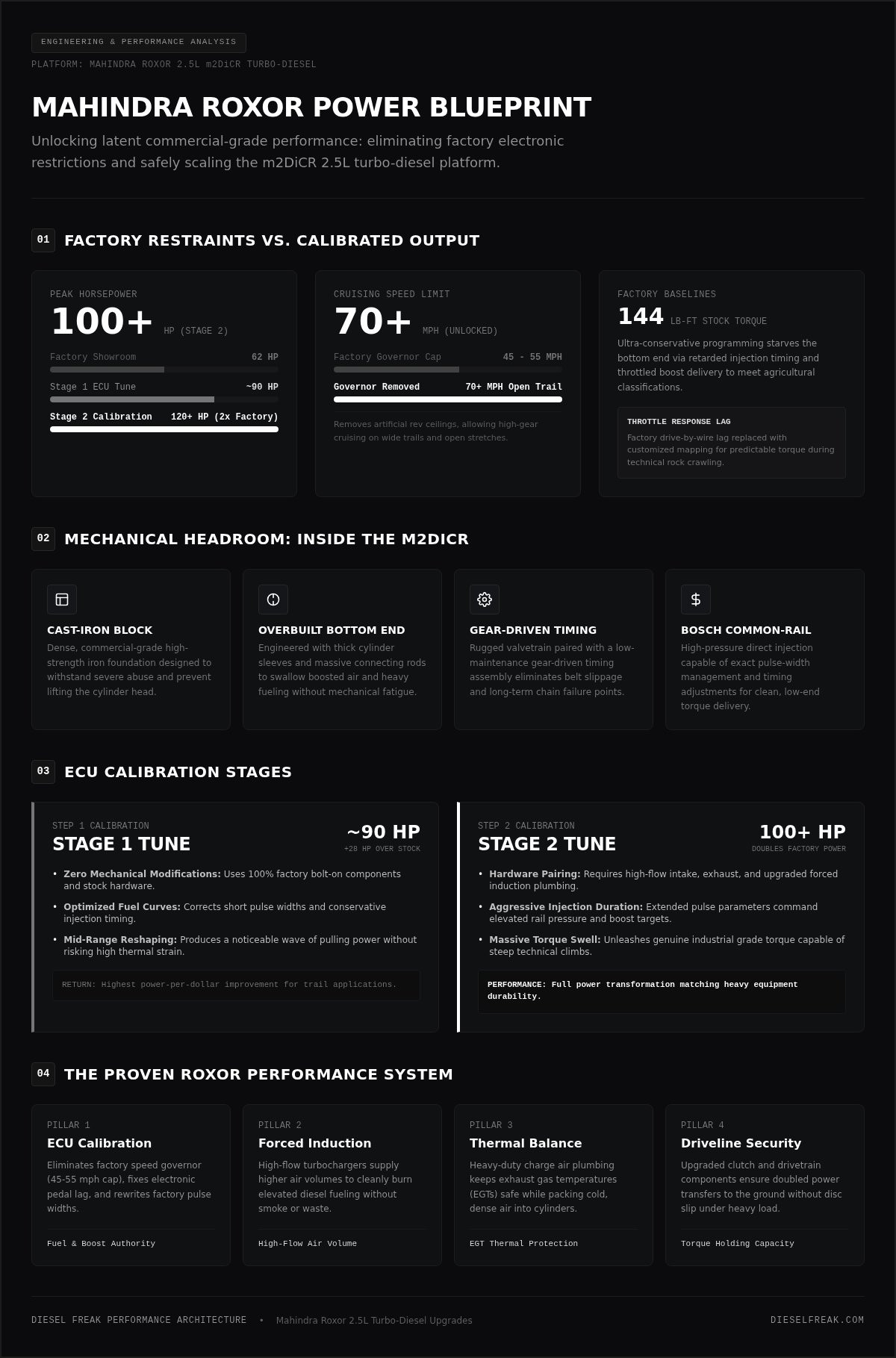
Pop the steel hood of the Mahindra Roxor, and you won't find a fragile, high-strung side-by-side engine. You find pure industrial iron. The powerplant under that sheet metal was built to haul heavy loads, dig through mud, and run for decades without complaint. Yet from the showroom floor, it feels choked. Factory programming handcuffs this platform to an ultra-conservative 62 horsepower and 144 pound-feet of torque. Worse yet, internal governors stop the party early, cutting fuel hard at 45 to 55 mph. If you want true off-road dominance, calculating your Roxor engine upgrades starts with understanding the mechanical monster lurking under that factory restriction.
Understanding the m2DiCR Engine Platform
The m2DiCR 2.5L four-cylinder turbo-diesel descends directly from commercial utility workhorses. Its foundation is a dense, high-strength cast-iron block fitted with a rugged valvetrain and a low-maintenance gear-driven timing setup. Fuel delivery runs through a sophisticated Bosch common-rail direct-injection system capable of extreme rail pressures. Because this engine was engineered for commercial equipment, the bottom end features massive connecting rods and thick cylinder sleeves. It doesn't flinch under load. That heavy-duty architecture gives the m2DiCR massive structural headroom to swallow boosted air and heavy fueling without lifting the cylinder head.
Factory Bottlenecks: Electronic Governors and Conservative Fuel Maps
Mechanical strength isn't the problem. The bottleneck is pure software. To meet agricultural utility classifications and strict fleet limits, the factory engine control unit (ECU) runs neutered fuel curves. Pulse widths stay short, injection timing remains retarded, and boost thresholds stay locked at low levels. Then comes the electronic governor: hitting 45 or 55 mph drops throttle input off a cliff, turning long straightaways into sluggish slogs.
These factory guardrails rob you of usable trail capability. Realizing the vehicle's true potential requires opening up those electronic channels:
- Eliminating the hard speed ceiling: Recalibrating the ECU software restores full throttle authority beyond factory parameters.
- Optimizing injection events: Bosch common-rail direct injection allows precise fuel timing adjustments to unlock clean, usable bottom-end grunt.
- Balancing airflow and thermal margins: High-quality Roxor engine upgrades utilize that heavy cast-iron durability to safely push boost without blowing past sensible exhaust temperature thresholds.
ROXOR Tuning: The First Step to Unlocking Latent Horsepower
Hardware changes without software calibration are useless on a modern common-rail diesel. The computer dictates everything: fuel volume, rail pressure, injection pulse width, and wastegate actuation. Recalibrating the engine control unit rewires that brain. It delivers the highest power-per-dollar return of all Roxor engine upgrades, turning a detuned farm implement into an aggressive, free-breathing trail machine in a single shot.
Eliminating the Factory Speed Limiter
The stock governor is an electronic wall. You step on the throttle in high gear, and the computer simply cuts fueling once you hit the 45 or 55 mph ceiling, regardless of remaining pedal travel. Software calibration deletes this artificial cap entirely. Unlocking top-gear potential lets you cruise at comfortable 70-plus mph speeds on wide trails and open stretches without bouncing against a rev limiter. You must, however, match that top-end capability with proper tire speed ratings and mechanical discipline to keep the engine spinning safely inside its intended RPM range.
Stage 1 vs. Stage 2 Diesel Engine Calibration
Calibration files are built around your hardware tolerance. A Stage 1 tune optimizes fueling within the limits of factory bolt-on components, bumping power from the stock 60 hp mark up to roughly 90 hp with zero mechanical changes. Stage 2 takes it further. It commands aggressive injection duration and elevated boost targets, pushing well past 100 horsepower and effectively doubling factory power when paired with high-flow intake and exhaust modifications. Both stages reshape the torque curve, delivering a massive wave of mid-range pull right where you need it most.
Throttle Mapping and Pedal Response
Stock electronic throttle response feels dead. There is a noticeable delay between dropping your right foot and the engine actually delivering torque, which makes technical rock crawling unpredictable and frustrating. Customized mapping fixes the drive-by-wire lag:
- Linear pedal curve: Delivers instant off-idle throttle authority for climbing ledges and powering out of ruts.
- Smooth low-end modulation: Prevents jerky, neck-snapping surges while crawling over loose rocks.
- Dynamic mid-range delivery: Keeps the turbo spooled so power stays ready the second you feed in more pedal.
When you are ready to wake up your machine, investing in dedicated ROXOR TUNING builds the essential foundation for every mechanical modification down the road.
Forced Induction and Airflow: Turbochargers and Charge Air Plumbing
Dialing in fuel parameters unlocks serious muscle, but fuel without air creates dangerous heat. Diesel performance hinges entirely on mass airflow. The factory wastegated turbo is tiny, sized strictly for emissions compliance and modest low-RPM utility. Push beyond basic programming, and that small turbine housing turns into a literal bottleneck. Backpressure spikes, exhaust gas temperatures (EGTs) climb toward the danger zone, and usable horsepower hits a hard ceiling. Upgrading your forced induction system balances the combustion equation, transforming black smoke and excessive heat into raw, usable forward drive.
Upgraded Turbocharger Options for the Roxor
Dumping more diesel into the cylinders demands higher CFM to burn clean. Purpose-built drop-in turbochargers feature larger compressor wheels and free-flowing turbine housings. This geometry increases volume without sacrificing off-idle spool. A properly matched performance turbo balances boost pressure against drive pressure, maintaining a healthy 1:1 or near 1:1 ratio. Lower backpressure lets the cylinders evacuate spent exhaust immediately. You get lower cylinder head stress, cooler EGTs, and intense pull that stays strong all the way to redline.
Charge Air Cooler Plumbing and Intercooling Systems
Hot, compressed air straight off the compressor wheel lacks density. Because early factory setups routed charge air straight to the intake without an intercooler, thermal soak is a constant threat under heavy load. Installing dedicated charge air cooler plumbing routes boosted air through an efficient heat exchanger, dropping intake temperatures dramatically. Cooler air packs tighter oxygen molecules into every cylinder stroke:
- Denser combustion charge: Delivers cleaner fuel burn and crisper throttle snap under heavy throttle.
- Thermal headroom: Keeps valves, pistons, and cylinder heads protected during long trail climbs or continuous heavy towing.
- Boost reliability: Rigid mandrel-bent aluminum plumbing eliminates ballooning rubber hoses and blown-off boots when running high manifold pressure.
High-Flow Intake and Exhaust Flow Dynamics
Turbochargers can only pump the air they can breathe in and shove out. The stock airbox restricts incoming airflow, while the restrictive stock exhaust traps radiant heat right against the engine bay. Upgrading to an open-element, high-flow air intake lets the compressor wheel draw maximum volume without restriction. Pairing that intake with a mandrel-bent, straight-through exhaust drops post-turbo resistance instantly. Downpipes with enlarged transitions prevent exhaust gas reversion, moving scorching exhaust away from the turbine quickly. When executing comprehensive Roxor engine upgrades, pairing proper turbochargers with dedicated charge air plumbing turns raw boost into reliable, repeatable trail dominance.
Thermal Management and Driveline Reliability: Supporting Heavy Torque
Torque breaks parts. When you double factory output and send over 200 pound-feet of twist downstream, every weak link in the chassis raises its hand. Pushing extra fuel and boost without reinforcing your mechanical backbone leads straight to slipping clutches, scorched exhaust valves, and sheared axles. Unlocking serious power demands equal respect for heat management and mechanical load. True performance is about building an unbreakable machine that takes relentless punishment without leaving you stranded in the backcountry.
Heavy-Duty Clutch and Flywheel Upgrades
The factory organic clutch disc works fine for 62 stock horses. Throw an aggressive fuel calibration at it, stomp the pedal in third gear, and watch the tachometer jump while the vehicle stays still. That burning friction smell means your stock pressure plate has surrendered. Installing a heavy-duty clutch kit with an uprated pressure plate and ceramic-metallic friction material restores positive, slip-free clamping force. Matching this with a heavy-mass flywheel maintains crucial rotating inertia, giving you smooth off-idle tractor crawl on steep rock faces without stalling.
Exhaust Gas Temperature Monitoring and Cooling Upgrades
Heat kills diesel engines faster than boost pressure ever will. Running extended uphill pulls under heavy throttle commands high fuel volume, making an exhaust gas temperature (EGT) pyrometer mandatory. Keep an eye on real-time numbers: sustained temps past 1,300 degrees Fahrenheit threaten aluminum pistons and turbo vanes. Upgrading to a high-capacity aluminum radiator paired with heavy-duty silicone hoses keeps engine coolant temps stable, while dropping exhaust backpressure pulls thermal energy away from the head before pistons suffer thermal distortion.
Driveline and Axle Reinforcement
Torque multiplication in low-range 4WD puts violent stress on the driveshafts, universal joints, and differential ring gears. Installing larger off-road tires amplifies that leverage even further:
- Inspect universal joints regularly: Factory U-joints take tremendous torsional shock; upgrade to heavy-duty, greasable units to prevent trail failures.
- Re-gear for tire height: Installing matched differential ring and pinion sets restores proper mechanical leverage, taking stress off transmission shafts.
- Control axle wrap: High traction combined with massive low-end torque causes leaf springs to twist; heavy-duty traction bars lock axle geometry firmly in place.
Don't let broken drivetrain parts sideline your rig. Reinforce your machine with field-proven Roxor Engine / Driveline upgrades built specifically to handle massive diesel torque.
Building Your Ultimate Roxor: Proven Power Packages from Diesel Freak
Slapping random aftermarket parts together is a recipe for broken metal and trailside headaches. True diesel capability comes from balance. When your fuel injection mapping, turbo compressor sizing, charge air cooling, and drivetrain clamping force are engineered to operate in lockstep, your rig runs cooler, pulls harder, and stays reliable under severe abuse. Diesel Freak eliminates the trial-and-error guesswork by delivering matched Roxor engine upgrades tested in real-world dirt, deep mud, and heavy-load conditions.
Matching Upgrades to Your Driving Mission
Every driver runs a different trail. A utility machine working remote property demands instant, low-RPM torque for towing heavy trailers and hauling firewood, where an optimized Stage 1 tune and durable charge air components deliver bulletproof daily grunt. High-speed dune running and open-trail cruising require a different approach: aggressive Stage 2 calibrations, high-flow turbochargers, and heavy-duty clutch kits that hold firm when feeding power at wide-open throttle. Structuring your build in clear, purposeful stages ensures each modification supports the next without exceeding mechanical safety thresholds.
The Diesel Freak Advantage: Built for Raw Performance
Family-owned and founded in 2009, Diesel Freak approaches side-by-side performance with heavy-duty diesel standards. Instead of relying on unverified forum theories or adapted gas-engine parts, every tune and hardware component is engineered specifically for the Roxor platform. That in-house engineering ensures your air-to-fuel ratios remain clean, exhaust gas temperatures stay inside safe boundaries, and your driveline survives the massive jump in torque.
Transforming your machine goes beyond raw horsepower under the hood. Building a complete, trail-ready rig requires a complete performance ecosystem:
- Engine and Driveline Strength: Pair matched turbochargers with reinforced pressure plates and heavy-duty charge piping to withstand brutal torsional shock.
- Trail Usability and Vision: Install durable Roxor wipers & windshields to maintain clear sightlines when cutting through heavy rain, brush, or flying mud.
- Custom Aesthetic Styling: Stand out on the trails with bold Roxor graphics and genuine Diesel Freak apparel built for wrenching and riding.
Stop settling for factory restraints or piecemeal hardware. Build a balanced, trail-dominating machine with high-performance parts direct from Diesel Freak.
Dominate the Trail with Uncompromised Diesel Muscle
Leaving your rig handcuffed by factory limits wastes the genuine mechanical potential built into that cast-iron block. Dialing in precision ECU calibrations deletes artificial speed limiters, while matching high-flow turbochargers and charge air plumbing balances extra fuel with dense, cool oxygen. Backing up that brute force with reinforced clutches and driveline upgrades ensures every pound-foot of torque drives you forward instead of snapping components miles from the trailhead. With the right roadmap of Roxor engine upgrades, your machine transforms into an unstoppable off-road workhorse.
Don't gamble your build on unverified theories or mismatched parts. As heavy-duty diesel performance specialists since 2009, we engineer complete hardware, tuning, and drivetrain packages tailored specifically for Mahindra Roxor platforms. You get proven reliability, savage power, and the confidence to conquer any terrain. Ready to unleash true diesel power? Upgrade your build today at Diesel Freak and build the rig you were always meant to drive.
Frequently Asked Questions
How much horsepower can you get out of a Mahindra Roxor?
You can easily double the factory 62 horsepower rating on the 2.5L engine. A basic ECU recalibration bumps output to roughly 90 horsepower on bone-stock hardware. Adding high-flow turbochargers, free-flowing exhaust, and upgraded intercooling pushes rear-wheel output past 120 horsepower. Highly modified builds running matched fuel systems and custom tuning can achieve upward of 200 wheel horsepower when supported by heavy-duty drivetrain components.
Will tuning my Roxor remove the 45 mph top speed limiter?
Yes, removing the factory 45 to 55 mph speed governor is a core feature of custom ECU calibration. The factory software artificially cuts fuel delivery regardless of how much pedal travel remains. Flashing the computer eliminates that digital ceiling entirely. This allows your diesel engine to pull through its full gear range, unlocking comfortable cruising speeds of 70 mph or higher on open trails.
Do I need an intercooler to run an aggressive tune on my Roxor?
An intercooler becomes mandatory once you step up to aggressive Stage 2 calibrations or upgraded turbochargers. The factory 2.5L setup lacks charge air cooling, which causes intake air temperatures to soar under heavy boost. Adding dedicated charge air cooler plumbing drops compressed air temperatures significantly. Denser air keeps exhaust gas temperatures manageable and shields internal engine components from extreme thermal stress during long pulls.
What are safe exhaust gas temperatures for a modified Roxor diesel?
Keep your sustained exhaust gas temperatures below 1,250 to 1,300 degrees Fahrenheit under heavy load. Brief temperature spikes past 1,350 degrees during short, wide-open throttle bursts are acceptable, but prolonged heat at that level risks melting aluminum pistons. Installing a dedicated pyrometer gauge is the smartest way to monitor thermal load when hauling, towing, or tackling steep, sustained hill climbs.
Can the stock Roxor transmission and transfer case handle upgraded power?
The cast-iron manual transmission and robust gear-driven transfer case easily handle high-output tunes, but the factory clutch cannot. Factory organic friction discs begin slipping under heavy throttle once torque climbs past 200 pound-feet. Upgrading to a heavy-duty pressure plate and high-friction clutch disc resolves this bottleneck immediately, allowing the rest of the stout driveline to transfer power without mechanical failure.
How hard is it to install an ECU tune on a Mahindra Roxor?
Installing an ECU calibration is a straightforward process requiring zero internal engine disassembly. Most owners simply disconnect the negative battery cable, unplug the engine control module under the hood, and mail it to a dedicated specialist for bench flashing. Once the computer is recalibrated with optimized fuel, boost, and timing maps, you bolt it back into the factory bracket and turn the key.
What is the difference between Stage 1 and Stage 2 Roxor upgrades?
Stage 1 focuses entirely on optimizing factory hardware, bumping output to around 90 horsepower while deleting the sluggish speed limiter. Stage 2 commands aggressive injection duration and higher boost targets, requiring supporting hardware like charge air cooler plumbing and a heavy-duty clutch to survive. Selecting the right combination of Roxor engine upgrades ensures your build matches your specific terrain and driving demands.
Disclaimer
Diesel Freak LLC is in no way associated, sponsored, or affiliated with Any OEM manufacturer. Products from Diesel Freak LLC presented in this listing are not to be confused with any of the products or trademarks of any OEM company. All parts listed to fit these manufacturers are replacement aftermarket parts.