

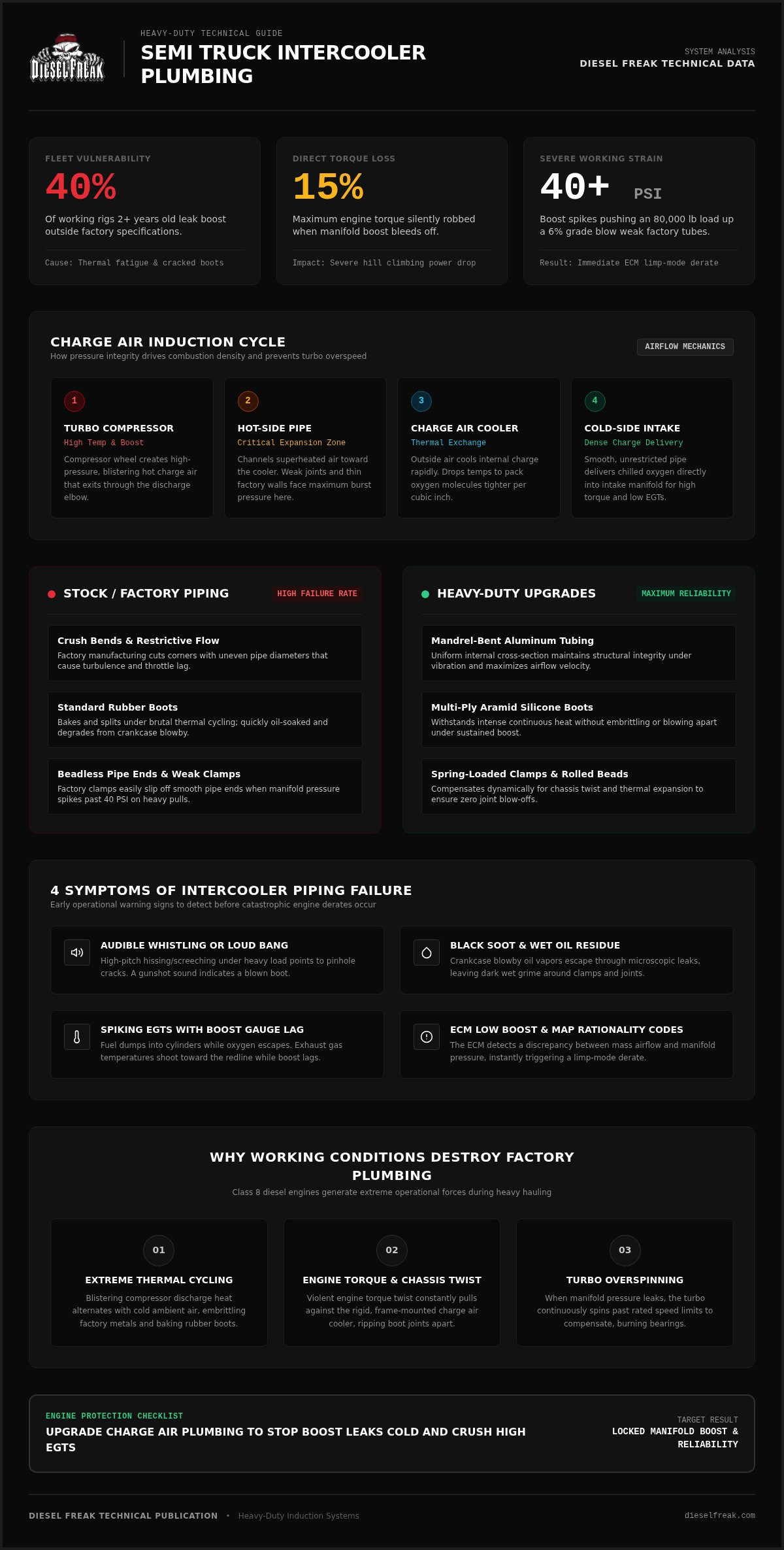
An estimated 40% of working rigs two years or older leak boost outside factory specs, silently robbing up to 15% of your engine's torque. When you're dragging an 80,000-pound load up a six-percent grade, cracked factory tubes and blown boots turn into instant roadside downtime. Upgrading your semi truck intercooler piping stops that power leak dead in its tracks.
You already know the drill. The throttle is pinned, your manifold pressure collapses, and exhaust gas temperatures shoot straight toward the redline. Thin factory pipes can't handle sustained boost punishment, and cheap boots blow apart right when you need maximum pull. You didn't build your rig to limp along in derate mode.
Discover how heavy-duty charge air cooler plumbing eliminates boost leaks, drops exhaust gas temps, and unleashes peak diesel horsepower. We break down mandrel-bent aluminum piping, bulletproof silicone connections, and induction upgrades engineered to hold high boost all day long.
Key Takeaways
- Upgrading to heavy-duty semi truck intercooler piping stops air leaks cold, locking in manifold boost and crushing high exhaust gas temperatures.
- Identify subtle whistling, power drops, and soot buildup early to keep your ECM from triggering sudden, load-killing engine derates.
- Mandrel-bent aluminum plumbing outlasts restrictive factory crush bends and holds structural shape under intense heat and vibration.
- Multi-ply aramid silicone boots and heavy spring-loaded clamps eliminate blown connections when manifold pressure peaks past 40 PSI.
- Matching your charge air cooler plumbing to high-output turbochargers maximizes airflow velocity and delivers instant throttle response under heavy haul conditions.
The Role of Semi Truck Intercooler Piping in Boost Efficiency
Your heavy-duty diesel engine demands dense, oxygen-rich air to make raw horsepower. Boost starts at the turbocharger compressor wheel, whipping atmospheric air into high-pressure heat. That blistering charge cannot enter the combustion chamber directly without roasting valves and spiking exhaust gas temperatures. Rugged semi truck intercooler piping serves as the critical mechanical artery bridging your turbo, heat exchanger, and intake manifold.
A heavy-duty intercooler drops charge air temperatures significantly before it reaches the cylinders, but the cooler is useless if your plumbing bleeds pressure along the way. Quality charge air cooler plumbing maintains manifold pressure, ensuring every pound of boost created by the compressor feeds combustion directly. Solid induction plumbing stops turbo overspeed in its tracks, prevents excessive fuel burn, and protects hard-working diesel engines from extreme thermal stress.
Understanding Charge Air Cooler Plumbing Mechanics
Compressing intake air heats it rapidly. The turbo compressor forces this hot, pressurized charge out the discharge elbow and through the hot-side piping straight into the charge air cooler. As outside air rushes across the cooler core, internal charge temps drop fast. Cooler air packs tighter oxygen molecules per cubic inch, fueling cleaner combustion, lowering exhaust gas temperatures, and producing massive low-end torque. The cold-side pipe then channels this chilled charge directly into the intake manifold. Smooth, unrestricted pipe runs maintain high air velocity, delivering instant throttle response under heavy haul loads.
Why Factory Piping Fails Under Heavy Working Loads
Stock plumbing cuts corners to shave assembly costs. Class 8 diesels endure brutal working conditions that destroy weak induction components fast:
- Extreme thermal cycling: Blistering compressor discharge heat alternates with cold ambient air, embrittling factory metals and baking standard rubber boots until they split.
- Violent chassis vibration: Heavy engine torque twist fights against a rigid, frame-mounted charge air cooler, ripping joints apart at the boots.
- Boost spikes over 40 PSI: Sustained manifold boost stretches stock thin-wall aluminum pipes and forces factory clamps to slip off beadless pipe ends.
Pinhole cracks leak air invisibly. Your manifold absolute pressure drops, forcing your turbocharger to spin beyond rated limits to compensate. The result is rapid turbo fatigue, unburnt diesel fuel washing cylinder walls, and sudden electronic derates that strand rigs on steep climbs.
Symptoms and Diagnosis of Semi Truck Intercooler Piping Leaks
Boost leaks waste fuel and shred components. When pressurized air escapes through compromised joints, your engine starves for oxygen while fuel continues dumping into cylinders. Modern ECMs monitor manifold absolute pressure (MAP) down to the millibar. Detect an unexpected drop between calculated mass airflow and actual intake boost, and the computer pulls fuel fast. You drop straight into a limp-mode derate right when pulling a steep grade. Never ignore subtle pressure loss; letting your turbo continuously overspin to compensate burns up bearings and grenades compressor wheels.
Audible and Visual Signs of Boost Pressure Loss
Catching leaks early saves thousands in shop repairs. Inspect your induction system for these clear operational red flags:
- High-pitch screeching or hissing: Whistling under load signals pinholes. A loud gunshot bang means a boot blew completely off the pipe.
- Black soot and wet oil mist: Crankcase blowby vapors travel through the induction tract. Wet dirt and oil film around pipe clamps highlight escaping boost.
- Climbing EGTs with slow gauge response: When manifold boost lags behind throttle input while pyrometer temps spike rapidly, air is escaping before the intake.
- Trouble codes: Diagnostic codes like low boost or MAP rationality errors mean your charge plumbing has failed.
As highlighted in DrivingLine's breakdown of Intercoolers 101, maintaining a tightly sealed charge network is critical for keeping EGTs under control and preserving engine longevity. If you spot oil-soaked couplers during pre-trip checks, inspect your charge air cooler plumbing immediately before hauling another run.
Pressure Testing Your Semi Truck Intercooler System
Visual checks miss hairline cracks. Pressurize the entire circuit to uncover hidden fractures in your semi truck intercooler piping before hitting the highway:
- Rig the test plugs: Disconnect hot-side pipe at the turbo compressor discharge and cold-side pipe at the intake horn. Secure heavy-duty test plugs with safety retention straps. Never stand directly in line with pressurized test plugs.
- Pressurize the system: Apply shop air regulated to 30 PSI through the test fitting. Shut off the air supply valve completely.
- Track the decay rate: Measure pressure drop over fifteen seconds. Commercial vehicle maintenance standards generally allow no more than 5 PSI loss over that window.
- Spray soapy water: Soak every bead roll, weld seam, and silicone joint. Foaming bubbles pinpoint exact failure points instantly.
Comparing OEM vs. Aftermarket Mandrel-Bent Intercooler Plumbing
Stock plumbing cuts corners to satisfy factory production lines. Standard factory tubes rely on cheap materials and crush-bent corners that choke off compressed air right when your engine works hardest. Upgrading to aftermarket mandrel-bent semi truck intercooler piping transforms your induction tract into a high-flow delivery route. You ditch structural weak points, eliminate boost drop, and secure rock-solid reliability that outlasts millions of highway miles.
Mandrel-Bent Aluminum vs. Restrictive Factory Pipe Runs
Crush bending crushes airflow. Traditional factory bends collapse inner wall dimensions, creating severe turbulence zones that disrupt smooth velocity. Mandrel bending supports the interior tube during manufacturing, preserving an identical inner diameter throughout severe angles. Boundary layer airflow glides cleanly along polished walls without aggressive drag. That reduction in intake restriction drops pumping losses, driving clean boost straight to your intake while maximizing the potential of matched diesel performance parts.
Multi-Ply Silicone Boots vs. Standard Rubber Couplers
Factory synthetic rubber boots harden and fail under continuous heat cycling. Heavy-duty semi truck intercooler piping systems demand superior coupler materials engineered for severe duty:
- Extreme temperature resistance: Multi-ply silicone withstands temperatures above 500 degrees Fahrenheit without softening, while factory rubber cooks into brittle plastic at half that heat.
- Aramid reinforcement: Four to five layers of high-tensile aramid fabric weave prevent wall expansion under 40+ PSI spikes and resist engine oil mist degradation.
- Flexible hump designs: Integrated expansion humps flex under violent engine torque twist, protecting rigid piping connections from cracking under load.
Heavy-Duty Spring-Loaded T-Bolt Clamps vs. Worm-Gear Clamps
Standard worm-gear clamps belong on garden hoses, not Class 8 diesels. Thin slotted bands slice directly into silicone jackets, strip their drive threads, and loosen as aluminum pipes heat and expand. Heavy-duty spring-loaded T-bolt clamps provide continuous dynamic tension. Heavy internal coil springs compress and expand alongside thermal shifts, maintaining uniform 360-degree clamping pressure at all times. Paired with bead-rolled pipe lips, these clamps bite down hard, locking high-pressure boots firmly in place under maximum haul loads.
How to Select and Install Charge Air Cooler Piping
Bolting down heavy-duty hardware requires precision. Even the toughest semi truck intercooler piping fails if it's misaligned or installed over slick oil residue. A proper installation locks in boost pressure, clears chassis obstacles, and delivers maximum airflow velocity without unwanted spool lag.
Sizing Pipe Diameter to Match Turbo and Engine Specs
Bigger isn't always better. Expanding pipe volume beyond what your engine displacement demands creates excessive lag, killing throttle response down low. Your compressor has to pressurize all that extra empty airspace before manifold boost builds. Match hot-side tubing diameter directly to your compressor discharge port to maintain air velocity. Run slightly expanded cold-side plumbing to handle dense, cooled air entering the intake manifold. Nailing this geometry is vital when you pair your charge plumbing with a high-flow BorgWarner turbo, where induction balance prevents compressor surge under sudden throttle lift.
Step-by-Step Installation and Torque Procedures
Sloppy wrench work leaves you stranded on the shoulder. Follow these steps to secure your semi truck intercooler piping for the long haul:
- Scrub every mating surface: Clean aluminum pipe ends and boot interiors using fast-drying solvent or isopropyl alcohol. A single drop of oil acts like grease under high boost, launching boots straight off the pipe.
- Verify chassis clearances: Maintain at least an inch of clearance around steering shafts, radiator brackets, and frame rails. Engine torque twist will force tight pipes into chassis metal, wearing holes through the tube wall.
- Seat clamps behind the bead: Position your spring-loaded T-bolt clamp just behind the pipe's retaining bead roll. Clamping directly over the bead crushes the lip and spits the boot off under boost.
- Torque fasteners with care: Tighten clamp nuts evenly with a calibrated torque wrench, keeping to manufacturer torque limits. Over-torquing crushes aluminum tubing, while under-torquing allows boost leaks under load.
- Run a loaded shake-down: Pull a steep highway grade with a full payload. Verify boost holds steady across peak torque before dispatching the truck.
Tired of chasing blown boots and cracked pipes out on the road? Upgrade your charge air cooler plumbing with race-proven Class 8 hardware built to conquer extreme manifold boost.
Upgrading Your Rig's Charge Air System with Diesel Freak
Stock components aren't built for drivers who push their equipment to the absolute limit. Hauling heavy freight across demanding terrain exposes every weak link in your intake tract. When you need sustained manifold pressure and peak pulling power, cutting corners on your induction plumbing is a recipe for catastrophic roadside downtime. Diesel Freak supplies heavy-duty Class 8 hardware engineered specifically for drivers who refuse to compromise on horsepower, reliability, or build quality.
Built for Severe Hauling and High Boost Demands
Long-haul freight and severe-duty vocational routes punish light-duty materials. Stock plastic ends and thin-gauge tubes fatigue quickly, flexing until they crack and bleed boost. Upgrading to heavy-duty semi truck intercooler piping locks in manifold pressure and keeps your rig pulling hard on steep grades.
Diesel Freak lives and breathes diesel performance. We supply components built to shrug off continuous heat cycling, violent engine torque, and rough chassis vibration. You eliminate blown boots, cracked pipes, and costly ECM power derates before they strand your payload. Every piece of charge air cooler plumbing in our inventory is selected to deliver maximum durability under extreme boost pressures.
Completing Your Air Induction System Overhaul
Plumbing is the backbone of your charge air system, but true induction efficiency requires a balanced setup. Unrestricted pipes mean little if your induction hardware cannot supply the required volume, or if your turbocharger faces excessive backpressure.
- Match induction flow: Pair smooth-flowing piping runs with high-capacity turbochargers to ensure unrestricted boost delivery from compressor housing to intake valves.
- Maximize built power: If you run a tuned setup with heavy-duty Cummins engine performance parts, low-restriction piping ensures your engine breathes freely to deliver every pound-foot of torque.
- Seal the circuit: Eliminate weak factory couplers with high-temp silicone and constant-torque clamps to lock boost into the intake tract permanently.
Boost leaks waste fuel and kill your bottom line. Stop settling for fragile factory piping that cracks under pressure. Build a rugged induction tract that handles everything you throw at it. Upgrade your rig with heavy-duty charge air cooler plumbing at Diesel Freak and lock in peak diesel performance today.
Lock Down Maximum Boost and Own the Road
Stock charge tubes flex, crack, and bleed manifold pressure right when your diesel engine needs to pull hardest. Swapping weak factory plumbing for rugged semi truck intercooler piping stops air loss cold, drops exhaust gas temperatures, and shields your turbocharger from severe overspeed wear. Smooth mandrel bends maintain uninterrupted charge velocity straight to the cylinders, keeping your rig out of power derates and running at peak operational capacity.
Roadside breakdowns chew through your drive clock and eat your profits alive. Diesel Freak delivers specialized Class 8 heavy-duty diesel expertise, offering induction hardware engineered specifically to hold up under severe manifold boost. Don't let split rubber boots and hairline pipe fractures rob your rig of its true work capacity. Secure your intake tract now and upgrade your heavy-duty rig with bulletproof charge air cooler plumbing at Diesel Freak. Build for unrelenting strength, haul with complete confidence, and leave boost leaks behind for good.
Frequently Asked Questions
What is the difference between hot-side and cold-side semi truck intercooler piping?
Hot-side piping routes scorching compressed air directly from the turbocharger compressor discharge into the intercooler inlet. Cold-side semi truck intercooler piping carries chilled, oxygen-dense air from the intercooler outlet straight into the intake manifold. Hot-side pipes endure blistering thermal stress up to 400 degrees Fahrenheit, while cold-side runs focus on smooth volume delivery to feed combustion cylinders without restriction.
How do I know if my semi truck has a charge air cooler boost leak?
You'll notice sluggish throttle response, high exhaust gas temperatures, and an audible hissing or whistling under heavy acceleration. Look for greasy oil mist collecting around boot seams, which flags escaping boost carrying crankcase vapor. Modern electronic dashboards will often throw low-boost diagnostic trouble codes or trigger unexpected engine derates on hard hill climbs when actual manifold pressure falls short of ECM targets.
Can a loose intercooler boot damage my diesel engine or turbocharger?
Yes, running a loose boot destroys turbochargers fast. When boost escapes, the ECM demands more air, forcing the turbo wheel to spin beyond engineered RPM limits to hit target pressures. This turbo overspeed cooks journal bearings, causes compressor wheel fatigue, and spikes exhaust gas temperatures dangerously high. In severe cases, failed couplers suck unfiltered road grit directly into the cylinders, scoring liners instantly.
Why do intercooler boots keep blowing off under heavy highway loads?
Boots blow off because of oil contamination, improper clamp positioning, or missing retention beads on pipe ends. Crankcase blowby leaves a slick oil film inside boots that acts like lubricant once manifold pressure climbs past 30 PSI. If your clamp sits over the bead roll rather than behind it, or if you use standard worm-gear bands, boost pressure pops the connection loose under load.
Is aluminum piping better than steel for semi truck charge air systems?
Mandrel-bent aluminum is superior for semi truck intercooler piping because it dissipates heat faster and eliminates internal rust. Steel pipes are heavy and prone to internal oxidation from moisture condensation, which can send loose rust flakes into your intake valves. Thick-wall aluminum handles high vibration, resists corrosion permanently, and sheds radiant under-hood heat much faster during hard runs.
What type of clamps should I use on semi truck intercooler boots?
Always install heavy-duty spring-loaded T-bolt clamps with constant-torque Belleville springs. Standard worm-gear hose clamps loosen during normal heat expansion cycles and slice into silicone layers under tension. Spring-loaded T-bolt clamps maintain uniform 360-degree radial tension as aluminum tubing expands and contracts, locking multi-ply silicone boots firmly onto bead-rolled pipe ends under maximum working boost.
How much boost pressure loss is considered acceptable in a Class 8 rig?
A healthy commercial charge air system should lose no more than 5 PSI over a fifteen-second test window when pressurized to 30 PSI. Any pressure drop faster than that signals a cracked core, split coupler, or leaking tube joint that requires immediate attention. Even a small leak bleeds noticeable horsepower, wastes fuel on every run, and forces unnecessary turbocharger wear.
Disclaimer
Diesel Freak LLC is in no way associated, sponsored, or affiliated with Any OEM manufacturer. Products from Diesel Freak LLC presented in this listing are not to be confused with any of the products or trademarks of any OEM company. All parts listed to fit these manufacturers are replacement aftermarket parts.