

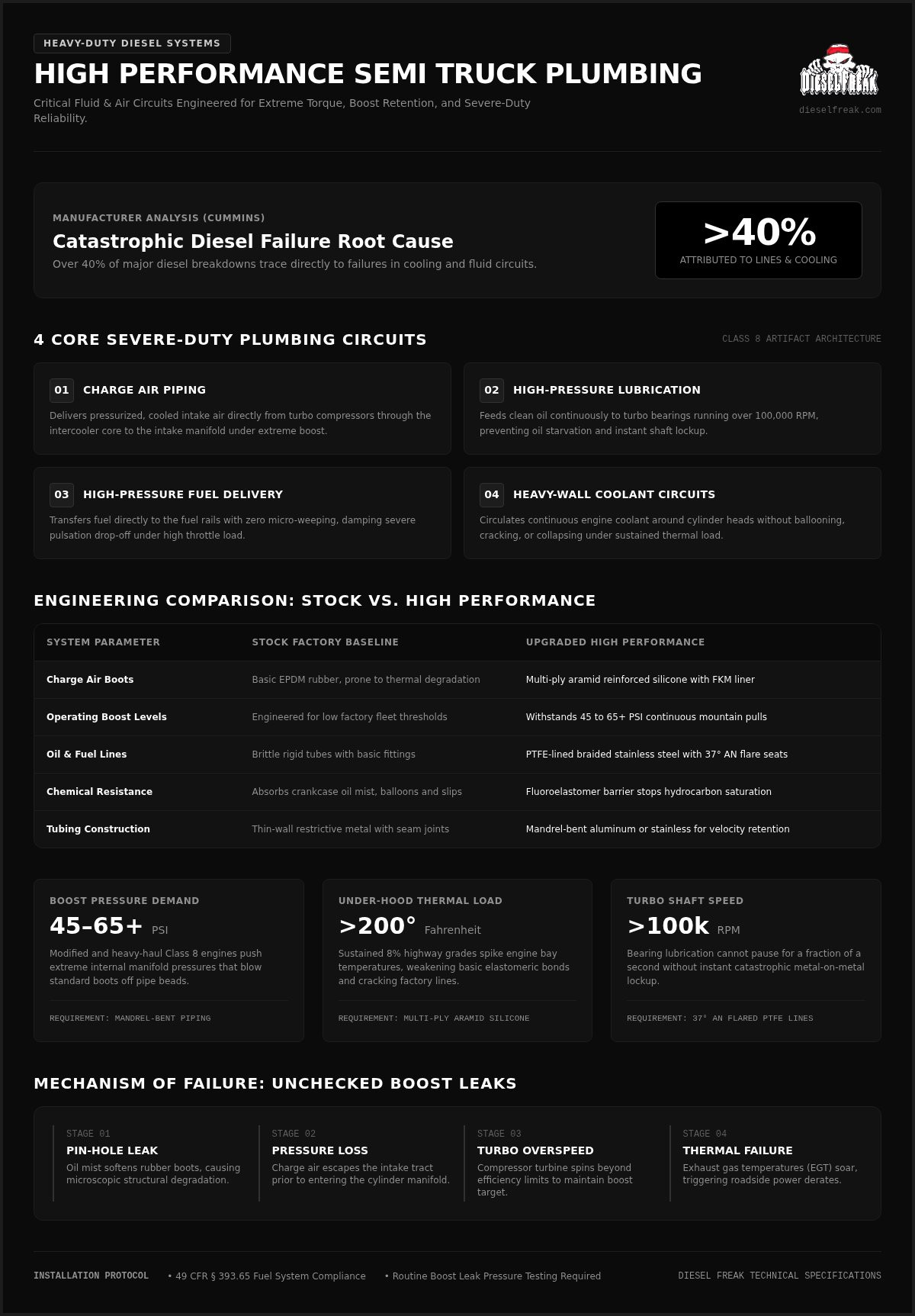
According to engine manufacturers like Cummins, over 40% of catastrophic diesel failures trace directly to cooling and fluid circuit breakdowns. Your engine build is only as tough as the lines feeding it. You can bolt on massive turbos, but if stock EPDM rubber balloons and splits under heavy load, you're dumping horsepower onto the asphalt. Delivering consistent pressure to the intake requires rugged semi truck high performance plumbing engineered for brutal exhaust heat and high-torque vibration.
Every driver knows the frustration of hearing a deafening pop on a mountain pull, watching the boost needle plunge, and facing expensive roadside downtime from a blown silicone coupler. Factory rubber can't survive high-output diesel heat cycles, and undersized lines choke compound turbo setups when you need power most.
This guide shows you how to eliminate boost leaks, master multi-ply charge air cooler connections, and protect critical oil feeds. We'll break down the exact hardware you need to lock in peak boost and keep your rig pulling hard across hundreds of thousands of highway miles.
Key Takeaways
- Master the critical air, fuel, oil, and coolant circuits that define semi truck high performance plumbing on working Class 8 rigs.
- Discover why severe heat soak and high boost pressures destroy stock EPDM hoses, costing you power and road time.
- Upgrade to multi-ply aramid reinforced silicone boots and mandrel-bent charge pipes to ensure zero boost leaks under brutal loads.
- Implement routine boost leak pressure testing and preventive inspections to catch line fatigue before hauling heavy freight.
- Equip your rig with proven hardware engineered specifically to handle aggressive compound turbos and peak torque demands.
What Is Semi Truck High Performance Plumbing on Class 8 Rigs?
Forget municipal pipes or commercial drain cleaning. In the heavy-duty diesel world, semi truck high performance plumbing refers to the rugged fluid and pneumatic circuits that keep an eighty-thousand-pound rig pulling under brutal conditions. Class 8 engines face violent chassis flex, continuous heat soak, and intense harmonic vibration. Stock factory rubber hoses and cheap worm-gear clamps simply cannot hold up. Upgrading these lines ensures uninterrupted fluid transfer, absolute boost retention, and structural resistance against blowout.
A severe-duty engine bay relies on four foundational high-performance circuits:
- Charge air piping: Delivers pressurized, cooled intake air straight from the turbo compressors to the intake manifold.
- High-pressure lubrication lines: Feeds clean oil directly to high-rpm turbo bearings to prevent metal-on-metal lockup.
- High-pressure fuel delivery: Transfers diesel to the fuel rails without micro-weeping or pulsing drop-off.
- Heavy-wall coolant circuits: Circulates coolant past hot engine cylinder heads without ballooning or collapsing under pressure.
Charge Air and Boost Delivery Lines
Charge air cooler plumbing routes compressed air from the turbocharger through the intercooler core and into the engine. While factory setups struggle with mild boost, modified or heavy-haul diesel engines push 45 to 65+ psi across mountain passes. Boost pipes must withstand these massive internal spikes without blowing boots off the beads. Upgrading to mandrel-bent aluminum or stainless steel tubing maintains smooth internal airflow, prevents turbulence, and locks in critical air velocity when the throttle drops.
High-Pressure Oil and Fuel Feed Systems
Turbochargers rely on continuous oil flow to survive shaft speeds exceeding 100,000 rpm. A sudden drop in volume destroys bearings instantly. Replacing brittle factory tubes with braided stainless steel lines lined with smooth PTFE delivers unmatched durability. Builders utilize strict AN thread specifications with 37-degree flared seating surfaces to eliminate microscopic weeping near scorching exhaust manifolds. These heavy-duty assemblies resist chassis vibration, isolate pulsating fuel delivery, and provide the bulletproof reliability needed for real mechanical performance.
Why Stock Commercial Truck Plumbing Fails Under Heavy Loads
Factory diesel plumbing is built for standard fleet duty cycles, not extreme pulling power. Stock commercial rigs run basic EPDM rubber boots and thin-wall metal tubes engineered to meet minimum production budgets. Dragging eighty thousand pounds up an eight-percent grade changes everything. Engine bay temperatures regularly climb past 200 degrees, degrading standard elastomeric bonds. Meanwhile, heavy torsional torque twists the engine block against the rigid chassis frame. Rigid factory connections fatigue, crack at the seams, and cause unexpected roadside derates.
Investing in proven diesel performance parts eliminates these mechanical weak links. Critical systems also demand safe routing; professional installations adhere to strict 49 CFR § 393.65 fuel system standards to prevent line chafing, excessive vibration fatigue, and dangerous fluid leaks near hot exhaust piping. If your rig relies on basic components, you are running on borrowed time.
Thermal Degradation and Oil Mist Contamination
Closed crankcase ventilation systems vent oily vapor straight into the turbocharger intake tract. Over hundreds of thousands of miles, that oil mist pools inside lower boost boots. Standard silicone and EPDM rubber absorb these petroleum distillates, turning soft and spongy. Under pressure, softened couplers balloon outward and slip straight off the pipe bead rolls. Upgrading to advanced semi truck high performance plumbing with fluoroelastomer (FKM) inner liners forms an impenetrable chemical barrier, stopping oil saturation and structural failure entirely.
The Hidden Cost of Unchecked Boost Leaks
Pin-hole boost leaks rob your truck of working horsepower long before blowing a boot completely loose. Here is what happens inside the engine bay when charge air escapes:
- Turbocharger overspeed: The wastegate or variable-geometry turbine works overtime to hit target boost, spinning the compressor wheel far beyond its efficiency island.
- Soaring exhaust gas temperatures: Lost manifold pressure causes an overly rich fuel-to-air mixture, spiking EGTs and cooking exhaust valves.
- Severe horsepower loss: Just a five-pound boost drop costs significant pulling torque when lugging heavy freight across steep terrain.
Toughen your engine bay before your next haul. Checking out rugged charge air cooler plumbing from Diesel Freak helps ensure your rig maintains continuous boost without burning excess fuel or roasting your turbo bearings.
Key Components of Upgraded Heavy-Duty Diesel Plumbing Systems
Locking down massive boost requires precision-matched hardware. When you ditch brittle factory parts, your entire intake and cooling tract transforms into a sealed, high-pressure corridor. Purpose-built semi truck high performance plumbing uses heavy-duty materials designed to handle high boost pressures and extreme heat cycles. Pairing these parts with high-output cummins engine performance parts gives your rig the structural muscle needed to pull heavy loads without tearing boots or blowing seals.
Upgraded plumbing relies on three mechanical pillars to maintain an airtight seal:
- Reinforced silicone boots: Multi-ply woven reinforcement designed to eliminate sidewall ballooning under load.
- Mandrel-bent alloy piping: Smooth internal geometry engineered for low-restriction air delivery.
- Spring-energized clamping hardware: Continuous retention mechanisms built to stop thermal contraction leaks.
Reinforced Silicone Boots and Couplers
Hot-side charge air lines straight out of the turbo require boots built with four or five plies of woven aramid fibers. These robust layers resist internal blast pressures and handle continuous operating temperatures exceeding 500 degrees. For sections spanning the engine block and frame-mounted intercooler core, flexible hump hoses absorb severe driveline torque twist. Coolant circuits also benefit from severe-duty construction, with premium lines conforming to the rigorous SAE J20 coolant hose standard for burst protection and extreme temperature cycling.
Mandrel-Bent Tubes vs Crushed OEM Pipes
Crush-bent factory pipes create restrictive internal ridges that generate unwanted airflow turbulence. Mandrel-bent aluminum piping maintains a uniform inner diameter through every radius, ensuring smooth air velocity straight to the intake manifold. Lightweight aluminum sheds engine bay heat faster than factory steel and provides natural corrosion resistance. Rigid pipe ends feature raised bead rolls that physically lock silicone couplers in place, preventing connections from blowing loose under sudden throttle snaps.
T-Bolt Clamps and Heavy-Duty Retention Hardware
Standard worm-gear hose clamps tear into soft silicone, strip their teeth, and apply uneven surface pressure. High-performance diesel builds require heavy-gauge stainless steel T-bolt clamps. Engineered with integrated 360-degree floating liners and stacked Belleville washer springs, these constant-torque clamps automatically expand and contract during heat cycles. They apply an even 90 inch-pounds of torque across the joint, permanently ending cold-weather leaks and blown-off boost boots.
How to Inspect, Match, and Install High Performance Plumbing
Preventive maintenance keeps your rig earning. Catching a weak connection in the shop beats calling a heavy wrecker on a mountain pass. Regular inspections and static boost leak tests separate high-mileage champions from broken-down statistics. Dialing in your semi truck high performance plumbing requires patience, clean surfaces, and exact clamping torque.
Diagnosing Plumbing Wear and Pressure Leaks
Never wait for a complete line rupture. Inspect every boot, clamp, and tube during scheduled oil changes. Look for dark oil rings around coupler collars; this residue reveals oil saturation and seam weeping. Listen for high-pitched whistling under heavy engine load, which signals boost slipping past loose seals. Check rigid tubing clearance along frame rails and crossmembers to catch metal-on-metal chafing before vibration saws through the pipe wall.
Step-by-Step Installation Best Practices
A leak-free seal requires zero shortcuts in your prep work. Execute these four steps on every install:
- Degrease surfaces completely: Strip away all oil film, soot, and road grit from pipe ends and boot interiors using a residue-free brake cleaner.
- Seat couplers squarely: Slide silicone boots fully past the raised pipe retention beads, keeping connections straight without twisting the rubber.
- Position clamps properly: Center your T-bolt bands squarely behind the pipe bead roll to create mechanical lock under pressure.
- Torque with hand tools: Tighten Belleville spring clamps to factory torque specifications. Never use pneumatic impact guns that warp bands and crush thin-wall piping.
Plumbing Upgrades for Upgraded Turbo Systems
Massive boost demands unrestricted flow. When swapping out stock units for high-flow borgwarner turbo upgrades, factory charge pipes choke incoming air volume. Step up your pipe diameter to match your compressor discharge nozzle. Upgrading your charge air piping eliminates bottle-necks and lets compound setups breathe freely. Equip your rig with charge air cooler plumbing from Diesel Freak to lock down your boost and dominate every haul.
Diesel Freak Hardware: Rugged Plumbing Built for Real Horsepower
Working rigs do not get days off. When your truck pulls heavy freight across severe terrain, weak components get exposed fast. Cheap rubber lines split, thin clamps snap, and your boost vanishes. Diesel Freak engineers severe-duty hardware specifically to take that punishment. As an American family-owned specialist serving the diesel community since 2009, we know what working owner-operators face on the road. We build real, dyno-tested parts that keep commercial trucks running at peak output.
Engineered charge air cooler plumbing is cheap insurance against costly roadside breakdowns. Upgrading to purpose-built semi truck high performance plumbing ensures every pound of compressed air reaches your combustion chambers. Our lineup delivers extreme mechanical durability across all major commercial platforms:
- Peterbilt and Kenworth chassis: Precision-fit piping layouts engineered to clear tight engine bay configurations.
- Freightliner severe-service builds: Heavy-gauge components designed to withstand constant chassis shudder.
- High-torque engine platforms: Tailored plumbing kits for Caterpillar, Cummins, Detroit, and PACCAR power plants.
Engineered Charge Air Cooler Solutions
Our heavy-duty charge air cooler plumbing kits eliminate boost leaks and roadside headaches. Every pipe is crafted with precision bead-rolled ends that physically lock multi-ply silicone couplers under heavy acceleration. Multi-layer aramid reinforcement prevents heat fatigue, while spring-energized constant-torque hardware keeps continuous 360-degree retention. Direct-fit designs ensure straightforward installation in your shop, dropping directly into your factory routing without awkward modifications.
Equip Your Rig for Maximum Reliability
Don't let a twenty-dollar factory hose blow out and take down an expensive turbocharger. Eliminate the weak links between your compressor outlet and intake manifold today. Upgraded plumbing protects your engine investment and ensures consistent pulling torque from coast to coast. Explore Diesel Freak charge air cooler plumbing to bulletproof your semi truck with hardware built for real power.
Lock In Peak Boost and Dominate the Long Haul
Every pound of escaped boost robs your engine of pulling power and burns hard-earned fuel. Factory rubber couplers and weak worm clamps will never survive severe heat cycles or punishing mountain grades. Upgrading to engineered semi truck high performance plumbing ensures maximum air density charges into your intake manifold without blowing boots or weeping fluids. Mandrel-bent aluminum piping, multi-ply aramid silicone, and spring-loaded retention turn your engine bay into an indestructible power corridor.
Stop risking roadside downtime from blown lines. As a dedicated, family-owned team passionate about heavy diesel performance, Diesel Freak supplies specialized Class 8 semi truck parts built specifically to endure extreme boost pressures and brutal highway vibration. You built your rig to haul heavy; make sure your plumbing can handle the strain. Upgrade your rig with Diesel Freak high-performance parts today and keep your rig pulling hard on every single run.
Frequently Asked Questions
What does high performance plumbing include on a Class 8 semi truck?
On a Class 8 rig, high performance plumbing includes heavy-duty charge air cooler piping, multi-ply silicone boots, braided stainless steel turbo oil lines, and reinforced coolant hoses. It replaces fragile factory rubber components with severe-duty materials designed to handle elevated boost pressures, extreme exhaust gas heat, and violent engine vibration. Upgrading to engineered semi truck high performance plumbing creates a reliable fluid and air system that protects expensive engine hardware.
Why do silicone boots blow off charge air cooler pipes under load?
Boots blow off when internal boost pressure overcomes the clamping friction holding the coupler to the pipe. This problem happens when crankcase oil mist saturates the inner rubber, pipe ends lack raised retention beads, or standard worm-gear clamps loosen during thermal cycles. Under hard throttle on a steep grade, aggressive manifold pressure easily forces a compromised, oil-soaked boot off a smooth pipe end.
Can upgrading semi truck plumbing improve fuel economy and lower EGTs?
Yes, absolutely. Even small boost leaks force your turbocharger to work significantly harder, overspinning compressor wheels and pushing air charge temperatures through the roof. This lost pressure causes an overly rich combustion cycle, resulting in wasted fuel and dangerously high exhaust gas temperatures. Sealing your intake tract with high-performance plumbing restores proper air-to-fuel ratios, drops operating temperatures, and recovers lost fuel mileage.
How do I know if my truck has a charge air cooler boost leak?
Watch for distinct mechanical warning signs: sluggish throttle response, loud hissing under heavy load, excess black exhaust smoke, and rising pyrometer readings. You can also spot dark oil residue gathering around boot seams where pressurized crankcase vapor escapes. To confirm invisible hairline splits or failing seals, connect a regulated air testing kit and perform a static boost leak test at 30 psi.
Are T-bolt clamps required over standard worm gear clamps for boost pipes?
Yes. Standard worm gear clamps lack the clamping force needed for commercial diesel boost circuits. They strip their threads easily, pinch silicone unevenly, and loosen as engine bays heat up and cool down. High-torque spring-loaded T-bolt clamps deliver constant 360-degree radial clamping tension. Integrated Belleville spring washers absorb thermal expansion cycles automatically, preventing boots from blowing loose during heavy-haul pulls.
What is the difference between four-ply and standard silicone couplers?
The core difference comes down to internal fabric reinforcement and thermal endurance. Standard factory boots use two or three layers of basic polyester fabric that balloon and rupture under aggressive boost pressure. Four-ply and five-ply boots incorporate tightly woven aramid reinforcement layers. This rugged construction delivers superior burst strength, resists continuous temperatures exceeding 500 degrees, and withstands brutal driveline torque twist without failing.
How often should commercial truck charge air hoses and boots be replaced?
Inspect boots at every preventive maintenance service and plan on replacing them every two to three years or roughly 300,000 miles. Severe heavy-haul applications or rigs running high-boost turbos degrade rubber components much faster. If you spot oil saturation, soft spots, exterior dry rot, or chafing from chassis brackets, install fresh semi truck high performance plumbing components immediately to prevent roadside downtime.
Disclaimer
Diesel Freak LLC is in no way associated, sponsored, or affiliated with Any OEM manufacturer. Products from Diesel Freak LLC presented in this listing are not to be confused with any of the products or trademarks of any OEM company. All parts listed to fit these manufacturers are replacement aftermarket parts.